
32.Wamakers en Grofsmede van Montagu

Updated: 17/10/2024
An age old profession that was alive and well in Montagu at a time…
Volgens Tokkie Bussells se boek “Soos Die Dorp Was Vanaf My Kinderdae” was daar drie Wamakers/Grofsmede in Montagu:
JAPIE NÖTHLING
“Vanaf die onderste hoek van Bad en Du Toitstraat, was Brinks se store. Langsaan was ʼn groot sinkgebou, daar het mnr. Japie Nöthling sy grofsmidbesigheid gehad. Hy was ʼn wamaker van beroep. Hy het vanaf Swellendam gekom, daar het hy sy beroep geleer, hy was in die wamakerbesigheid”.
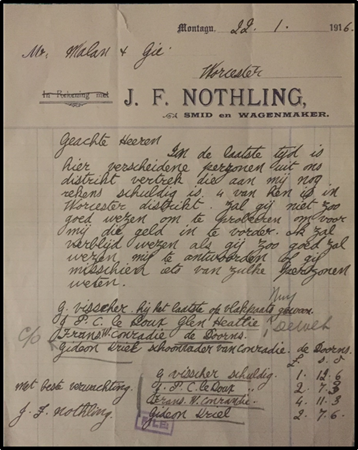
‘n Rekening van mnr. Nöthling
Document: Montagu Museum
An extract found in the Montagu Museum by an untitled author validates the existence and locality of Mr. Nöthling business.
1930: Op Brinks se perseel was ʼn motorhawe. Dit was ʼn ou sinkgebou met mnr. Nöthling se wamaker besigheid langsaan. Mnr. Albertyn was die eienaar van die besigheid en een aand vroeg gaan hy na sy kantoor en toe was alles nog reg. Wat gebeur het sal niemand weet – daar ontplof die hele gebou en mnr. Albertyn verbrand – vrou in die bed met baba.
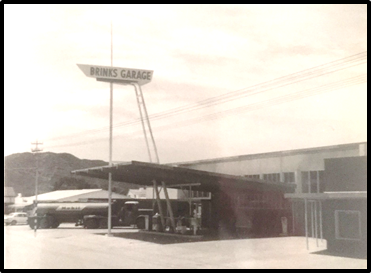
Brinks Garage Bath Street
Mr. Nöthling’s wagon making and blacksmith business was probably on the right hand side of Brinks Garage. His premises would most probably have been between the Agrimark building and the garage where the building occupied by Werners Meat Market stands today (2020).
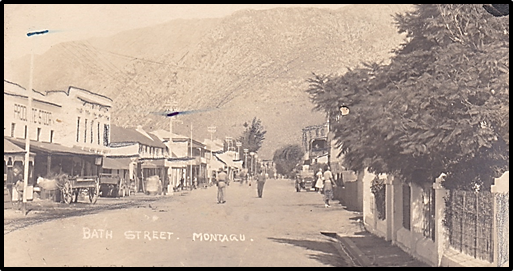
Mr. Nöthling business would have been somewhere on the left hand side of lower Bath Street
J.F.D. KRIEL skryf in “Onthou U Nog” – ‘n handgeskrewe herinnering : “Albertyn se garage en oom Japie Nőthling se smidswinkel was op die plek waar Brinks se Garage en die bottelstoor (Werner’s slaghuis 2020) nou is”
Soos Izak Nel Oom Japie onthou het (uittreksel uit sy storie “Die Poort na Kanaän”):
Hy was ʼn timmerman en grofsmid van format. Hy kon buikplanke vir ʼn bokwa uit ʼn ruwe balk saag en dit met ʼn blokskaaf gladstoot dat die ysterhout- krulle voor die lem uitrol. As hy met die werk klaar was, sou daar oor die rofste pad nie ʼn plank skeeftrek nie. Hy kon nawe vir ʼn wawiel uit stinkhout beitel, wat onder die swaarste vrag nooit sou skiet gee nie. Oom Japie kón met yster werk en dit met ʼn handhamer vorm asof dit deeg in sy hande is.
’n Rong of ʼn skamelbout wat hy gemaak het, sou nooit meegee nie. Hy kon ʼn waband uit platyster maak en dit kort, en in sy blaasvlam witwarm maak, en met sy voorhamer op ʼn aambeeld swys sodat dit dig om die wiel pas en die las nooit sal loskom nie. Die wa wat hy gemaak het, was ʼn kunswerk.
‘n Berig wat geskrywe is deur mnr ‘n D J Nolte onderwyser van die Hoërskool Montagu vir publikasie in Die Burger:
1 Januarie 1945 – Japie Nöthling
Na sy onlangse lang siekbed is mnr. Japie Nöthling nou soverre herstel dat hy weer sy werk kon begin. Hy het egter besluit om hom aan die werk te onttrek, hoofsaaklik weens arbeidsmoeilikheid. Hy hou seker byna ‘n rekord. Ses-en-veertig jaar en vier maande het hy hom aan smidswerk gewy. In Augustus 1898 het hy begin werk by Steyn op Swellendam. Hulle het al hul aandag gegee aan die maak van waens en karre vir die binneland en het lang trekke rytuie na Transvaal en die Vrystaat gestuur.
Hy het reeds sy gereedskap verkoop aan die firma Roulou Barry en net ‘n paar stukkies uitgehou om hom mee onledig te hou.
RAVENSCROFT FAMILIE
In Du Toitstraat regoor die huis La Rochelle was Ravenscroft se Wamaker Besigheid. Al die boere het perde gehad en die perde is beslaan en die waens en karre reggemaak.
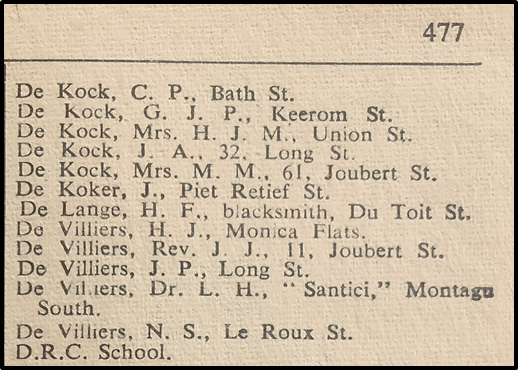
(At some stage the business was sold to a Mr. H.F. de Lange. This fact came to light in an early telephone directory found in the KWV building. (See more on the Ravenscroft business later in this document)

The likely site of the old Ravenscroft/de Lange business at 4A Du Toit Street (2020)
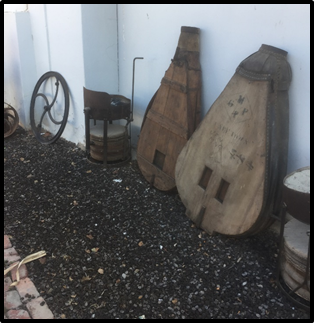
Artifacts from the Ravenscroft/de Lange blacksmith business on display at the KWV building
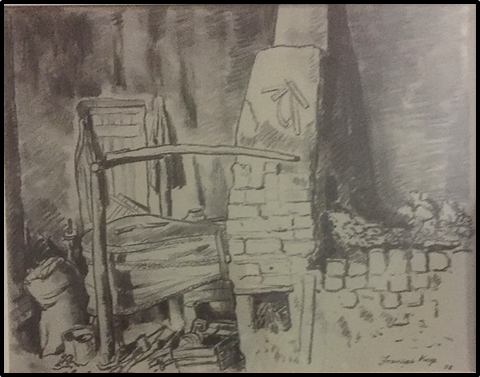
This painting by Francois Krige (1972) is to be found on display in the KWV Gallery Montagu. The painting was donated to the KWV Gallery by James Walton well known for his studies of vernacular architecture of many countries around the world. According to the KWV Curator Blackie Badenhorst it is a painting of the old Ravenscroft/de Lange Wagon Makers and Blacksmiths who had their workshop in Du Toit Street across the road from La Rochelle.
Some Additional information on the Ravenscroft business as described by a Ravenscroft family member in her book:
Uittreksel uit die boek Montagu Days
English translation follows
deur Margaret Minnie Stoddart gebore Ravenscroft
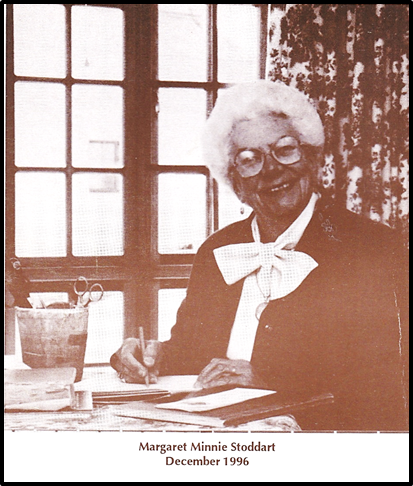
Die Smidswinkel van Montagu
Soos ek vertel het, was my ma nooit by die huis nie en ek het haar geweldig gemis, veral middae na skool. Maar die omstandighede het haar daartoe gedwing.
Dikwels het ek, uit pure verveligheid, koersgekry na my pa (Willam Ravenscroft) se werksplek. By Brink se winkel verby, kon ek al die hamerslae op die aambeeld hoor en geweet daar is groot werk aan die gang. My pa se smidsafdeling was die eerste gebou aan die straatkant. Net agter was die groot werkswinkel waar oom Jors (George Ravenscroft) koning gekraai het en waar Nelie (niggie) die hoenderneste geplunder het op ons aansporing. Die paar kere wat ek in die werkswinkel beland het, was dit ‘n ewige gewerskaf met baie werknemers, wit en bruin, wat rats beweeg het onder die waaksame oog van oom Jors. Hier is die speke van die waens se wiele gemaak, waarna my pa die ysterbande daarom gesweis het. Die vloer was besaai met krulle, wat van die skawe afgetuimel het grondwaarts. (Hierdie krulle het ‘n lekker vuur in ‘n swart stoof aangeblaas).
Groot waens, skotskarre en kapkarre het hier hul begin gehad. Elkeen het sy jop geken en talle kere het ek so’n klaargemaakte wa in die tamaai agterjaart gewaar, met een van my ooms besig om die verfwerk aan te bring. As dit ‘n groen wa was, is die fynste patroontjies in oranje kleur reg random die bakwerk geverf. ‘n Ware plesier vir die oog en die trots van almal wat ‘n deel aan sy totstandkoming gehad het.
My pa kon wondere verrig met yster. Ek sien nog in my geestesoog die groot vuurherd met swart steenkool aan die een kant wat die vuur altyd gevoed het. Dan was daar die enorm blaasbalk wat op en af manupileer word om die vuur aan te blaas. Die swaar aambeeld het reg in die middel van die vertrek gestaan, met ‘n venster sonder ruite, om genoeg lig te verskaf. Die hele smidswinkel was pikswart. Ek was lief om stukkies plat yster op te tel want hulle was ideaal vir die speel van tjoeksie-baan, wanneer jy die ystertjie aanstoot met jou skoene, eenbeentjie staail.
Die boere in die distrik was baie gepla met tiere wat onder hulle vee gemaai het. My pa was goed bekend vir die kuns om slagysters te maak en almal het geglo dat as William Ravenscroft ‘n slagyster gemaak het, jy maar seker kan wees ‘n tier beland daarin.
My pa het dikwels stories vertel van die tiere (luiperds) en ek kan een nog goed onthou. ‘n Boer het weer ‘n slagyster gestel op ‘n plaas op in Keurkloof. Op ‘n dag het ‘n storie Montagu bereik dat ‘n tier gevang is en daar was ‘n helse gebrul en lawaai en almal wat ‘n ryding gehad het, was Keurkloof toe. My pa wasook daaren ‘n paar honde het geblaf en getjanken stormbewegings gemaak na die dier wie se een poot in die slagyster vasgepen was. Een klein hondjie wat baie kordaat was, het dit te na aan die tier gewaag. Dié het met sy ander poot die hondjie ‘n hou gegee wat hom in ‘n poel water laat beland het. Maar
hondjie het deurgeswem en weer die tier gehinder totdat die boer opgedaag het met ‘n geweer en met een skoot die tier van sy pyn verlos het.
Verder was my pa ook verantwoordelik vir ysterwerk wat gedoen moes word in Montagu, soos toe Lover’s Walk opgegradeer word na Oude Burgermeesterslaan. Hy het al die ysterwerk aan die hekke aangebring. Van sy werk het ook gepryk met die uitlȇ van die George Euvrard park. Aunt Lily Anderson het dikwels vir haar seun, met die naam van Zoon, gestuur met klein ysterwerkies, waarvoor my pa nooit beloning gevra het nie. Hy het net vir Zoon gesȇ “Sȇ vir jou ma sy moet ‘n lekker stuk op die orrel speel Sondagmôre in die kerk spesiaal vir my”. En sy het.
Met die koms van motorkarre het die wamakery ‘n stadige dood begin sterf en was daar later net klein joppies soos die regmaak van plaasimplemente, ens. My pa was toe al te oud om te leer om met die binnegoete van motors te werskaf.
Hier volg nog ‘n storie van die dae toe die werk nog volop was. My pa vertel van oom Thys du Toit se groot hingsperd wat van tyd tot tyd ingekom het om beslaan te word. Dis nou sy ysterhoewe wat vervang moet word met nuwe ysters wat met sekere spykers ingeslaan word. Nee, die perd kry nie seer nie, sy hoef is baie dik en kan vergelyk word met vinger en toonnaels. Daar is geen lewe in nie.
Nou ja, my pa vertel dat ou Poon ‘n vreeslike angs en vrees gehad het vir die beslanery en dit het ‘n fris Masbiegher arbeider gekos om sy toom vas te hou. (Hierdie swart man was seker afkomstig van Mosambiek). Ou Poon moes dan die een, en dan die ander poot gee vir die werksman met sy seilvoorskoot, waarop die poot rus, vir die uittrek van die ou spykers. Ou Poon kon dit nie alles vat nie en die sweet het horn begin aftap.
Tussen die werkswinkel en oom Jors se huis was ‘n soort van ‘n poort, en wanneer die jop klaar was het ou Poon losgebreek en met geweldige winde deur die poort afgesit wat Ghörr-Ghörr weergalm het. Die volkies het dit vreeslik geniet.
(Nota: In die Afrikaanse spreektaal word die woord “tier” gebruik vir luiperd)
English Translation
As I have told you, my mom was never home and I missed her terribly, especially in the afternoons after school. However her absence was forced on her by circumstances beyond her control.
Often, out of sheer boredom, I headed to my father’s (Willam Ravenscroft) blacksmith shop. Passing Brink’s shop, I could hear all the hammer blows on the anvil and knew there were lots going on inside. My father had his blacksmith shop in the first building facing the street. Just behind this was the large workshop where Uncle Jors (George Ravenscroft) was king and where Nelie (cousin) looted the chicken nests at our urging. The few times I was in the workshop, it was very busy with the workers, white and brown, moving swiftly under the watchful eye of Uncle Jors. Here the spokes of the wagons’ wheels were made, after which my father welded the flat iron tires around them. The floor was always littered with wooden shavings, which had tumbled from the carpenter’s plane. (These curls was very useful to light a nice fire in the black stove).
Large wagons, Scotch carts and Cape Carts had their beginnings here. Everyone knew what he had to do and numerous times I noticed a newly made wagon in the large backyard, with one of my uncles busy painting it. If it was a green wagon, the finest patterns in orange were painted right around the bodywork. A real pleasure for the eye and the pride of all who had a part in its creation.
My father could perform miracles with iron. In my mind’s eye, I can still see the large hearth with the black coal on the side which was used to feed the fire. Then there was the enormous pair of bellows that was manipulated up and down to fan the fire. The heavy anvil stood in the middle of the room, and a window without panes provided enough light. The blacksmith shop was pitch black with dirt. I loved picking up the pieces of flat iron from the ground because they were ideal for playing hopscotch – when you push the iron with your shoes using only one leg.
The farmers of the district had lots of trouble with leopards catching their stock. My father was well-known for the type of traps he made and it was believed that when William Ravenscroft made a trap, you could be sure a leopard would end up in it.
My dad often told stories about leopards and I can still recall one clearly. A farmer had set a trap on a farm in Keur Kloof. One day a story reached Montagu that a leopard had been trapped. Everybody who had a vehicle jumped in and took off to Keur Kloof. My father also went along. He told us later that he saw a few dogs barking and howling and trying to charge the leopard, whose one foot was pinned in the trap. One small dog, who was a bit too brave for its own good ventured too close to the leopard. With the other paw the leopard swiped at the little dog and it landed in a pool of water. Undeterred the dog swam back towards the leopard and started harassing it again, until a farmer arrived with a gun and with one shot put the poor animal out of its misery.
My father was responsible for various ironwork projects in Montagu, for instance when Lover’s Walk was upgraded to the Mayoral Avenue. He was responsible for all the iron gates. He also made all the iron work needed when the George Euvrard Park was developed. Aunt Lily Anderson often sent her son, called “Zoon” with little iron jobs that my father had to attend to. However, my father never asked for payment. He just said to “Zoon” – “Tell your mother she should play a nice piece of organ music, just for me, during Sunday morning’s Church service “. And she always did.
With the advent of motor cars, the wagon maker’s job become obsolete. The only work remaining to them was to repair farm implements, etc. By then my father was too old to learn to fix the engines of motor cars.
There is another story from the days when the work was still plentiful. My father tells of Uncle Thys du Toit’s large stallion “Poon” which visited the blacksmith shop from time to time to be shod. He needed his horseshoes to be replaced with new ones and certain nails had to be used. This procedure did not hurt the horse, its hooves are very thick and it could be compared to finger and toenails.
According to my dad, “Poon” was terrified of being shod and it took one of the strong labourers (a sturdy Masbieker) to restrain him and keep him calm. (This black man must have originated from Mozambique). In order for the blacksmith to pull out the old nails, he had to place one of the horse’s feet on his sail apron at a time. “Poon” could not handle this procedure and the sweat used to drip from him.
Between the workshop and Uncle Jors’ house there some sort of gateway. Once the job was finished, Poon broke loose as he took off through the gate. The gateway echoed with the sounds of “Ghörr-Ghörr” which caused great mirth amongst the workmen.
Document: Blackie Badenhorst
EUVRARD FAMILIE
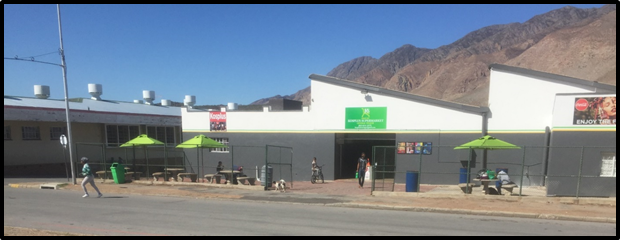
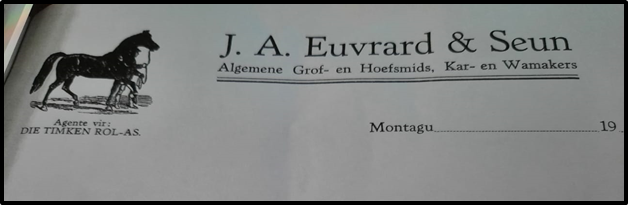
Net bokant Brinks se winkel in Du Toitstraat links, het die Euvrard familie vir ‘n hele paar geslagte (vir 80 jaar volgens ondergenoemde koerantberig) net so ‘n groot Kar en wamakers besigheid gehad. Dit kan moontlik die gebou wees waar KOSPLUS (2020) tans is.
Bron: Montagu Museum
The following article appeared in the Cape Times (date unknown) and was written by Violet Noake. However, due to the quality of the newsprint had to be retyped.
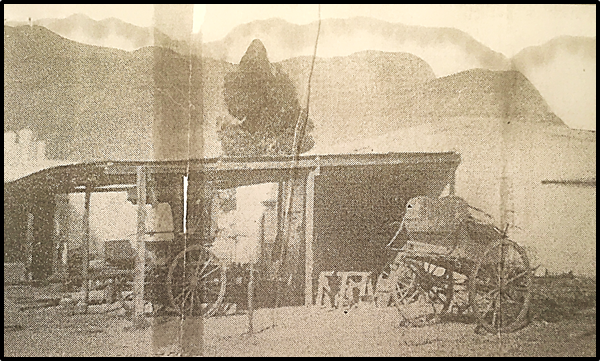
Newspaper clipping from article
THE VILLAGE BLACKSMITH OF MONTAGU
An Old World craft that is fast disappearing
Think of stopping off at Montagu on your way north? You are? Well then, you could’nt do better than take the old trail of the coaches, which brings you inevitably to the village blacksmith – and you would not be disappointed!
For over 80 years this blacksmith business remained in the Euvrard family, passing from grandfather to son and then to son and then to grandson – the present Mr. William Euvrard.
The picturesque blacksmith shop, the former meeting-place of farmers and travelers on the road has of late years become increasingly rare and South Africa where the smallest dorp can boast at least one or two up-to-date garages is no exception.
As was the case with most blacksmith shops, the place is very congested. Gallant old carriages, whose “best days” have been relegated to the lumber of yesterday’s travelling, rest shoulder to shoulder with the chassis of old motor cars. Fragments of various and bewilderingly shaped harness’s festoon the smoke-shadowed old walls, while odd assortments of disc less ploughs and ancient buggies threaten to overflow to the pavement outside. But in the open doorway the eye is met with the gladsome sight of an anvil in action. A bored horse, one foot suspended in mid-air is being shod, while the cheery glow of the forge lights up the face of the village blacksmith – Mr Euvrard.
The resounding clang of iron against iron tells us that so long as horses, mules and donkeys are still used in farming districts, “Ye olde village blacksmith shop” will remain with us!
But this smithy has moved with the times. Step in a moment, if you have time, and hear what Mr. Euvrard has to tell of yesterday’s long procession of coaches, carriages and the homely but indispensable buggy.
The eye is, at first, bewildered by the thousands upon thousands of iron tools decorating the walls. Many of them will never again be used, their use went out the day wagons and carriages lost favour. One strangely shaped old bush-maker, last used 40 years ago, for shaping wooden axles, lies covered with the dust of years in the corner. It was upon the groaning wooden axles shaped by just such an instrument that the Voortrekkers went forth in search of peace and freedom so many years ago. An old drill which was last used about 50 years ago seems more like a museum piece, when viewed beside the modern drill now in use.
Then we noticed that all these old donkey-carts and motor-cars, including even a battered motor bike are almost without exception incomplete. For a long time they have been providing the spare parts for the numerous repairs that come in from time to time. For instance, the wheels complete with tyres from an old crock, are now adorning some smart farm cart! Gradually the old buggies, carriages and once-so-dashing “spiders” have dwindled down, until only their battered shells remain as skeletons of their former glory.
In the little cobbled yard we stumble over a tremendous heap of scrap iron, some ancient, some comparatively new. We learn that since January, in consequence of the great armaments race, the price of scrap iron has gone up 100 per cent.
The peak period of the blacksmith business was during the diamond and gold rushes. Mr. Euvrard was told by his grandfather of how residents had to drive to Wellington (then two or three days away) in order to catch the Cape Town train. Nowadays, the distance from Montagu to Wellington is easily covered in two hours!
In the old days it was not unusual for a passenger to return on foot to the blacksmith shop for a new wheel having broken one while traversing some precipitous kloof miles away!
With all the mute reminders of the stirring times of yesterday the business to-day goes briskly forward. There are agricultural tools to be mended and sharpened; repairs to tractors and various forms of carpentering. A carved wooden cradle or a coffin is needed. Life and death so closely intermingled in everyday life has its part in the busy round of the village blacksmith’s shop.
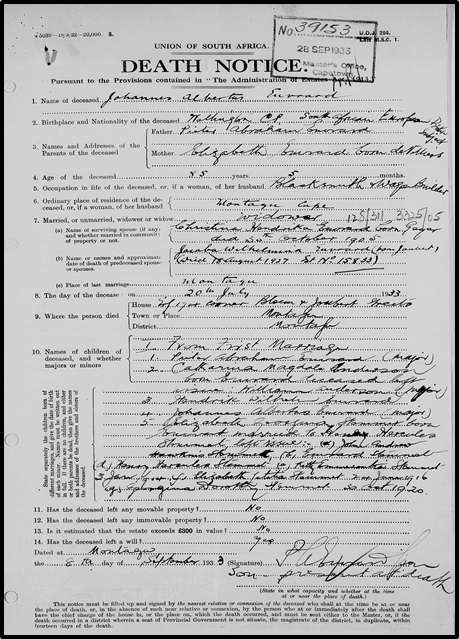
Death notice of J.A. Euvrard see point number 5. He was probably the person who began the business
Document: Henry Northall collection
Anelma Oosthuizen (Kriel) wie grootgeword het in Montagu – onthou die volgende:
“Die smidswinkel was in Piet Retiefstraat hoek met Du Toitstraat. Skuins regoor die oop plein waar die ou polisie en magistraatskantoor was. Met ander woorde aan die westekant van Brinks se winkel.
Die grofsmid was mnr. Vermaak. Daar was later ʼn winkel in die gebou. Ek weet nie wat nou daarin is nie. Die Vermaaks het gewoon op die hoek van Piet Retiefstr. en Kohlerstr. Suidekant van die hoek regoor dr. Jocky le Roux se huis. Verder het die Vermaaks langs my ouma Kriel gewoon. Jy weet mos die Lou Kriel huis. Die Vermaaks se groot tuin was langs my ouma se huis. Later het die Vermaaks die tuin afverkoop en daar is ʼn huis gebou tussen hul huis en my ouma Kriel se huis. Verder die dogtertjie op jou foto is Christine. Sy is later getroud met prokureur Theron . Hul het op Worcrster gewoon. Christine was op die skoolkomitee van die Laer Meisieskool in Tulbaghstr. Nou ʼn voorbereidingskool. Christine was ʼn kenner van persiese matte. In 1970 was Christine saam met my op ʼn Europese toer. In Amsterdam het haar broer (die baba op jou foto) vir Christine kom groet. Hy was dr. Jan Vermaak. Hy het in Amsterdam verder studeer om te spesialiseer in longkwale. Mediese dr. dus. Die jongste dogter was Ansa. Van haar weet ek niks. Net dat sy in 1948 die new fashion rokke gedra het. (lang rokke). Die mode is genoem die New Look.
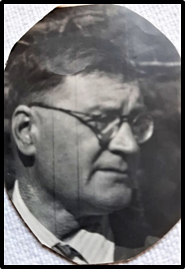
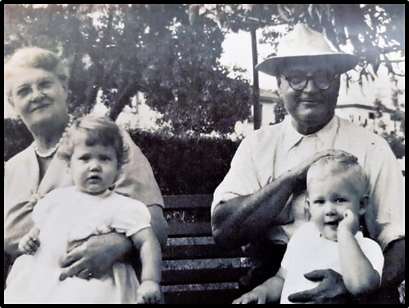
Mr. & Mrs. Vermaak with their grandchildren
Pictures: R.Hill
Van der Merwe House Long Street
According to an audio tape found in the Montagu museum archive on which Ben “Koster” van Deventer states van der Merwe House Long Street was also at one stage the premises of a Wagon Maker. It was a passing comment on the tape and no further information could be found.
Riaan Esterhuizen Montagu History Facebook page 17/04/21
My Oupa Pieter Kriel en sy broer Gideon (Giepie) Kriel was wamakers op Montagu en hul werkswinkel was daar waar Mettlerkamp se werkswinkel nou is (langs die Montagu polisie stasie) – ek het van die familie vir fotos aangevra en sal spoedig plaas – ja lank voor motors deur die Kogmanskloof gekom het.
Contributions: Blackie Badenhorst and Irma Jordaan
