
151.(Part 3)The Pietersfontein Chronicles Part 3 of 3 (English)


The Afrikaans version is available on the link below
https://montagumuseum.co.za/montagu-stories/pietersfontein-deel-3-van-3/
Part 3 covers Chapter 10 to 19(end)
CHAPTER 10
How transport and farming equipment improved
It’s probably because the roads were so bad and difficult at the beginning that farmers prior to 1900 only used the heavy bumper carts with eight draft animals, or traveled on horseback or on foot to get anywhere. The first old cart with a long carriage was bought by oom Dawid’s oupa prior to 1900, but with the bad road he frequently had to harness 4 draft animals. It’s probably because of this that old Grootjie frequently used his own two feet to get to town. One day he walked towards Baden and went for coffee where Tokkie Bussell now resides. Oom Le Roux then offered to take him home by “car”. “Okay,” Grootjie replied (thinking of a cart, not a motor vehicle). “Start harnessing, I’m walking so long”, and then threw his town shoes over his shoulder and hit the road; the host only caught up with him at Die Erf.
After the rear brake replaced the brake pad, it took a while before the front brake and springs were put on the wagon and thereafter the services of the rear brake turner weren’t needed as frequently. My parents’ bridal wagon, pulled by white horses, already had springs in 1895, but no front brake.
The oom told the story of youngsters harnessing oom Sias’ old big bumper cart in the afternoon to transport the bride and groom from Groenland-se-hoogte to the farm.
The carts quickly multiplied, but with iron axles, also called knocking axles, which were lubricated with grease and had a plug and socket in front of the wheel through the axle. In the 1920s the knocking axles were replaced with “patent axles”, which had oil as lubricant. The Tasse family retained their knocking axles and oom blue cart is still on the farm. At the time there were only two Cape Carts, one white and one black, on the farm.
The farmers with teams of draft animals usually kept two breeding mares, because the horse and mule sales to the Jewish Traders served as an additional source of income. A certain person, not one of us, one day sold his two cart horses to a Jewish Trader who immediately harnessed them, but before he drove off, his wife emerged from the house and ordered him to unharness the horses, because they were hers. “But missus, I bought them,” the buyer protested, but relented and freed the animals. The defeated Jewish Trader then told the man: “Jozua, you must buy Ellen corduroy for a pair of trousers ‒ flannel is too soft for her.”
It took a lot of persuasion by my sister to convince my dad to buy a new 1930 model Plymouth Sedan with wooden spokes for R600. Petrol was only 15c per gallon, but my dad argued: “I have control of my feed of my cart’s horses, but this thing’s feed takes my money overseas.” My brother then sold his cart horses, Sandillie and Calvyn, and his cart lock, stock and barrel. Shortly thereafter the freight trucks made their appearance, because the Grootland folk bought a second-hand two-ton Chevrolet 6, which was replaced in 1938 by a new green Chevrolet with a wooden hood. The truck, which handled all transport and on which A.F.’s six sons all passed their driver’s tests, gave 33 years of good service and left the farm only in 1977. Kriel Brothers bought a new three-ton Sedan-hood Chevrolet freight truck for £389 (R778) in 1945 and this liberated me from the transport wagon. Our new K.W.V. depot in 38 Long Street by then (1944) only had truck-oriented offloading facilities.
Prior to 1950 everyone on the farm had one or more petrol driven vehicle. The four wagon-drafting animal teams decreased to only one horse in 1976 to help pull the vineyard plow, because the first tractor, a second-hand Massey Harris, made its appearance at oom Piet Kloof in 1950. In 1957 the author himself bought a second-hand David Brown with a triple point, a two-bladed plow and a cutting harrow.

JFD moves with progress
Picture: Montagu History F/B page
It’s definitely due to the conservative lifestyle that our farm developed relatively slowly, like we will soon indicate in its valuation.
Until around 1910 money in the farm was scarce, and although the farmers made small loans among each other to make ends meet, they never initiated big loans for developments. (In my father’s income and expenses logbook the amount “valued at eleven shillings and six stuivers at 10% interest” was listed). Today it does happen that some of the farmers take out loans for development, but still on a small scale. Certainly because the guys from the last century lived through difficult times, they impressed on their children the policy to live below and not over their means. This was how oom Giep de Kock received a beautiful testimonial from one of our neighbouring farmers: A wealthy oom from Caledon enquired if oom Giep would spend his daughter’s money correctly if they were to marry. The neighbour answered: “oom, you can be assured on that point, her money will be as safe with him as with the Reserve Bank”. Unfortunately the lady passed on before he could prove it.
Speaking of slow progress: in 1946 the Divisional Council valued the farm at only R32 940, 101 years after Grootjie de Kock’s purchase of £600 (R1 200) in 1845, and taxes at R128,77 against Verreyne’s R15,30 for ordinance.
1950 valuation of R50 950, with taxes of R234,51.
1957 valuation of R89 620, with taxes of R375.
With the valuation in 1957 the Secretary of the Divisional Council and I split the taxes of the undivided Moedverloor, so that we could eliminate the annoyance of collecting the correct amount from every shareholder. One fellow said that if he was short on a quarter penny, the collector had to give him half a box of matches if he couldn’t make up the difference. With every new valuation a new division ‒ based on 96ths, had to be worked out. No one else wanted to take over the job from my dad, and later from me.
In 1962 the valuation stood at R114 160, with R80 580 taxable. The 1971 valuation came into effect in 1974, when the valuation was R34 630, with R229 630 taxable. Where would the next valuation place us?
CHAPTER 11
Church and religion
Due to the difficult roads and the congregation of Swellendam having Achter de Cogmanskloof as an outer ward, these people didn’t go to church often, but just like the Voortrekkers of yore they were committed to their Bible. Bible study occurred regularly in the morning and in the evening, as well as Sundays during the time of the morning service, at which time they didn’t want to be disturbed. Religious songs were frequently practiced and it was an experience to stand outside in the evening and listen how families, one after the other, could be heard singing their haunting evening hymns through the night air.
The folk went to Swellendam either for business or for communion, but baptisms for children could now and again be performed at an extramural service. This is how oom Grootjie de Kock’s parents traveled from Keerom to baptise him in Tulbach in February 1802, but they themselves were married in Swellendam. Couples who were anxious to get married but were stuck without an available minister, initially swopped rings at the more commonly available magistrate commissioner, and then later wed in church. That’s how my mother knew how the outfit of her grandma Kriel (nee De Kock) looked. It was a long tafsy skirt, but the torso was covered only by a short type brassière and on top a big doek on the shoulders, pinned under the throat with a big decorated brooch.
Through the efforts of Jozua P. Joubert (16 December 1799 – 16 August 1865) (married to S.C.M. Burger and progenitor of the Jouberts of Rietvlei No. 2), Montagu got its first church, named Gesticht, for ward gatherings. Joubert lived at Die Erf and was an elder for the ward Achter de Cogmanskloof of the Swellendam congregation. The church was located in Montana, Bath Street, where the Department of Health was housed up till recently. The first church council for the fully-fledged congregation was nominated by the ring on 16 October 1854. The first elders were J.P. van Zyl and P.J. Joubert and the deacons were D.J. Burger, F.D. du Toit, J.A. le Roux and G.J.P. Kriel.
The managers of the Gesticht, namely J.P. Joubert, B.B. Burger, A.P. Burger, J.F. van Zyl and D.S. van der Merwe, and lead by minister Robertson of Swellendam, handed over the building to the church council on 9 January 1855, with map and transport and 90c as a nest egg for a construction fund. The directors ‒ probably the town’s management, shortly hereafter handed over £1 500 as a construction fund, for which Minister Robertson expressed his gratitude. The group of directors were D.S. van der Merwe, P. Joubert, F.D. du Toit, J.A. le Roux, B.J. Keet, G.J. van Zyl and J.P. Roux.
A construction commission of seven members, including one Paulsen, was nominated and the Burger brothers of the Koo sponsored a possible shortfall. The construction contract of £4 300 (R8 600) was awarded to Barry & Nephew and the government official in charge of Oudtshoorn and Swellendam layed the cornerstone in 1858. Minister Servaas Hofmeyr was called upon and accepted, but could only deliver his inaugural sermon on Romans 15:29 on 29 September 1860.
(Ref. 1. Thesis of J.A. Theron for M.A. degree on Religion and Education in Montagu. Available in the Education Library Service Archives. 2. Joubert History – Montagu Museum. 3. Dominee S. Hofmeyr.)
During his house calls the dominee didn’t see all the children, who were spying on him from a distance ‒ sometimes from a tree. At the time children didn’t dine with important guests at the same table, but had to eat in the kitchen and peeped at the guest through the keyhole. My mother said my sister Maria couldn’t contain her curiosity when Dr. D.F. Malan came for a meal many years later. She slowly opened the kitchen door and disappeared under the table when mom saw her.
During his house call rounds and now and again during an extramural service, dominee Servaas and some of his successors frequently offered to baptise, sometimes more than one child of parents.
Oom Gertjie de Kock, who was also baptised here at the school, said that he was already nine years old when he went to town for the first time to help his half blind father on the road. He also had interesting encounters. It happened one time that he stopped at the house of oom Andries. Oom Andries’s wife went to call her husband who was busy processing tobacco with oom Gertjie Roux. Oom Andries was very deaf and did not hear his wife. When the dominee entered and greeted the Andries and inquired about his well-being, he answered: “To take to the Roggeveld”. The oom surely thought to himself that the dominee was asking what he wanted to do with the tobacco. The two old ladies then went to sit on the couch under which oom Gertjie hid when the dominee arrived. Oom Gertjie’s wife sat with a knife in her hand, eating an apple and when she noticed the man’s head, she made a point of bumping the butt of the knife on his head in-between while in conversation. His head started to hurt so much, he was obliged to crawl out from under the couch before the dominee started reading the Bible. The dominee luckily didn’t make a remark and asked him to walk with him to the old cattle herder’s cottage at the dipping kraal in the evening. As they chatted, the dominee asked him: “Gert, are you also committing sin?” “Yes,” says Gert, “but at least only the lesser sins.” The dominee didn’t pobe any further. One time ds. Servaas asked him if he prays and says grace at the dining table. Gert says “No!”… “Why not?”is the reply….“Because I don’t have a table and if I were to pray ‘Bless our table with the food so generously received from your hand…. I would lie, because we dine at a tea chest box which Aunt Martjie lent us.”
Dominee Servaas passed on in December 1888 and there were about a thousand grieving souls at his funeral. The same number showed up for his welcoming, years earlier.
The same illiterate oom Gertjie also embarrassed himself with the dominee’s successor, George Malan. The minister held a service in the house of oom Andries and my father guided attendees to their seats, but oom Gertjie, a strenuous tobacco chewer, thought he’d just stand on the stoep, so he could easily get rid of the excessive tobacco fluids by spitting on the garden. When all the people were seated, there was one more opening right in front of the dominee and my father pulled the unsuspecting oom Gertjie in before he could get rid of his chew. During the sermon he had to quietly gulp down the chew fluids and later managed to let the tobacco also go the same way without any outward signs of discomfort. Oom Gertjie was properly saturated with peach tobacco fluids, and one day he made a bet of 20c with oom Andries that he could eat up a whole sweated tobacco leaf without any consequences. He won the 20c. No insect would bite him and survive after the encounter.
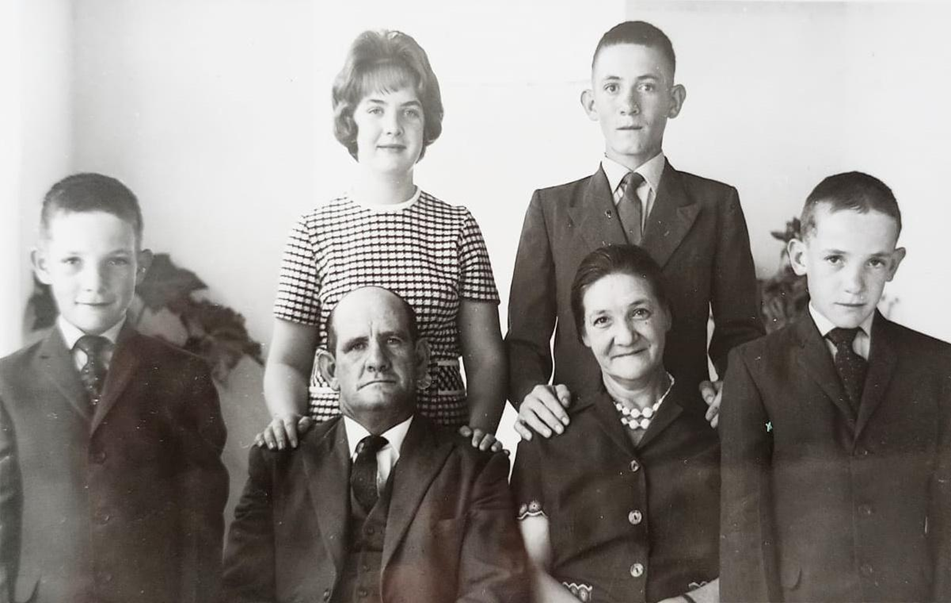
Back, left to right: Esta and Kotie
Front, left to right: Alewyn, J.F.D., Ma Hester and Willie, twin brother of Alewyn.
In the early years of our congregation there was only one big congregation fete in town, but after ds. D.F. Malan’s arrival in our congregation he printed a card, signed 15 April 1908, and sent it to congregation members along with an open letter. I still have the card in my possession. In it he calls on the congregation to transition to ward bazaars because there were so many poor people without vehicles who couldn’t come to town to participate. I don’t know whether our farm’s women organised faster than the other wards, but the first ward bazaar was held here. Schoolgirl Anna Retief put a buttonhole bouquet on the dominee and afterwards all the schoolchildren came to shake out their little linen pouches filled with their savings onto the table for the Children’s Service (“Kinderkrans”). The boys probably had a lot more to shake out than the girls, because they picked up ostrich feathers to sell to the Jewish Traders and the bird eggs and heads were sold to the local Management of the Afrikanerbond branch. Old Vaas had the most money in his pouch, but a girl, Ellie, only had a cent and when she asked the old oom for a little extra, he sent her to dominee Malan, who put a thrupence (2½ cent) in her pouch. The dominee was so overjoyed when he announced the sum of £50 (R100), he remarked that he will hold up Pietersfontein’s fete as a model for the other wards. Our ward included Middelvoetpad, Patatsfontein, Krakadouw and Doornkloof. The first bazaars exclusively had coffee, beer and baked goods to buy, and a few products for the auction, but my mother then began cooking food for a dozen people who wanted to come eat at our house for 15c for a full meal. I still clearly see in my mind’s eye old dominee Van Huyssteen with his frock-coat and top-hat and his long strides zig-zagging through the group on the road on his way to eat. For interest’s sake, the most pleasant memory of dominee Van Huyssteen’s time was the lovely annual children’s festivals in the Spring, on the side where Montagu South’s bowling green is now situated. Hundreds of children gathered there. Everyone only had to bring their own cups and ensure their name was written on the cup, and each child would receive their coffee in it and cake in the other hand. Group games, singing, making a noise, marbles and seeking out turkeys was oh-so-nice. Sundays were a children’s day.
Later my mother brought a delicious hot meal to school and even later three other women also had a food table at the school, but the younger folk cooperated and they now only have one big food table. Our bazaar remains renowned for its tasty meals – even if today it costs R1. After the bazaar is concluded with the announcement of the returns and the older people packed up and went home, the young bunch played “Suffer or Slip” (Ly of Gly), “Old man’s black pig” (Oubaas se swartvark) and “Advice in time of illness” (Raad in tyd van siekte) until the shadows grew long. The sociable custom extended deep into the 1920s, until us young folk became far and few between, but today one must really be diplomatic so that everyone stays until the bazaar returns are announced.

Some of the youths of Pietersfontein, with Pietersfontein Primary School in the background, in the early 1900s
The improvement on financial situation was reflected year-on-year in our thanksgiving festivals. Unfortunately I only started recording these numbers from 1955 and will provide a few, namely: 1955 – £595 (R1 190); 1964 – R1 617; 1974 – R2 058 and in 1976 – R2 925, while in 1979 the good-looking sum of R3 040 was collected.
During house calls the dominee with his cart and horses only came as far as the elder of our ward and then the elder had to provide further transport by horse cart, meaning he slept over in the ward for an evening or two. Old dominee Van Huyssteen had a motor vehicle for ages, but didn’t want to drive around with it for his house-call rounds. Today the dominee crisscrosses the ward in only one day, mostly without the elder.
From just after 1900 until around 1925 there was a Sunday prayer circle in the school, but under the direction of dominee’s Leon Steenkamp and Japie Weideman we started up again with a monthly prayer time from home to home in 1971, and so far attendance has been pretty good. It was a beautiful sight to see a string of horse carts going up the Keisieshoogte when Communion happened. Our folk back then all owned Sunday houses – today I am the only one who still has one. My father already bought the Sunday house in 1913.
To conclude this church chapter with ‒ just a few things about funeral customs and our cemeteries.
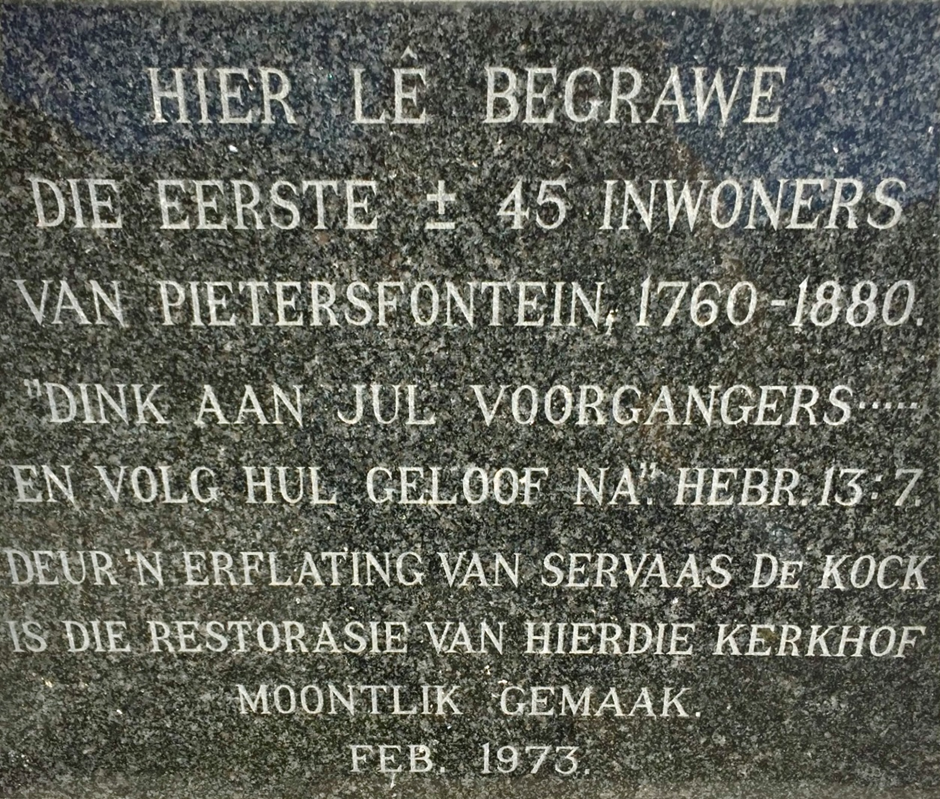
Wording on the plaque mounted on the obelisk in the old cemetery
The last resting place for the first settlers on our farm was next to the southern wall of my turn dam, which was constructed over 100 years after the cemetery was laid out. It contains about 40 graves, but the only familiar ones which could be identified from the graves, was that of oom Andries, his first wife and his boy who lay next to each other in the upper left corner of the cemetery. He was married to his second wife for many years and suffered a severe stroke that left him speechless, but before he passed on he one day opened his eyes and clearly told his children that they must bury him in the old cemetery – this was in 1902. Fortunately there was still one vacant space in the old cemetery. The small fourth grave is familiar due to the solitary tombstone – a flat rock on which his mother herself carved out his name. The old cemetery was fenced in by the farmers during the 1918 flu pandemic, but the graves became completely overgrown. The state of neglect and the location of the cemetery ‒ on fantastic arable land which could tempt subsequent owners to plow it up like what is so commonly happening today, upset old Vaas de Kock so much that he bequeathed R2 000 for the restoration and maintenance thereof. De Kock and I jointly decided on a plan and after his death in 1973 the work was neatly completely, with an obelisk and plaque being placed in the old grave yard in remberence of the people buried there (An obelisk is a tall, slender, tapered monument with four sides and a pyramidal or pyramidion top). Next to the obelisk in cement on the grave of the boy the words “Johannes Hendrik Jordaan; Born 5 January 1871. Died on 24 August 1877” are visible (2025).
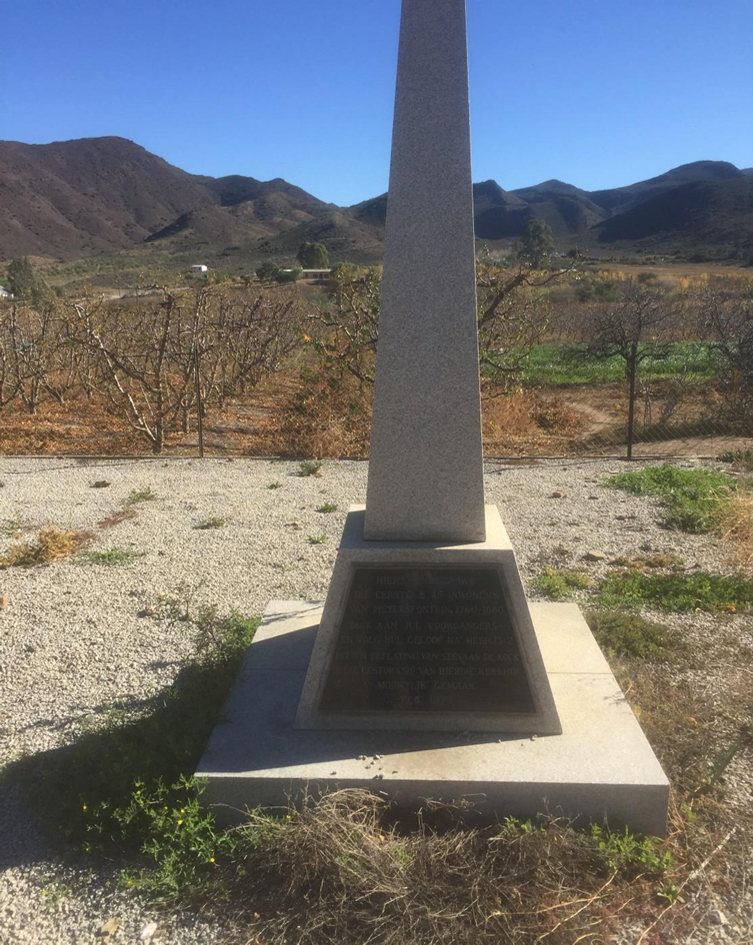
The old cemetery obelisk with plaque
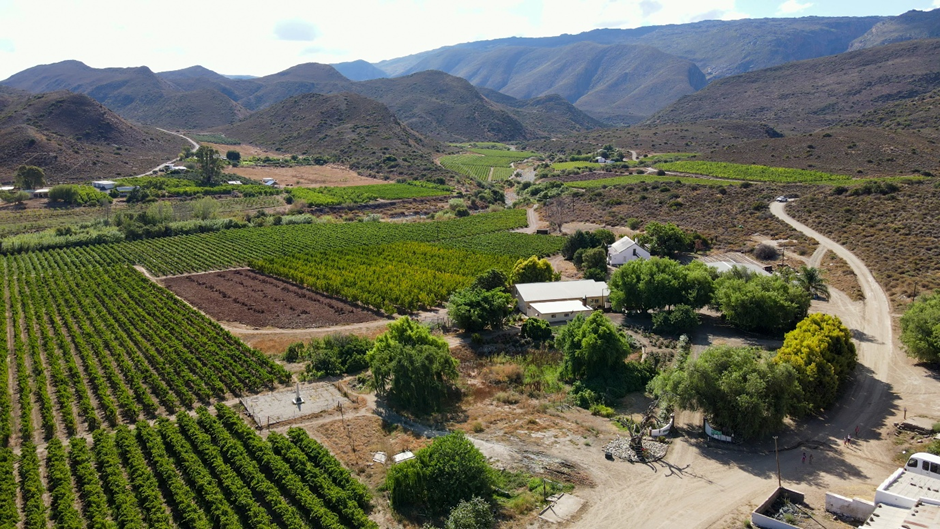
The old cemetery on the right of the picture with the obelisk in the middle
Since the restoration occurred in the “Year of Green Heritage”, I planted a cemetery cypress adjacent to it to round off the work.
The new cemetery, which was started in 1893 with the first buriel being that of one of hen a Palvie daughter was buried there. Aunt Pattie spoke about how her dear niece cried on the evening of the funeral because the people went to bury the poor little girl in the veld. At the time it was actually an ostrich encampment. The second Palvie daughter, quickly followed and the Christian Youth Association (C.J.V.) put up a fence around the spot of holy ground in 1918. In 1971 we enlarged the cemetery, with place for an extra three rows, with money that Hannie (Pattie) provided and a big gate was also installed. Tombstones only started to be erected from 1931, but in 1973 coarse granite stones ‒ still from the funds from old Vaas ‒ were placed on all but four nameless graves, which brought the total expenditure to R1 900. It left R100 for maintenance.
Already in 1950 I compiled a plan for the cemetery and filled in all of the names on the graves in the plan and indicated family ties as five of the farm’s eldest women pointed out to me. Only the two Palvies couldn’t be placed in family context.

The old cemetery (left) and new cemetries
In the years before the telephone, the funeral letter was sent from farm to farm on horseback or on foot and as a rule the funeral wasn’t held earlier than three days after the person passed on. The body was kept in his own home or in the outbuilding and was carried to the school before the service. After the service the six pallbearers carried the coffin, with the bearers wearing a hat with a 30mm wide brim and 1m long material crepe draped on it, plus a crepe armband. The family women, aside from black attire, also draped big square crepes over their shoulders and stuck parts of it to their hats. It’s probably the “crepes” referred to in the old national anthem. The crepes were frequently loaned back and forth. Two chairs were carried with the procession and used to support the coffin when the bearers switched places.
After the coffin was lowered with straps and the dominee completed the burial, a board is placed on top of the earth and the family approaches the coffin and drops a spadeful or two of earth….The men of the family fill up the grave while a whole lot of hallelujah songs are sung. I am pretty sure that family always filled up the graves prior to the 1950s.
A funeral director was used the first time on 29 March 1958, for the funeral of my sister-in-law Martjie. She was also buried in the first fully masoned grave. In 1949 a hearse was used for the second time and after that it was a fixed institution. The three quiver trees were planted in 1972.
When we lay the rough stones at the old graves, the makeup of the grave was intentionally left untouched. On many of the graves there was a lemoenball cactus in a bucket. Another two were planted now.
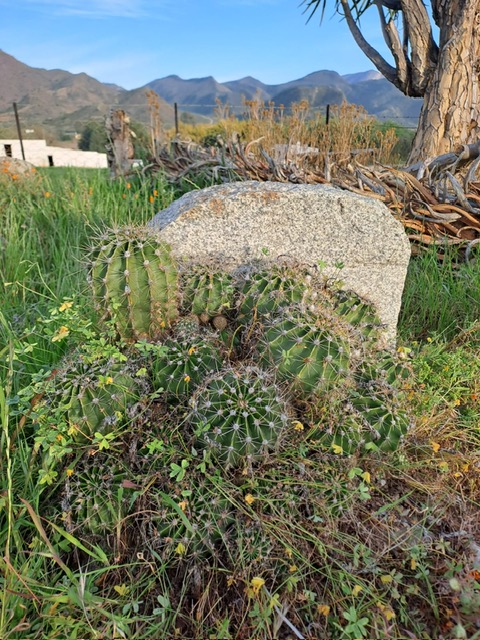
Lemoenbal kaktus
The farm’ workers cemetery was cleaned up in 1970 and fenced off and now they maintain it. They are also making use of a funeral director. At the time of writing there was only one little gravestone – that of Hannah Swart.
To end off this chapter, I’m including a concession I found in the Archives, namely an Estate bill for funeral costs sent by a caretaker in April 1849 in Cape Town.
| Rixdollars | Shillings | Stuivers | |
| Made use of hearse | 24 | ||
| Made use of sheet and 64 ell (23m) crape | 40 | ||
| Church costs and death shroud | 4 | 4 | |
| Notifications to Gardens and Green Point | 10 | ||
| 600 invitation letters | 30 | ||
| 14 pairs of black silk gloves | 2 | 4 | 4 |
| One roll of ribbons | 3 | 2 | |
| Sounding of the Reformed Church’s bells | 166 | 6 | 4 |
Or, converting to today’s money: R1,78.
CURRENCY VALUES:
| DUTCH CURRENCY | SOUTH AFRICAN CURRENCY |
| 1 Stuiwer (Penny) | 1/8th penny |
| 2 Stuiwers | Twopence |
| 1 Cape Guilder | 1/4 penny |
| 20 Dutch Guilders | 1/8 (one shilling & 8 pennies) |
| 48 Rixdollars | 4/2 (four shillings & 2 pennies) |
| 3 Guilders (60 stuiwers) | 5/- |
| 72 silver Ducatones | 6/- |
| 105 golden Ducatones | 8/9 (eight shillings & 9 pennies) |
CHAPTER 12
Education
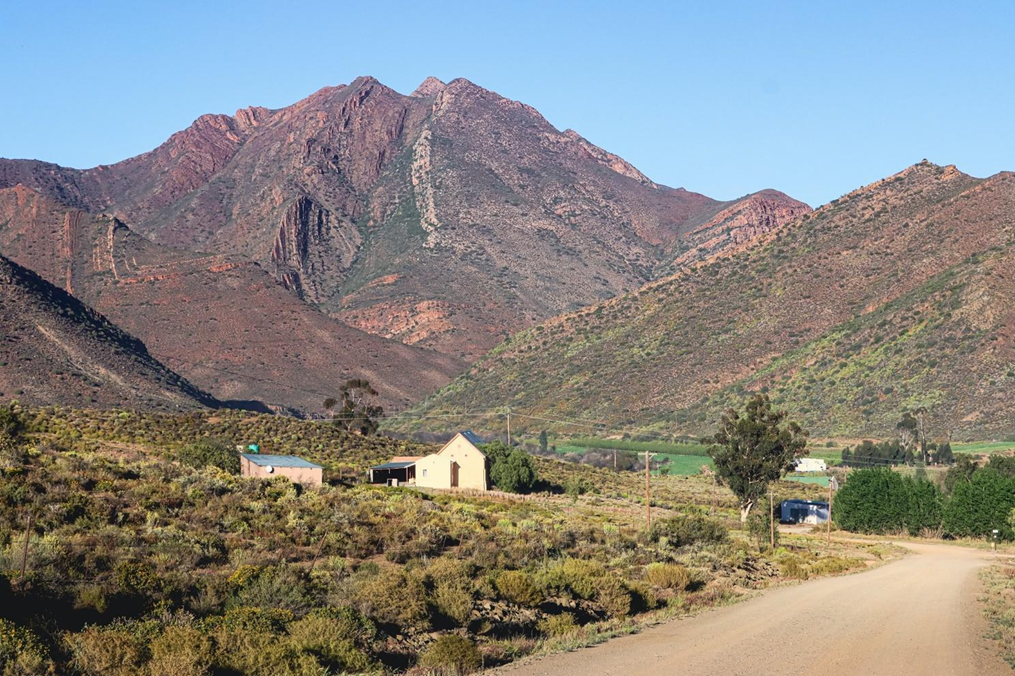
The Pietersfontein school on the right. The building is still standing (2025).
Along with church and religion comes education, although being knowledgeable sprung from using Christian youth literature “Trap der Jeug” for a scant ability to read, so you could use the Bible for confirmation and working out a few sums, a lot of singing and ‒ lo and behold, a refined youth!
The wealthy farmers mostly used deserting Dutchmen, some of them sailors, to teach their children. The old school masters of course took to the bottle when the opportunity arose, nearly without fail. One condition set by old Mister Kyfers, who for a long time taught the children of oom Hans Conradie, Grandfather of A.D. Conradie of Krakadouw, in Doornkloof, was to receive “one tot” (25-30ml) in the morning and in the evening. One evening it happened that he took one too big a swig and during the night he had a bit of an accident in the aunt’s bed. When she made the bed and saw the mess, she immediately grabbed the broom and gave the trangressor a hiding. The folk on the farm heard of the goings on and one day when the school Master visited here again, they asked him if the employers were good to him. “Oh yes,” he said. “Hans is one good man, but Sanna, she is a Cape Cobra” – but remained mum on the reason. The incident was retold to me by one of his pupils, oom Frikkie Conradie, now 93 years old.
The farm’s first School-Master was Mr. L.B. van Kieboom, who taught old Grootjie’s eldest grandchildren. Two of the boys, Jannie and Jakob, were pretty useless and one day they discovered their father’s vat of sweet wine in the reed cellar behind the dam wall. It would happen on occasion that the school master, who himself loved a glass of wine, got a familiar whiff standing behind the boys in class at school, at the time located below a canopy in front of Aunt Pattie’s back door. There and then he decided to keep an eye on the two lads. One day after lunch, when the adults were having a nap, the duo again set their sights on the cellar. Jannie, the bigger boy, pulled open the door from below and Jakob crawled in with his little cup, poured a bit and handed it over. As Jannie was about to take a sip, he looked school master in the eyes ‒ and now what? The son of a farmer can make a plan quickly and on the spot they offered the cup to the school master so that he wouldn’t split on them. Now the goose was cooked, because the vat had a third visitor. One day the school master was a little absent-minded and dear Aunt Sannie Michiel asked him where he got the wine. He tersely answered: “Go ask the boys”. Unfortunately for them one Saturday afternoon brought a little incident with painful consequences for the two friends.
They treated the school master again and after having more than a few cups, he wanted to go find a horse at Kriekheuwel to travel to Doornkloof. The teacher whistled at the horse, but instead of placing the halter on the horse when he got to it, he slapped the horse and then he had to talk nicely from scratch. His two young friends heard him and peeped at the goings on from behind a poplar grove. When the teacher again tried to put on the halter, he staggered backward and stepped off a high embankment, causing much delight to the youngsters when the teacher fell hard into Mother Nature. The teacher stood up, slapped the dust from his clothes and walked home to go rest.
The following Monday the school master detained the two boys after school. He directly asked them what they found so funny on Saturday. They didn’t realise he saw them and they tried to backpedal, but he insisted: “Jannie stood and laughed and Jakob stood and laughed, ‘there he goes, there he goes, there he lies’ ”, and let the quince tree stick do the talking. It marked the end of the camaraderie with the teacher and also the end of the wine tasting, because Jacob already decided: “Now I won’t give liquor to the old rubbish again”. When the teacher realised he was no longer in on the game, he split on them and for the second time they faced the strap from their parents.
Old Master Kieboom spent many years here and also compiled wills, of which one, signed 14 October 1867, is still in my possession.
After Mr. Kieboom an older man, Mr. R. Keet, arrived to teach. Virtually all of old Grootjie’s grandchildren were taught by him. Among others, he also provisionally trained the farm’s own teacher, namely J.A. de Kock (son of M.J.). After Sias was done here, he spent another two years under the competent instruction of the older Mr. Euvrard in Montagu, and in 1883 he began here. Another cousin, J.A. de Kock (son of A.F.), quickly followed. The boys pretty much only attended school when their fathers could do the farm work without them. My father told me that most of the time he carried his sum book to the veld with him when he had to look after the animals and there he worked on teacher Keet’s calculation questions. The longest unbroken time he spent at school was three months at Rietvlei 1. He was prepared for confirmation by a teacher called Mr. Warmeöven.

J.F.D., back row, first right
Singing was a key subject at school and Mr. Keet made his school kids sing a lot. Mr. Warmeöven’s catechists also had to sing the tonic sol-va well, but instead of today’s D-R-M-F-S-L-T-D, back then it was Ut Re Me Fa So La T Ut. During confirmation every catechist got the chance to sing a verse solo out of the hymn book. Dad was so nimble with his singing and knowledgeable of the Bible that old dominee Servaas Hofmeyr gave him a big Dutch Waterpressed Bible that is still in my possession.
Catechists is a term used for anyone engaged in religious formation and education, from the bishop to lay ecclesial ministers and clergy to volunteers at the local level. The primary catechists for children are their parents or communities.
For a time J.A. de Kock (son of A.F.) conducted a “Circuit School” here from 1880. The school moved around between Doornkloof, Pietersfontein and Groenland. If the school term was based in Groenland, our farm’s children walked over, but the Doornkloof children who failed to secure lodging simply stayed away. The children of Pietersfontein, the midpoint, could walk the three miles (about 4,8km) in either direction. Middelvoetpad received a state-supported third class school in January 1864, with Mr Leon as teacher. Dire circumstances forced the school to close in 1866 and relocate to Baden. In 1866 Rietvlei 1 had a school with 22 pupils. With the arrival of “Poor Schools” parents had to pay 5/- and 10/- for a child passing standard 1 and 2. (Source: Cape Education Library). By then the State at least started to look after the teacher’s salary, which was 12 golden Victoria pounds, and the teacher himself had to collect it at the rectory every term.
After the first Sias, who could sing beautifully, his cousin Sias Kockie came to teach for a while before he left for Vosburg. After many years there, he returned under the nickname Sias Vosburgie and began farming in front of the old Missionary Church, now the Montagu Museum, in Long Street.
The two De Kocks were succeeded by a third farm boy, their cousin A.P. Kriel Jr., my father’s brother. By then the school wasn’t roving any more, but was a permanent fixture here. Doornkloof and Groenland later also received their own schools.
Mr Kriel’s own time in the school benches was also limited to “highschooler” in town.
Initially his school venue was a canopy in front of oom Dries’ backdoor, but when his pupils became too plentiful, he moved to the empty, leaking tobacco house at the upper side of oom Dries’ dam ‒ but when it started raining, the class fled to the canopy again. He was also an excellent photographer, because some of the photos he took around 1900 are still very good condition today.
Two of the pupils were my father’s sister Sarie and Aunt Hannie (Koos de Kock). After Mr. Kriel ran the school for a while, Mr. Euvrard and inspector Muir, later Superintendent of Education, organised a parent meeting here in oom Dries’ house. The decision was taken that if the school could have regular attendance for a year, the Department would contribute £220 for the construction of a school. This was still before the division of the farm, but oom Andries promised to contribute his part of the piece of land for free.

The school building can be seen in the background (to the left)
Mr. Kriel (who had the first and only house organ, which later became ours) barely waited a year when in September 1896 he called up surveyor Greef ‒ then still busy in the Koo, and Minister Truter. The man said the dominee himself carried rocks in his frock-coat pockets to place the beacons where the pens had to go. While the farmers were still dithering, the Mr. Kriel appointed a couple of men and he let them hack some of the soft embankment rocks on the edge for the foundation. Those rocks might have been pretty unusable, but he succeeded in his goal, because the farmers jumped in and went to Rooivoetpaadjie-se-kop to harvest great-looking building rocks. Dad got a brick contract of R1,25 per 1 000, baked already ‒ today-as I write it would be R34 per 1 000. Dad’s expenditure logbook indicates three brick shapes bought for 50c a piece.

Brick shapes for the three stones, seen from above
It was with the baking of those bricks that the guarri groves to the upper side of our house paid with their lives, because when the ten loads of thornwood driven here were depleted and the fire struggled to burn with the necessary ferocity, the green guarri groves were used for fuel. Today a number of melted bricks can still be seen laying around where the baking ovens once stood. When the ovens cooled down, building could start, with oom Koot Hannie as builder and his two eldest boys as assistants.
The conveyance deed is dated 13 July 1897.
With the cargo of construction material they were stationary for a whole day near Groenland-se-hoogte, but perseverance eventually paid off and on 25 August 1897 dominee Truter, Mr. Euvrard and Mr. Basjan Wolfaard MPC arrived for the dedication ceremony. Shortly after the opening speeches the dominee started collecting money for furniture and himself donated the small table ‒ still in use today, while Mr. Wolfaardt gave two pendant oil lamps which were later replaced by two new ones my father donated. The church donated two old, elongated church pews, which were later removed and are currently serving as truck seats to transport the farm workers to church. The big outdoor bell was donated by the wealthy visitor Krisjan van Schalkwyk. Unfortunately, shortly after the school finally closed down, an unscrupulous person took off with the bell. We are still hoping that his conscience gets the better of him and he returns it.
A couple of the pupils who moved from the tobacco house into the new school, were Stoffel (assistant in the building of the school), his sister Hannie, Little Jakob, Hester, Miem and Soes ‒ all De Kocks, Lewies Jordaan and his sister Hester (Polkas). There is still a photo of 1901’s school children.
After Mr. Kriel got the affairs of the “Pietersfontein Poor School” (so named in the Department’s books) in order, he submitted his resignation and asked the then Superintendent General of Education, dr. Muir, to appoint as his successor Maria de la Hunt (“Dellont” in the vernacular), daughter of the road foreman of the Robertson Divisional Council.
With new school desks in use, the particularly lengthy and tall school bench which didn’t have room to place books on, landed in our house attic. I donated it to the Montagu Museum in 1976 to serve as exhibition space.
At the start of 1906 the first two school committee members were nominated by the school board, namely H.F.N. de Kock (oom Manie) and J.F.D. Kriel (Koot), with proxy to nominate a third member. On the first meeting on 24 October 1906 oom Manie however resigned and Johan A. and Josias A. de Kock were elected. My father, J.F.D. Kriel served as secretary from 1906 to 1920, then he became a school board member.
At the time the parents had to pay school fees and pay for the textbooks. How much the first school fees under the farmers’ management were, we don’t know, but in December 1906 the secretary of the school board sent out a red-flecked exercise book (which is still here), with the following notice written in front:
School Board Office
MONTAGU
20.12.1906
The Secretary
Pietersfontein Poor School
MONTAGU
| All standards up to III | 3/- | (30 cent) per term |
| Standard IV | 5/- | (50 cent) per term |
| Standard V and above | 6/6 | (65 cent) per term |
That’s apart from the textbook money.
The money must be collected at least 14 days before the end of the term and handed over to the Secretary of the School Board, together with a list of the names of children whose school fees are outstanding, the amount they owe and in what standards they are, and the names of the parents.
Witness N.J. (Nic) ACKERMAN
The book then also became the Minutes logbook and attendance register of the committee.
Aforementioned fees only remained in place for a short while, because the next year a new scaling of fees was introduced and stuck into the front of the Minutes logbook.
Scaling of school fees to be implemented from 1 October 1907 in the Poor Schools in the Montagu District:
| All standards up to II | 5/- per term |
| Standard III | 7/6 per term |
| Standard IV and above | 9/- per term |
At the committee meeting held in October 1907 Josias de Kock (oom Tas) was appointed to visit the parents and persuade them to send all their children of school-going age, so that the number of pupils could reach or exceed 24.
The Department was rather harsh, because in September 1908 our secretary received notice that the committee members must give the School Board a written guarantee for any shortage that may arise in relation to the “Poor School”. From the end of 1909 indigent parents could at least apply for a decrease in school fees or for free education and the first of these applications were considered by the committee in 1910. This school fee had to be paid by the secretary at the School Board office, he would receive a receipt and then the money was returned to pay the teachers landlord, because on a salary of £12 per term he could not pay lodging as well.
Here follows the names of the pupils on the first page of the aforementioned Minutes logbook:
| Martha M. Kriel and Cecilia H. Kriel | Standards 3 and 1 | 6/- |
| Cornelia de Kock (Collie) | Standard 3 | 3/- |
| Gabriel J. de Kock (Big Gawie) | Standard 1 | 3/- |
| Johannes L. Kriel (Cedraskloof) | Standard 1 I | 3/- |
| Jakob F. de Kock (Little Jakob) | Sub B * * | 3/- |
| Jacobus D. de Kock (Big Koos) | Sub B | 3/- |
| Servaas H. de Kock (Vaas) | Standard 2 | 3/- |
| Josias A. de Kock (Tas) | Standard 1 | 30c |
| Johanna S. de Kock (Hannie Pattie) | Sub A | 30c |
| Machiel J. de Kock (J.A.T./Sn) | Sub A | 30c |
| Rachel J. de Kock (Pattie) | Standard 2 | 30c |
| Hester M. Jordaan (Polka) | Standard 4 | 5/- |
| Hannah M. Jordaan | Standard 3 | 30c |
| Catharina E. Jordaan | Standard 1 | 3/- |
| Jacoba F. Jordaan | Standard 2 | 3/- |
| Maria B. Jordaan (Baba Polka) | Standard 3 | 3/- |
| Margaretha J. Jordaan (Polka) | Standard 3 | 3/- |
| Rachel J. de Kock | Standard 2 | 3/- |
| Susanna C. de Kock | Standard 3 | 3/- |
| £3-2-0 | ||
Quite a few names of pupils who went to the new school aren’t on this list. It is possible that a register wasn’t compiled from the very beginning.
There was not one Standard IV or V pupil because attending school wasn’t compulsory yet. One pupil remarked “Now I am skilled” after completing Standard II, and never came back.
Here follows a further short overview from committee Minutes. In 1909 the Secretary and J.A. de Kock were deputised to attend a School Board meeting.
At a meeting held on 18 July 1911 the Secretary asked for permission for the first whitewashing of the school for 3/-, lime 2/3 and 2/6 for the acquisition and putting in of windows, but the committee awarded 1/- extra for the whitewashing. At the meeting of 18 January 1912 one Miss Stemmet requested to be discharged of her duties due to poor health, but recommended her sister H.C. Stemmet, who had the same qualifications as her, as her replacement. On 14 January 1913 the Secretary reported that the school’s door broke and that the gate of the school encampment would cost more than what was budgeted for. (The father of the Stemmet teachers fenced off the school encampment and it was only repaired again in 1956 with a bunch of new stands. By the way, the old man was also the builder of the fort over the tunnel in the 1900 war.)
At the meeting of 18 October 1916 the new school committee was expanded by the school board to five members, namely Johan A. de Kock, Josias A. and J.F.D. de Kock, J.F.D. Kriel and his brother A.F. Kriel. The decision was also taken to bring the teachers to church in turn every fortnight. There was a certain complaint that a person providing lodging for a female teacher, was solely responsible for her transport. The decision was also taken that a third porch step would be built in front of the entrance, because the elderly folk found it difficult to get up and down these very high steps.
This committee was the last appointed committee, because on 5 January 1920 a committee elected by the parents in 1919 was constituted. At the same meeting the Secretary announced that he received £1 from the Helpmekaar Fund to provide free books to poor children. The last Minuted meeting in the red-flecked exercise book was on 5 April 1920, when the application of Miss C.H. Kriel, our own farm girl, was accepted. By the way, she was the first woman teaching who the moment she walked in one morning told the children: “Look, kids, you address me as ‘juffrou’ and not ‘miss’.” (Juffrou being the Afrikaans for miss.) Oh, wait, after her there was a Jewish lady, Miss Lipschitz, but more about her later. By then I myself was at school.
The last school fee collection list in the old Minutes book was the last quarter of 1911, although we think it was only abandoned in 1918, but free books only arrived in 1967. Around 1910, during an inspection, an inspector asked the boy, A.P. Kriel, during an English oral: “What is the name of your school?” The youngster very confidently retorted: “Pietersfontein Poor School and that of Montagu is Montagu Primary School”. The inspector was a bit surprised and asked the teacher if it was the case that we were still a “Poor School”. When she said yes, he promised to rectify the status, which then also happened shortly after his visit.
The inspector always came to the farms during June or July. Then the young ones who first started going to school in January could go to Sub B and be in Standard 1 already in the new year. The Standard sixes who must go to high school will then go sit with the town’s Standard sixes for six more months.
O-Boy!, the children were even more jittery from the cold and anxiety when the inspector approached with his suitcase down the hill. If you passed arithmatic, you could progress. They weren’t very strict about languages.
In the early years prior to and even after 1930 the rod was definitely not spared, not at home but also not at school. If the child messed up or did not want to learn, the quince-tree stick gave the necessary encouragement. When the child got home and complained and the parents thought the punishment justified, it could happen that the complainant got another hiding. Earlier a very common punishment was that children who transgressed, were kept after school and made to write out one hundred or more lines, for example: “I may not speak in class” or “I must do my homework every day”. There were a few teachers who locked the door and went home for a coffee break while the children carried out their punishment. The repetitive writing taught many of the kids the art of simultaneously writing two lines with two stacked slates. On occasion it happened that the teacher completely forgot about the children and then they made a big ruckus in the school so that someone could hear them.
There were also days where only English could be spoken ‒ “donkey day”. The one caught slipping up got a board around the neck on which a donkey was drawn with a caption: “I am a donkey”. The child had to wear the board until he caught another person who got a little tongue-twisted while speaking English. The plan apparently worked very well, because the “donkey” was all ears.
Mischief was aplenty, but I first want to tell this one. The children sat beneath old Aunt Pattie’s big willow tree on the dam wall between one and two in the afternoon (classes were divided in two sessions) and Giel Valie was swinging on the willow branches over the dam. One time his feet bumped into Hannah Kriel, shoving her off the embankment into the full dam. Soaking wet, she had to run to Aunt Pattie’s house, undress and lay under a blanket for as long as it took for her clothes to dry, because she was very, very far from her own home. Giel’s backside had to thoroughly suffer the consequences again.
CHAPTER 13
The teachers, roughly in chronological order, with one or two memories of some
Teachers Kieboom and Mr. Kyvers were already mentioned before, but I just want to add that Mr. Kyvers was succeeded by another Dutchman, Albert Heiberg, who did not have a noteworthy legacy. Just one more thing about Mr Kyvers to show what important role singing played in education. When oom Gawie le Roux (Jongie) asked him what he was actually teaching the children, he answered: “Oh, I teach them to sing ‘The small children are already there’ (De kleine kinderen zyn reeds daar), because the rascals don’t know any better”.
J.A. de Kock (son of A.F.), our own teacher from the farm who was also a founder of the first Christian Youth Association, was a deeply Christian man who could sing beautifully. During the Anglo Boer War the Khakis arrested him because he allegedly asked in a letter to a friend in the Koo about the latest news of the war. When they led him away from his parents, he got quite poetic and said: “This morning I can say, like Paul, I am not only willing to be shackled, but also to die.” After a while in prison he was released and he could return to teaching.
Following the aforementioned De Kock there was one Dirk Wolfaardt who brutally beat the children. He hit oom Dawid’s back and buttocks so badly that he couldn’t get out of his shirt, because it clung to him due to all the dry blood. After him came J.A. de Kock, A.P. Kriel, M. de la Hunt, Anna Frylinck, Lizzie Burger, Nellie Conradie (who could also sing beautifully), Tolla Geyer, Johan Bald (a strong swimmer) and the two aforementioned sisters Lenie and Cillie Stemmet.
Now we get to Maria Retief, who was a teacher when my brother went to school. She had a zest for life, she was thorough, and she was strict. Because the boys were on the receiving end so frequently, they one day decided to dig a hole in the footpath she followed to school, covered it with small sticks and hoped she’d break a leg. They kept an eye on the footpath from the corner of the school building. Luck was not on their side, though. Miss Retief saw the covered hole and gazing in the direction of the school, she saw how the children were looking her way. She put two and two together as she walked toward the school and when the bunch entered the building, justice came swiftly and arguing and lying could not get the rascals out of what was coming.
Long before my birth she lodged with my mother and after school on a Friday afternoon she took the grandchild on her back and mom took the bundle of clothes and they walked the 18km uphill through Krakadouw to the Koo, to grandma Kankoo. Monday morning before sunrise she picked up the bundle of clothes again and my mom the child and they hit the road again, so that she could be back at school on time.
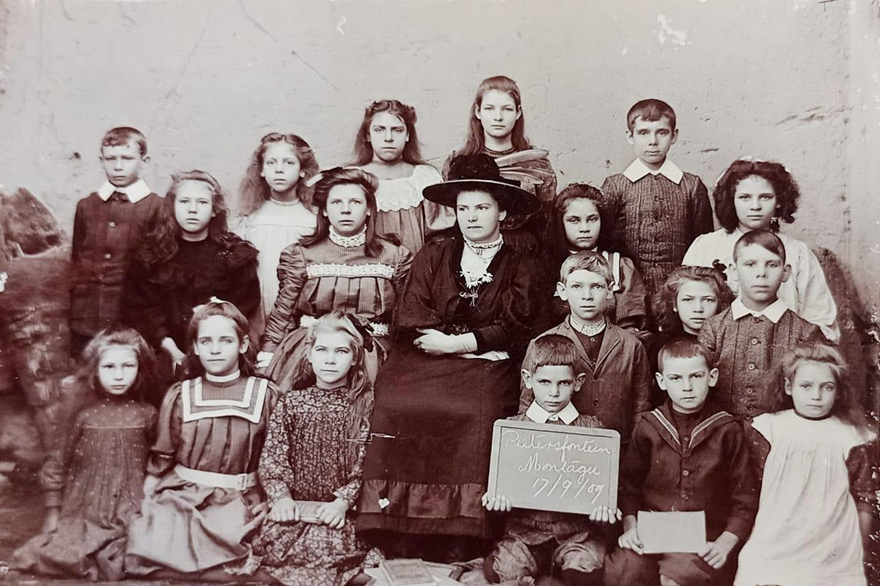
Pietersfontein 17/9/1909
1st row (back): Sias de Kock, Ellie de Kock, Collie de Kock, Sannie de Kock, Gawie de Kock
2nd row (middle): Rachel de Kock, Rachel de Kock, Miss Retief, Malie Kriel, Rachel de Kock
3rd row (right): Hans Kriel, Hannie de Kock, Kowie de Kock
4th row (front): Miemie de Kock, Cielie Kriel (Outannie), Sannie Kriel, Alewyn Kriel (J.F.D.’s one son), Japie de Kock, Ragie Jordaan
Sisters Hester and Stienie Cloete were gentle but competent educators. Miss Van Eeden was more irate than a Cape Cobra and gave needed ánd unnecessary hidings while she turned red like a fire coal. Chrissie Swart was a dear person. She gave the children good-looking little souvenir cards and during the 1918 flu pandemic taught us under the great orange trees for a lower chance of infection. Little did she know, however, that when she went home for the December holidays, she wouldn’t return. The illness cut her down, to her pupils’ great sorrow. The school committee then appointed Miss Martha van As (nickname: Karas) of Montagu as replacement, but she didn’t want to stay longer than six months, because the committee turned down her request to be driven to town once a week. I started school with her arrival. She was then succeeded by the aforementioned Miss Kriel. One time she removed a louse from a child’s head and placed it in his hand.
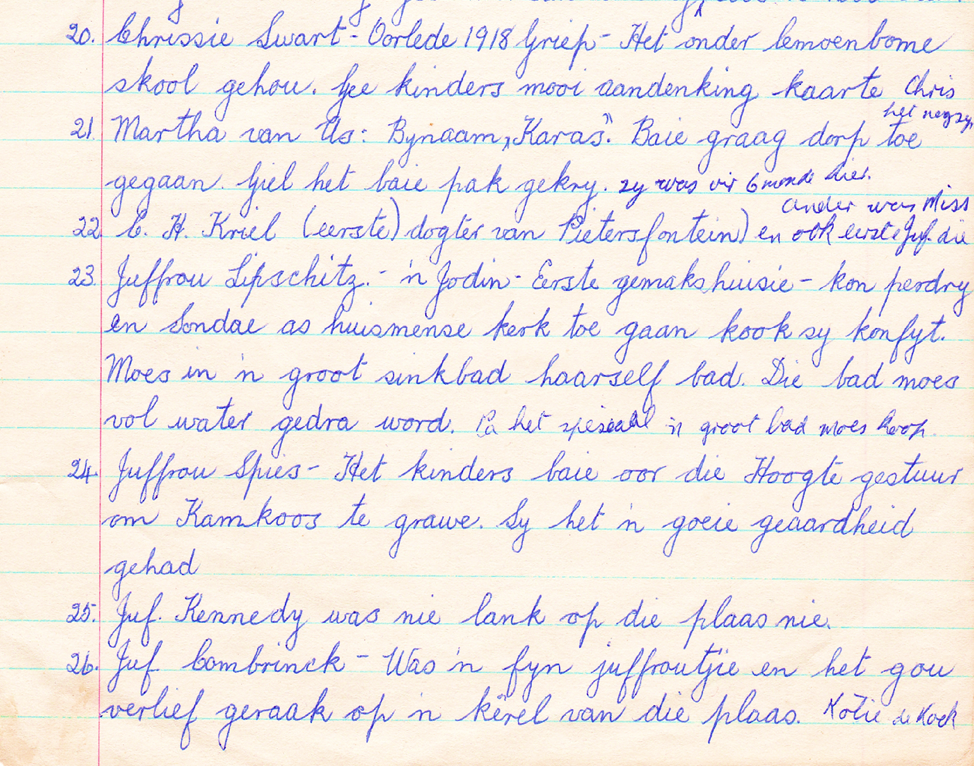
J.F.D. kept records of the teachers
The next educator was an interesting creature. Only one application came in, from Miss Lipschitz, a Jewish woman. Oom Sander had to go fetch her in town and the farmers endlessly teased him over the mountain of luggage he had to load, because his car looked just like old Mister Schachat’s hawker wagon. She gave my parents quite the headache, but eventually everything worked out. Families of the time bathed themselves in the same foot tub or little bathtub whether it was a weekday or the weekend, but out of necessity my father bought her a big old zinc bathtub (which is still being used for laundry) in which she could wash herself. Hannah, our loyal domestic worker, had to frequently help her with the cumbersome bathing attempt. The very Afrikaans Hannah told the priceless story about how miss. Lipschitz asked her (in English): “Give me the towel”, and when the unfamiliar order was met with a vacant stare, the Jewish lady exploded: “The towel, the towel, bloody fool. Don’t you know a towel?” Hannah still didn’t grasp the request and Miss Lipschitz had to get up and go fetch her towel herself. Hannah’s English vocabulary grew quite a bit on that day.
Another novelty thanks to her efforts was the very first privy that arrived on the farm. The school itself only got a loo after her service ended. She was a stickler for tradition and cooked her own food on Saturday and, when the household went to church on Sundays, she made marmalade jam. The thing that was most interesting for me as a pupil at the school, was that, if she got angry, she grabbed anything she could hit with and lightly poked your hands or back with short pieces of wood while saying: “I kill you in a minute, I kill you in a minute.” Then you noticed how onlookers tried very hard not to laugh. Her successor, Miss Spies, was very fond of kumquat jam and frequently during winter took her class to the veld on a Saturday to look for kumquats for making jam.
Miss Kennedy was really an attractive, fit lady, but her stay was short and she was replaced by Miss Combrinck, who quickly fell in love with oom Kotie de Kock, the shopkeeper at Kriekheuwel, but she apparently misjudged the situation and when the June holiday started, she disappeared without giving notice.
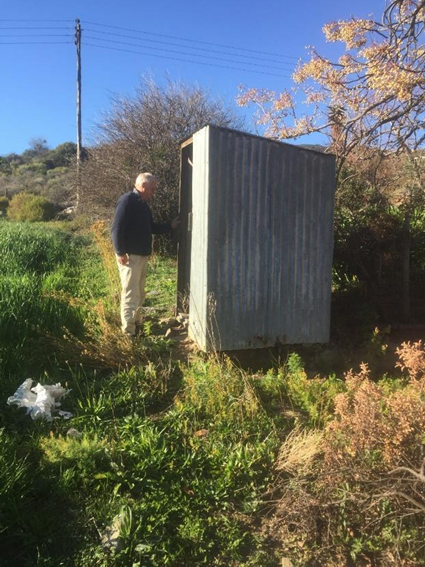
Now you can see what a privy looked like
Next up was Hannah Kriel, also a farm girl, from 1925 to 1928, and as a rookie had to face 23 pupils in every class, but in no time she had everything under control. (She was the only farm kid in the new high school when it was inaugurated at Kanonkop in 1921, while there were eight farm children when the current high school opened.) Under her direction we held two concerts with the Christian Youth Association to raise funds for a stage at the school, which at a cost of about R30 was then installed by her father. We had many field trips to the waterfall and caught tilapia (kurper) at Haasfontein and cooked it in braised onions.
The most pleasant excursion was one Saturday, heading to town on the horse cart, singing all the way. The children had to collect the harnessing equipment and the feed from the parents themselves. Alex Kriel and old Big Koos were the drivers. After we sniffed around town for a bit, we went to Mr. Kosie Wolfaardt’s studio in Montagu Street (now called Piet Retief Street), for a school photo. At the time there were thirteen De Kocks and ten with 5 other surnames. Around two o’clock we harnessed the horses and visited the Baths. For many it was their first experience. When we got to the main road again Hester Pattie, the eldest girl, took the reins and drove us home. It was a very enjoyable day, but it had a bad aftermath for my sister, because the next week her head started to itch and when my mother took a closer look, she found a few creepy crawlies that she must have picked up at the Baths. The fine-toothed comb soon did a thorough job.
With the first hoisting of the national flag all the farm schools’ children were invited to town for the proceedings and us country bumpkins sang the Anthem at the top of our lungs!
The most common game children kept themselves busy with at school, was bunny (“hasie”) and ewe sheep (“skaapooi”) and stonequoits for everyone, and (for the boys) “bok-bok” and “knoop”, while the girls played German and Scottish track and five-stones (“klip-klip”).
With most of the games a countdown had to precede it to determine the following turns. The most common rhyme was: “Iena Diena Dyna Das, Skotlewiena Wyna Was, lets Piets Muskadel, Ella Tella Twenty one”.
I don’t know if it was to encourage competition, but some of the teachers called up all the pupils according to their percentages after the exam results were compiled, and everyone stood in a row. It was quite interesting to see who outperformed who. In December 1927 Miss Kriel gave everyone Bibles.
Kriel’s successor in 1929 was Miss Fox of Riversdale and ‒ although she had a chest as hoarse as a Muscovy duck, she was an excellent teacher. After two years she was succeeded by A.P. Kriel (son of J.), a high school teacher, who administered our school for a few years after a mental health problem. Subsequently, in quick succession, there was Miss Fourie and a widow, Mrs. Homewood.
In June 1947 Miss R.H. du Toit of Bredasdorp took up the mantle for shepherding the youth and parents quickly noticed that she won the children’s trust and was at home in our community. She was the one who brightened our barren school hill with succulents and vygies. The numbers slowly increased and in a letter dated 2 February 1948 the Department gave permission to the committee that a second teacher could be appointed, even if it was a woman. The committee however struggled to find one before January 1949, and she was Miss I. du Plessis of Ashton, who set up shop in the verandah room of brother Gawie with her small class of 17 up to Standard 2. Miss Du Toit remained in the school, with 15 pupils up to Standard 6. With the renovation of the school in June, the partition and the back door was installed and teaching under one roof resumed. With the following renovations to the school and thanks to the intervention of our school board member oom Gielie Jordaan and the committee, the verandah and storage room were built, so that the children could have shelter on rainy days.
Miss du Toit had the following assistants to help teach: Miss Dippenaar, A. Jordaan, M. Mostert (nee Kriel), R. de Kock, Green, Mrs. Scholtz, Groenewald, Anna Bam and Sofie de Villiers, who one day with a measles outbreak only had Christie Kriel present in her class.
The numbers slowly dwindled again, however, and De Villiers had to resign, leaving Miss. Du Toit as the only teacher. The big knockback in numbers came when Standard 6 was merged with the town’s high school.
On 3 August 1964 seven parents met to discuss the possibility of a bus service, as the school couldn’t continue as a farm school in 1965. Miss du Toit already reached retirement age and submitted her resignation, dated 25 March 1965, but declared her willingness to continue with the farm school with its seven pupils until the end of the year. Therefore the committee was not surprised when the School Board gave notice on 4 May 1965 that the school would be downgraded to a farm school. This notice was discussed at the historic last meeting of the school committee on 2 June 1965. Present were J.F.D. Kriel (Chairperson), J.F. Kriel (Doornkloof), D.G. de Kock Jr. and J.S. Roux. Due to a misunderstanding secretary A.F. Kriel was unfortunately absent. The committee ‒ all former pupils at the school, expressed their gratitude to Miss du Toit that she would stay on until the end of the year. The decision was also taken that she ‒ and our Alma Mater as a centre of education, would be given a more fitting farewell at year-end. In June she married A.F. Kriel, a widower whose children all sat in her classes. On 10 December 1965 we had a big gathering of former pupils and visitors with a convivial meat braai. While the smell of barbecued meat hung in the air, the last seven pupils ‒ Erna, Pieter and Johan Kriel, and Jannie, Sannie and Alda Roux, and Sonja Kriel and Miss du Toit signed their named in the old Minutes logbook of 1906, followed by signatures of the 71 former pupils and 36 visitors. Jan Vermeulen, of Doornkloof, was pupil nr. 200 in the register long after the school closed down. At the date of closing the total was 267. The last inscription was by B.H. Kriel, of Kosie, Doornkloof.
The programme was as follows:
- Opening with Hymn 31 and Prayer.
- A motion in memory of the pioneers of the school ‒ those present arose to adopt it unanimously.
- Welcoming by committee member D.G. de Kock.
- Song by the Jordaan sisters (the Polkas).
- Recital from Totius by Esta Kriel.
- J.F.D. Kriel delivers a historic overview of education in Pietersfontein up to where Miss du Toit began.
- Miss du Toit gives a short overview of her 17½ years in service.
- J. Kriel delivers an appreciation speech to Miss du Toit and awards her a cheque of appreciation.
- Expressions of gratitude by J.F. Kriel after Abraham Conradie recited a long poem.
- We conclude with the singing of “Auld Lang Syne” (Sal ons ou kennisse ooit vergeet van die goeie oue tyd).
About a year after the school closure, the school board asked for tenders to sell the school and our church ward immediately began a collection list and collected R300 for the acquisition, conveyance and restoration work, which at the time only cost R236. Again, our school board members helped a lot. Because the conveyance could not be transferred to a community, we asked the Church council to stand in and subsequently the building was transferred to the Church, because the building in future would chiefly be used for church affairs, but also as a community centre. Christa Stemmet’s wedding reception was held there, for example.
I think the Keisie School, about as old as ours and currently still operating, together with Koo and Kruispad, possibly sent more pupils to go study education, namely 36, and from what I could gather five taught at their alma mater. We trump them, however, in the respect that eight of the twelve from our school taught at our alma mater for shorter or longer periods. In sequence, they were: Josias (son of A.), Josias (son of M.) – both De Kock, A.P. Kriel, Hannie de Kock, Cecile Kriel, Hannah Kriel, A.P. Kriel (son of J.) and M.B. Kriel, Sarie, Ria, Esta and her brother A.P. Kriel. The latter four did not teach here. At the start of the 1970s there wasn’t one child on the farm, not even a baby. Today there are six again. By the way, on 16 December 1978 the Keisie School held a very big reunion.
Poem recited in Youth Association by A.S. Conradie (translation provided):
OEMKOELEE
Brave warrior Oemkolani Oemkolani dapper krygsman,
King of Kamasiland Koning van Kamasiland.
Great captain of all his people Groot kaptein van al sy mense,
Great in wealth and intellect. Groot in rykdom en verstand.
Proud was King Oemkolani Trots was Koning Oemkolani,
Of all his armies and his livestock Op al sy leërs en sy vee.
He was proud of all his wives, Trots was hy op al sy vroue,
Even more proud of Oemkoelee. Trotser nog op Oemkoelee.
Oemkoelee was his youngest daughter, Oemkoelee sy jongste dogter,
Just passed her fifth birthday, Pas haar vyfde jaar verby,
She was destined, Oemkolani thought was bestemd dink Oemkolani
for a King’s son like him. vir ‘n Konings seun soos hy.
But, alas, great Oemkolani Maar helaas groot Oemkolani;
Even your greatness is over. Ook jou grootheid is verby.
Langa: King of the Bangoes, Langa: Koning van die Bangoes,
will gain the upper hand over you. sal die oorhand oor jou kry.
Savage war, Woeste oorlog,
bloody massacre, bloedig slagting,
Men and women are Man en vrou word
brutally murdered. wreed vermoor.
Oemkolani was Oemkolani word
tortured, gemartel,
Oemkolee is the sole survivor. Oemkolee alleen bly oor.
Oemkoelee, his youngest daughter, Oemkoelee, sy jongste dogter,
is the only one spared death. Word alleen die dood gespaar.
Like an ornament among strangers Soos ‘n sieraad tussen vreemdes
Protected against danger. Wat beskerm word teen gevaar.
Langa himself took her away, Self het hy haar weggevoer,
He himself would keep her. Self sou Langa haar behou.
He himself picked her ages ago Self het hy haar lank gekies al
to be the King’s wife for his son Vir sy seun tot Koningsvrou
Bigger, prettier, lean and stately, Groter, mooier, slank en statig,
She became over the years. Word sy soos die jare gaan.
The choice among all King’s daughters Keur van alle Konings dogters
Who are you and from where? Wie is jy en waarvandaan?
But even King Langa did not know Maar selfs Koning Langa wis nie.
That with Oemkolani’s death Dat met Oemkolani’s dood
Thirteen years ago Dertien jare vantevore
He was hiding in a ditch. Weggekruip was in ‘n sloot.
A Kamasie Warrior boy, ‘n Kamasies Krygsman seuntjie,
Miraculously was spared. Wonderbaarlik is gespaar.
Picked up by the Bakwenas Opgetel was deur Bakwënas
and escaped from danger. En ontkom het aan gevaar.
Tjatlangaan, a tough warrior, Tjatlangaan, ‘n stoere krygsman,
He was young and fearless Jonk en sonder vrees was hy
Heard about Oemkoelee, Het gehoor van Oemkoelee,
And decided to go fetch her. Het besluit om haar te kry.
He alone Kamasie daughter; Hy alleen kamasi dogter;
He alone Kamasie son; Hy alleen kamasie seun;
Would his fathers not assist him, Sal sy vaders hom nie bystaan,
Would their spirits not support him? Sal hul geeste hom nie steun?
Quiet and still in black darkness, Sag en stil in swarte duister,
He slipped into the Bangoe kraal. sluip hy na die Bangoe kraal.
Out of the hut of King’s wives, Uit die hut van Konings vroue,
He would go take Oemkoelee. sal hy vir Oemkoelee gaan haal.
Gently, without a noise in deathly silence, Ruisloos sag in doodste stilte,
He slipped in through the little door. sluip hy by die deurtjie in.
Now carefully alert, Nou versigtig op sy hoede,
the danger has begun. nou het die gevaar begin.
Oemkolee! He whispers quietly. Oemkoelee! Hy fluister saggies.
Oemkolee! He whispers again. Oemkolee! Hy fluister weer.
Oemkolee! He hears something rustle. Oemkolee! Hy hoor iets ritsel.
Oemkolee! The last time. Oemkoelee! Die laaste keer.
Who is calling me? Wie is dit wat my geroep het?
Shush! Be quiet, little Oemkoelee. Sjuut! Wees stil klein Oemkoelee.
Whisper softly, otherwise Fluister saggies, anders sal ek
I’ll be losing my life for this. Hiervoor nog my lewe gee.
Oemkolee, Kamasie daughter, Oemkolee, kamasie dogter,
Oemkolee, it’s Tjatlangaan. Oemkolee, dis Tjatlangaan.
For your father’s sake and mine, Om jou vaders wil en myne,
Don’t you want to go with me? Wil jy dan nie met my gaan?
Red like blood and ominously Rooi soos bloed en onheilspellend
the sun shines on Komla. skyn die son op Komla neer.
In the Bangoe kraal down below, In die Bangoe kraal daaronder,
Anxiety is blowing through. Angs gewarrel heen en weer.
Bangoe heroes, armed to the teeth, Bangoehelde goed gewapen,
Circling wider and around. Kringel wyd en wyer rond.
Meticulously, grumbling, threatening, Soek noukeurig brommend dreigend,
Seeking tracks on the ground. Soek na spore op die grond.
Suddenly a chant breaks the silence. Skielik breek ’n kreet in stilte.
Someone found the tracks. lemand het die spoor gekry.
Together the Bangoe fighters moves Same stroom die Bangoe vegters
and forms lines, row on row. En vorm linies ry aan ry.
Pounding, quick and resolute, Stampend, snel en vasberade;
the Impi now follows the tracks. volg die Impi nou die spoor.
Threatening chants, gasping Krete dreigend, asem hygend,
the Bangoe choir drones furiously. Woedend dreun die Bangoe koor.
The midday sun and rocky terrain, Middagson en rotsig bodem,
was too much for Oemkoelee. was te veel vir Oemkoelee.
In a ravine, bushy and shadowed by trees In ‘n kloof, ruig, boomoorskadu
The two rest next to a little stream. Langs ‘n stroompie rus die twee.
Listen! Listen! Tjatlangaan, Luister! Luister! Tjatlangaan,
I hear the Bangoe war chant. Ek hoor die Bangoe Oorlogskreet.
Save yourself! Save yourself! I am safe, Red jou! Red jou! Ek is veilig,
Flee! I will never forget you. VIug! Ek sal jou nooit vergeet.
I will not flee, Oemkoelee, Ek sal nie vlug nie, Oemkoelee,
I will give my life for you. Ek sal vir jou my lewe gee.
I will stand and fight and die! Ek sal staan en veg en sterwe!
Therefore ‒ Farewell, my Oemkoelee. Dus – Vaarwel my Oemkoelee.
The attack was short and fiery, Kort en vurig was die aanval,
Three had died ‒ one more still to go. Drie was dood – nog net een meer.
A spear brutally pierces his body, Wreed deurboor ‘n spies sy liggaam,
He collapses, tottering, trembling. wankelend, sidderend, stort hy neer.
Be frightful, Bangoe heroes, shudder, Skrik maar Bangoe helde sidder,
You could not prevent this. Dit kan jul tog nie verhoed.
That in Kamasie daughter’s arteries, Dat in Kamasies dogter’s are,
Kamasie blood is still pumping. Tintel nog Kamasiebloed.
Quickly she pulls back from his body, Snel ontruk sy uit sy liggaam,
The weapon stained with blood. Bloedbevlek die wapen weer.
And with a biting smile, she stabbed again En met ‘n honend glimlag steek sy
And then collapsed next to him. En toe stort sy naas hom neer.
The stream of water now turned red, Rooi getintel waterstroompie,
a mixture of Kamasie blood. mengsel van Kamasie bloed.
Monument to a heroic nation, Monument van helde nasie,
The swan song of a glowing love. Swanesang van liefde gloed.
CHAPTER 14
Association life and merry-making
Earlier it was mentioned that Mr Sias de Kock was the founder of our first Christian Youth Association. This must have been around 1895, because my dad ‒ who welcomed the establishment of the group, was by then a long-time member of the Koo’s association (22km away), and on one of those association trips he met my mother in Kankoo, a good resting stop for his horse. After the courting lead to a positive outcome in July 1895, he resigned from the Koo’s association. The association was not active for long and apparently collapsed with the passing of the founder. It wasn’t long before Mr. Van Rooyen ‒ later a professor at the Stellenbosch seminary, established a second C.Y.A. with 28 members, which remained standing for many years. This C.Y.A. was chaired by Andries Kriel. According to the oldest available Minutes logbook, the first meeting was held at the school “on 3 March 1917 with the following agenda: The Chairperson, Deputy Secretary and 16 members were present:
| 1 | Recitation | Mr. Piet Kriel (Absent) |
| 2 | Reading | Miss Rachel de Kock (Jos. De Kock): “The True Gentleman” |
| 3 | Discussion | Mr. Giep de Kock and Miss B. de Kock: “Who is the smartest?” |
| 4 | Reading | Miss C. de Kock: “What educators must hear and experience” |
| 5 | Recitation | Mr. Gert Jordaan |
| 6 | Debate | “Were the good old days better than the present?” |
Giep de Kock opened the debate and said: “The good old times were better.” Gawie de Kock delivered the counter-argument, saying the present was better.
When it was put up for a vote, the opener got 10 votes versus the counter-argument only mustering 3.
The meeting was concluded the usual way: with singing and prayer.
Chairperson: J.A. Kriel”
The Minutes of a spiritual meeting held in March 1918 follows:
“The programme for the evening is as follows:
| 1. Bible questionnaire | Where does one read in the Bible of a circle and where is Hell mentioned the first time? And who was the man who lay on his side the longest? (Who knows?) This quiz obviously helped the prospective catechists a lot. We had a set of six big Bible cards, each with Bible questions and the 72 answers with supporting evidence on small cards. The one who filled in his big and small cards first, was the winner. It was a pleasant Sunday game. |
| 2. Recitation | John Jordaan |
| 3. Improvisation | “Cowardice” by Gawie de Kock |
| 4. Reading | Johannes le Roux |
| 5. Sketch of life | Our chairperson: Mr. Andries Kriel |
| 6. Recitation | Miss Sannie Kriel |
| 7. Topic | “Saul as King” ‒ Speakers: Mr. Giep & Miss R. de Kock |
| 8. Recitation | Mr. Jacobus de Kock (still in the present) |
Every third month “Journal” was added to the social program, in which the young bunch’s antics or events were placed under the microscope. At this meeting attendance was naturally very good. In the management there were two “contributors” for the journal. Luckily we still have the journal book. Cecile Kriel wrote the first Afrikaans Minutes in June 1920.
Some members had to walk four to five kilometers from the surrounding farms or travel by horse cart to attend the association get-togethers. After the meeting some of the guys walked back with the ladies who lived far, while other guys stayed behind to court a member of the opposite sex, and sometimes slept over at friends on a “Christmas bed”. Now and then the associations of Keisie, Koo and ours held inter debates and regular socialising happened on Sundays. When I was still a little boy, it was too priceless to watch how this bunch transported the guys from Doornkloof to near the highland, but the next moment you see everybody returned and the last bunch then take the road home on their own. The most common place for conversation on Sundays was on the dam wall below oom Manie’s nut trees, where in March wreaths were braided around hats from the fragrant white “Traveller’s Joy” vines. Peaceful old time, hey!
Speaking of oom Manie. The old man had a long, pure white beard. His naartjie and orange orchards were next to the nut trees and one Sunday afternoon a couple of boys ate naartjies there, and as luck would have it that a long ladder was standing against the tree. When the bunch were busy picking, the oom’s slow voice came from behind a nut tree: “Who is climbing up and down my ladder? It’s not even my ladder ‒ it is a borrowed ladder. It is Koot’s ladder, but do continue picking ‒ it’s yours, you know.” Some of the chaps jumped up high and sped off as quickly as possible.
CHAPTER 15
Merry-making
But let’s begin at the start with the merry-making outside of association life, visits and working.
In the early days of our community, when Grootjie de Kock’s many grandchildren were still young and even much later, the farm’s young folk had a real zest for life and didn’t wring their hands because they couldn’t go court the ladies in the Cape or farther away or go visit the Nico Malan Theatre. They looked for their own entertainment at home, or by foot or by horse cart.
Aunt Pattie (born 1874) recounted that about ten of them walked over the Rooiberg at the Wolwevoetpad, through an ostrich camp, to go dance in Bosrivier until the wee morning hours. They returned in the dark on the footpath over the mountain, but when the sun rose in the morning over Grootland, the ladies were so tired and stiff that they got home with bouts of resting and dragging their feet. The men had to walk ahead from Blouhoogte, because their fathers were standing around waiting for them to fall in for the workday. Too frequently the men, after such an excursion where they only made it to bed when the rooster started crowing or the sun was already up, awoke to the old man’s voice at the entrance of the ram enclosure: “Come, come, rise and shine, gentlemen, if we don’t start threshing now, we’re not getting the grain in the sacks this evening”. It’s a difficult order, because watch out for the summer sun baking the landscape, the cicadas endlessly buzzing and you on the threshing floor with the groups of horses circling around you. All sorts of needs, except the actual one, are expressed to get someone else to take charge of the threshing belts, so that you could just quickly disappear somewhere for a nap. Or, after such a late night, a man must manage the boiler or the must jam pot in the March sun. Then he’ll surely repeat along with aunt Alie of the SABC: “There is just no mercy for a young man”

J.F.D.’s matric farewell photo from Montagu High School in November 1932. They sure were dressed to a T.
In the 1920s our picnic spot was on the upper side of Dassiesdrif, behind the big karee trees. A turntable playing music for complex dances there wasn’t, but pure singing with guitar or the harmonica, or a fast dance (“tiekiedraai” ‒ before the term “Volkspele” was in use) accompanied by the violin. The songs included “Daar kom die wa, die vierperdewa”, “Tant Miena kook stroop”, “Jopie Mei, die wind waai deur my sy” en “As julle nie kan kekkel nie, dan smaak die kos nie lekker nie”, of “Skud ek die tak dan val die peer, val die peer” and “Kielie ek die nooi dan slaan sy neer”, to name a few. A couple of English songs were not far away, like “Johnny Miller”, “Oh, Rosy, my Darling” (“Oh Rosy, my Darling. Rosy I love you well. Oh, Rosy, my Darling, Rosy I love you well. Rosy is my darling dear, darling dear. Rosy is my darling dear, darling dear, darlinggg dear”) or “Musical Arms”. When the bunch was tired of all the twisting, they quickly shifted gear to team games like “Oubaas se swartvark” (Old man’s black pig) or “Raad in tyd van siekte” (Advice in time of illness), because courting each other couldn’t be left behind! By noon, when the inner human has been strengthened, the waltzes and “pattikas began ‒ still accompanied with singing and “boeremusiek”. Vingertrek (“pull my finger”), skilpadloop (“turtle walk”), Jukhaakskop, or Sweepstok (“Sweep stick”) and Dooimens optel (“Picking up a corpse”) all got a turn.
The toddlers, among which I still counted, kept themselves busy with circle games like rotten egg or boompie-verplant (“transplanting a sapling”). Now and again the boys broke away to ride the butterboom trunk down the smooth embankments or small cliffs or play “bok-bok staan styf, hoeveel horings op jou lyf”.
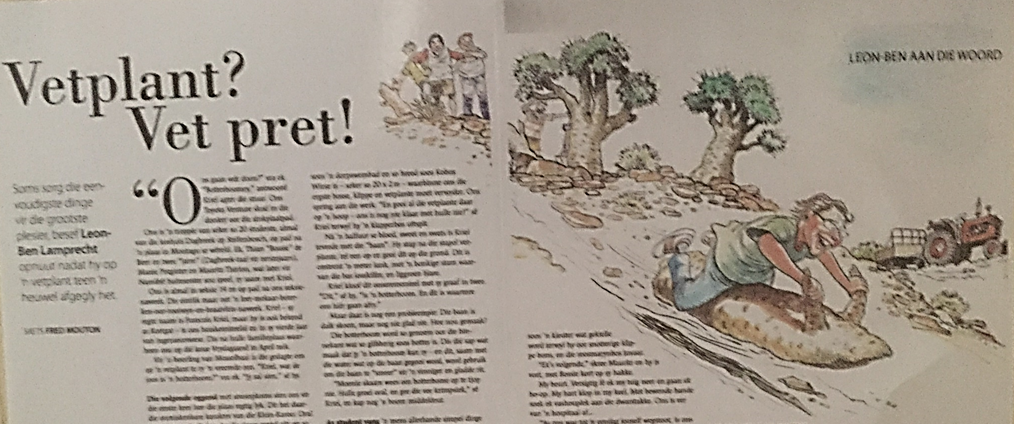

The butter tree (Tylecodon paniculatus),also known as butter bush or botterboom
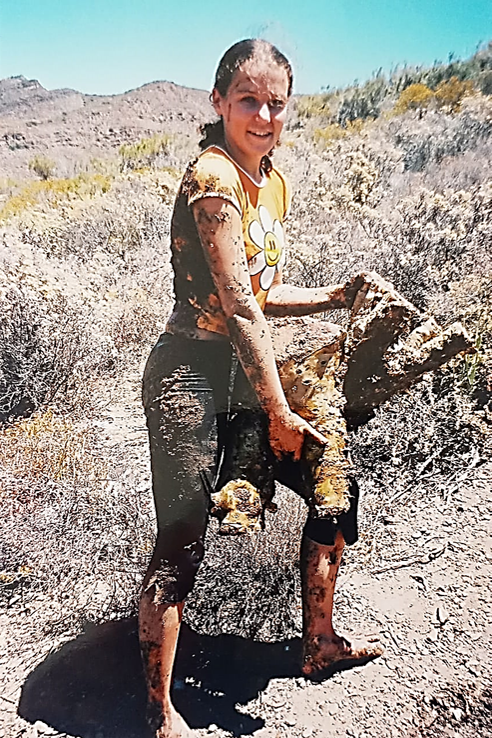

Riding the botterboom trunk
Today I still love playing “Jakob en Rachel”, “Walking on the green grass” or “Sally go round the moon” with the little ones.
In the 1920s New Year’s celebrations were held under oom Dries’ big old oak tree at the upper side of the dam, or under Aunt Triena’s big old weeping willow in the afternoon, but in the evening the party moved to the front of Aunt Pattie’s door at the two big white and pink oleanders. From the 1950s we held our New Year’s picnic in the Poort where the dam now is, under the big thorn trees. Many friends from elsewhere traveled here and even I, when too few women were living on the farm, transported the ladies from elsewhere. These days our remaining couples (there are no young ladies here), gather in the Waterkloof, but not so frequently any more.
Our people, who lived far away in town, earlier only had picnic sport ‒ table tennis was very popular in our home, but in the 1940s we at least had two functional Jukskei teams with a few extra reserves and in the second season of competing with Langeberg, the town and the Keisie, we won the mounted Ox Yoke. Thereafter interest in the sport waned again. Rugby was never played here, but in their high school years my sons played and after they began farming, still drove into town for rugby.
The farm also had a few badminton players and through the efforts of Sally Kriel (of Jannie) a pistol club was founded at the start of 1977 in our ward. The police regularly came out to give lectures and demonstrations of handling a weapon for self-defense, The shooting was initially done on the other side of the school, but now there is a course according to specifications in Konkelleegte in front of Sally’s Dam. The women already challenged the men one time and didn’t lose too badly. There was already a weapon survey done in our ward for the event of home defense.
Christmas
Our farm folk crisscrossed the entire farm on Christmas Eve with the beautiful custom of singing in front of all 12 houses, from long before I was born. However, in the olden days they used to lie down for a bit and from around 23h30 started arriving at our house with lanterns and Hallelujahs, while some only joined when the group walked past their house. After the farmers families travelled a few houses down, the farm workers began their singing journey. Since the late 1930s the bunch gathered on my lawn from early in the evening and passed the time with games until 11pm, then we drank soft drinks and “silence” followed until it was time to walk. It has happened that the singing group was 70 strong, coming from all four provinces. When we still covered the entire range of 12 houses on foot, we closed off the night with “God be with you till we meet again” (God sy met u tot ons weer ontmoet) at the top of our lungs. Now we sing “Auf Wiedersehen” (Wedersien) on top of Uilkoppie. The bunch frequently set off to Grootland or the Kloof, or just wandered about for the sake of it until dawn breaks. I have only missed one Christmas night’s singing since I first joined as a school boy in 1926 ‒as my wife was ill. Oom Giep de Kock came all the way from town to join at the age of 71. The meeting place on New Year’s Eve was for many years in front of my door, on the lawn.
CHAPTER 16
Politics
Before the Anglo Boer War there was exclusively only one party in the Cape, namely “Het Zuid-Afrikaanse Party’ with “Ons Land” as mouthpiece, but as countermeasure for Cecil John Rhodes’ antics the Afrikanerbond (“Afrikaner League”) was founded in Burgersdorp. On 3 June 1903 a strong branch was established in Robertson, attended by a number of Montagu’s influential residents. In turn they organised a meeting on 4 July 1903 in Montagu, reported on as follows in the “Ons Land” of 14 July 1903: “Last Saturday, 4 July, it was lively again in our little town. A great number of residents of our district came to town to attend a meeting, convened by ten of the most influential men of the area, to discuss the desirability of the establishment of a local branch of the Afrikanerbond”. The original minutes are in the front of the thick Minutes logbook on our farm, as well as a Circular in which the above mentioned meeting was announced by the following members of the preliminary committee: D.S. du Toit, D.J.G. Joubert, Dr. C.A. Wessels (all from Montagu), P.D. du Toit (Kruispad), A.P. Burger, Jr. (Klipkuil), P.H. Burger and A.J. Joubert (Baden), J.D.K. Conradie (Harmonie), J.S. Cloete (Concordia) and C.J. van Zyl (Stockwell).
On the first meeting of the league, chaired by P.W. Cloete and with A.W. Hofmeyr as secretary, it was decided for the time being to not establish branches in the district. At the second meeting a “motto” bearing the words: “Afrikanerbond, established in Montagu on 4 July 1903 ‒ Unity is Strength”, was handed over by Ms. Borrie Joubert to the attendees in the name of the Youth Association. She also created the motto.
On 15 August 1906 it was our farm’s turn, with a meeting at the home of A.P. Kriel “at half past two in the afternoon, with the aim of establishing a branch of the Afrikanerbond and Farmers’ Association”. P.W. Cloete was proposed as provisional chairperson and J.F.D. Kriel as secretary. After the chairperson opened the meeting with prayer, he presented the aims and the constitution and after discussion, 17 of the 19 attendees signed it. The name was to be “the Montagu Ward Branch”. One wonders why they did not add Pietersfontein. The management elected were as follows: P.W. Cloete (chairperson), H.F.N. de Kock (deputy chairperson), J.F.D. Kriel (secretary) and J.A. Kriel (deputy secretary). Additional members: A.F. Kriel (so far everyone mentioned hailed from Pietersfontein), A.F. Jordaan (Middelvoetpad) and J.D. Kriel (Patatsfontein).
At the inaugural meeting a thick book for the recording of the Minutes was handed over to P.W. Cloete. It is still used today and was used to highlight this information.
The meetings were held all around our ward. At the next meeting in Patatsfontein it was decided on 10 cent per 100 heads of problem birds and 3 1⁄2 cents per 100 eggs and chicks of the problem birds. The children furiously competed for pocket money. If one found a Cape sparrow’s nest in which only one egg had been laid, you would stay quiet on your find and now and again go check if the female finished laying all her eggs. One day cousin Hans stuck a finger in the nest to feel for eggs and he got pricked by a thorn. A snake bite, he thought and frantically ran to our house where dad was busy chopping wood. Standing in front of my father, he yelled: “oom, chop it off!” as my unsuspecting father was lifting the axe for the next blow. Hans grabbed the axe out of my fathers hand and lifted the axe with the intention to sever his finger, my father seized the axe again and so spared the cousin’s finger, afterwards determining it was only a thorn prick. One day oom Dawid forgot a bunch of bird heads in his blazer pocket when he hung it up in his room. After a few days his room developed a bad smell and after closer investigation he found the cause in the blazer pocket. The eradication of birds was stopped in August 1909.
Two of the first points of description sent by the Branch and District Management to the Congress in 1907, was:
- That no one who fails to pay Divisional Council taxes would be entitled to compensation if his vehicle breaks down on a public road.
- It is requested that a narrow railway or road locomotive be instated from Drie-Angel (Matroosberg Station) to Sandvlei.
- It is also requested that mange be combatted more efficiently. (The farm had a company dipping hole at the upper side of oom Dries’ dam.)
The league existed for 6 years, but then Onze Jan (“Our Jan”), the Bond’s founder, passed away and at the last minuted Branch meeting of 8 December 1910 a decision was made that every member would make a contribution of 1/- (10 cent) for the erection of a memorial for Onze Jan.
Before the collapse of the league, politics already started to creep in, because five candidates were nominated for election as MPL ‒ two by the league and three by the public.
After the league disappeared, no political organisation existed in the area for six years, but on 9 February 1916 our farm’s name popped up again in the Minutes logbook, this time in relation to the National Party. The Minutes read as follows: “The ward held a meeting on 8 February 1916 in the school building at four in the afternoon, with the aim of establishing a branch of the National Party”. Agriculture was again included.
J.F.D. was elected provisional chairperson and M.J. de Kock (son of J.) as secretary. Thereafter Mr. Andrew Hofmeyr (of Van Zyl & Hofmeyr) explained what the NP meant and set out the party’s goals. After question time the decision was taken to establish a branch, and 18 of the 20 attendees signed the following statement:
“The Undersigned herewith declares himself as a man of honour with his signature to embrace and uphold the expressed principles of the National Party of the Cape Province, and to comply sincerely and out of own choice with the obligations related to the aforementioned party membership and in line with its constitution”. The subscription was 15 cent.
The first signatories were: Brothers J.F.D. Kriel, A.F. Kriel and J.A.T. Kriel; father J.F.D. de Kock and his 4 sons M.J., C.J., J.F.D, Jr. and G.J.P. de Kock; J.F. J.A. and A.P. de Kock, and J.L. Jordaan.
After the whole management team was elected, Mr. Oosthuizen, oom Bella van der Merwe’s stepfather, closed the meeting with prayer.
At the time oom Giep (Hannes) en Koos de Kock of Pietersfontein were in the Wynberg camp and eager to help invade German South West Africa. He recalled how his heart was burning with the question of what his people would do with the choice between “Nat” (NP) and “Sap” (South African Party). He himself already felt like a “Nat”. Luckily one morning Jan Kriel (Ponie), a fellow party member, arrived with a letter from home at Giep’s place, in which his mother wrote: “Pietersfontein is now a Republic and oom Koot Kriel and his cousin Dries de Kock are their leaders”.
The Pietersfontein branch met every three months and at nearly every meeting had a debate, e.g. “What is the most indispensable for the country ‒ agriculture or livestock farming?”
At a meeting on 30 January 1920 Mr. Jan van Zyl of Ladismith was nominated here for the first time as National Party candidate for parliament, but he lost to Mr. Burton.
At the meeting of 6 May 1922 a point of discussion was brought forward, namely: That when a person buys land and he has already paid off most of it, but he goes bankrupt later, a part of the instalment is given back to him. Shame, the industrious man, who I knew well, never had the privilege of owning his own piece of land.
Improvisations were frequently used to keep the agenda interesting.
At the meeting in September 1922 letters were read in which it was requested that a protest meeting be held in Montagu against the incorporation of Southern Rhodesia to the Union.
The last meeting minuted in Dutch of the first National Party was dated 1 August 1923, during which Mr. Pieter Brink of Brink Bros was proposed by J.F.D. Kriel as candidate for the provincial legislature. He gained wide support for his candidacy, but lost to a Jewish trader, Mr. Man.
Subsequently there was a period of relative political standstill, but I was sure that the farm folk jumped for joy when the National Party came to power in the 1924 election in coalition with the Labour Party. With the introduction of women’s suffrage in 1930, our farm’s women were rather upset, because a woman’s place was in the kitchen and not in politics. They also rarely turned out to vote.
With the establishment of a branch of the Ossewa Brandwag in the war years by Commander Dawid Joubert of Rietvlei 2 and a number of his officers, it was probably the most exciting time of our lives, because now we were striving for a Republic under the ideal motto: “My God, My People, My Fatherland”. Our people again joined and also attended the big gathering in Worcester by Commander General Hans van Rensburg. Unfortunately the opposition with its divide-and-conquer politics soon came around and this, together with the OB leaders’ objectives of violence, made us reconsider and return to the old ways. We would continue with the tested Reunited National Party or People’s Party and its leader, dr. D.F. Malan. (None of us joined General Barry Hertzog’s United Party.)
For the establishment of the branch of the HNP (the abbreviation should not be confused with today’s Herstigte Nasionale Party), Mr. Johnny Thomson and Mr. Montie Hofmeyr (son of Andrew Hofmeyr, founder of the National Party branch here in 1914) visited again. At the time our Youth Association was still active and the decision was then taken to merge it with the party’s associations, because there weren’t any dissidents here. The decision was also taken to have future meetings from house to house, because the war was ongoing and there was a ban on holding political meetings in school buildings.
The first meeting was held on 31 October 1942 at the home of the 82-year old Aunt Hetta, chaired by D.G. de Kock, Sr.; J.F.D. Kriel was secretary and treasurer and Japie de Kock, M.J. de Kock and D.G. de Kock, Jr. were additional members, with a subscription of 30 cent.
Next to the great excitement during the era of the OB, the results of the May 1948 elections were not far behind, but obtaining our Republic in 1961 could not match the earlier enthusiasm.
We held regular meetings up until 1970, but since then we have basically existed as a branch managing its own organisation. It should just also be added that Pietersfontein’s farmers have organised a protest. In 1942, after representations by the town’s business sector, the Municipality granted permission that shops could remain open on Wednesday afternoons and close by one on Saturday afternoons. The district’s farmers were dismayed and called a protest meeting, and we took a truck to town to support the farmers, because at the time many farmers traveled in for business and church. Heated arguments ensued, but no one was injured and the farmers again pulled the short straw. Today,as I write, we must already drive to town on Friday mornings for petrol.
Before we end this chapter, just one more thing. Without one meeting being held here, the first election for members of the newly instituted United Coloured Council (“VKR”) was held on 24 September 1969. Our voting district, No. 913, had 114 voters on the list, of which 58% or 50% turned out. There were four candidates on the ballot paper for the Breede River Constituency, namely:
C.C. Fillies People’s Party
G.J. Fortuin Labour Party
J.H. Lategan Republican People’s Party
G.P. Michals Federal Party
There was also an inside and outside agent for the Labour Party, namely T. Hendriks and R.M. Stuart, while former teacher Mr. Greeff served as presiding officer.
Sewes van Wyk (my herdsman), Jonas Juries and his son Esau were the first men who made their mark, while Jannetjie Swanepoel (Oumeid) was the first woman voter. Labour had a runaway victory.
CHAPTER 17

Enjoy the aerial view of Mooi Erfenis and Pietersfontein by visiting the link below
This and that and the other thing
We just want to tell a few more stories on the personalities who lived and worked here, as well as party-affiliated anecdotes.
One of our guys, who now resides in the old age home, said there are three stages of work in a child’s life. As soon as he can unclench from his mother’s dress, he looks after the chickens and sometimes also pigs. There were no cages. A little later he had to look after the horses and oxen, because a wired fence was scarce. When the teenage facial hair started to stubble, he had to pick up his shovel and fall in among the adults.
Oom Dawid recalled that his older brother, Jan, had to look after the horses at oom Floors Vermeulen at Cedraskloof for a six week-long period. He would be paid 25c, but the oom could not immediately pay him. Dawid and his sister, Soes, later had to go and collect it for their mother, but they were afraid of walking through the Waterkloof footpath to get there. The road was only built much later. Arriving at oom Floors, they hesitantly told him the goal of their mission and there were no problems, because the oom told them: “Money is as plentiful as bushes here”, and they returned home with a half crown in hand.
One day the same oom Floors lay sick in the original flat roof house in front of the first old dam; it is a vegetable garden now. The morning sun shone directly on his face through the small open window boards. He called his wife: “Tootie! Please come and close the window ‒ the sun is shining on me,” but Tootie was a distance from the house, busy with her pots behind the cooking shade, and couldn’t hear the request. She also didn’t hear when he uttered the same request a second time. The old man was losing his temper and then yelled a third time: Bugger it “Tootie!, come and close the window! I have pleaded with you, but I won’t pray, because the Word prohibits idolatry.”
Under the chapter about religion it was stated that the catechists usually catechised with the teachers. Two young men, Johannes Kriel (Koning) from Laatsrivier and Willem Roux of Doornkloof, lodged at Aunt Sannie Michiel and later in the afternoon, after school, catechised with the teacher. The footpath through the poplar grove in the river ran over the embankment of the little river dam and one day when they were returning from the teacher, Kriel ‒ a real jester, got an idea. Before they entered the grove, he told Roux: “My friend, let’s play horse through the grove and then you ride on me”. Roux did not have to think twice and climbed on the two-legged horse’s shoulders. The boastful horse first made a few turns before it headed into the bush, but unfortunately for Roux, the horse got a fright on the embankment, throwing his rider with his new corduroy trousers off and into the water. The horse galloped all the way to the embankment on the other side, where he stopped and giggled at the dripping rider, shelling him with rocks and “uncouth” words.
Old Willem Landsman (a Dutchman) was a mason and tiler who moved around the district for a while and also built a couple of our buildings, like our big pressing cellar and oom Jan Polka’s house in the Kloof. Previously Willem always ate with the farmer at their dining table, but one day when my oom invited him for a meal after not seeing Willem for a while, Willem said he’d rather eat in the kitchen. “Why?,” my oom inquired. “Oh, I humiliated my standing, I took Filla Padda (my oom’s first wife) as my spouse.”
When one of our dominees took Willem to task for violating the Ten Commandments with a Coloured woman, he retorted: “Oh, you have violated all ten, because the Ten Commandments are like the links in a chain ‒ if you break one, you break the entire chain”. The dominee had to fall back and try and find another line of attack!
The late oom Johannes Krakadouw recalled that he heard branches break early one evening in Doornskloofrivier and after a closer look, it was Willem, busy making a bed for the evening with all sorts of veld bushes. The oom immediately recognised Willem’s voice when he told Jannetjie, his second Coloured wife: “Jannetjie, you must pray. You are very ill. You could die,” to which Jannetjie replied: “I can’t pray”. When Jannetjie again protested “I can’t pray” after a second request to do so, Willem came to her rescue and said: “You pray like this: Father, teach us to count the days, which days should we count? The days that are gone”. Jannetjie did eventually recover from her illness.
The types of people, also called parcel carriers or trannies, tinsmiths doing soldering work, masons, but even vagrants at times, disappeared from our roads. Old oom Krisjan van der Lid, a tinsmith, had a disability and drove through the district on horseback and frequently slept over here. To emphasise how important it was to cut off any tree that he transplants, he told you that if you transplant your parents, you must also first cut off their heads. Old Vos was the last who still wandered around in the 1940s. He didn’t want to work and just wanted to party, and frequently had to tolerate lack of hospitality.
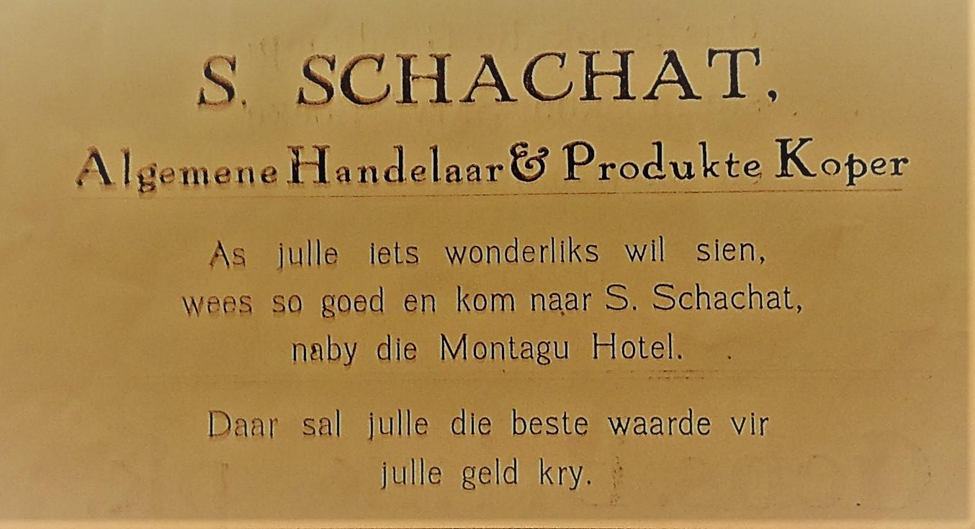

The building next to the Montagu Hotel(see arrow) was used by visiting commercial travelers and sales people to display their wares.
Then we also had frequent visits by old Mr. Schachat of Robertson, an elderly orthodox Jewish Trader with a long beard, his clothing cart pulled by two big horses. His overnight stay was with us, but he brought his own food to the dinner table. When his bread was a bit moldy, mom would give him a slice or two. It was an experience to see the wide variety of clothing and materials he could present from his cart, in big bundles and wrapped up well in a canvas. The biggest attraction for us children was when “mister” Schachat opened his jewellery box ‒ we called it the “little magic box”, with all its glittering things leaving a child in awe. If he was still around on a Friday and it was too late to take the road to Robertson, he stayed the entire weekend, because from dusk on Friday evening he must keep his candle burning and spend the Saturday in prayer and fasting. The guy slept in the outbuilding with us siblings and in the morning it was quite amusing to observe the old man’s prayer ritual. First he reads a piece from the Bible, then he puts on a long striped frock or toga, followed by harnessing his phylactery (a type of Jewish prayer dress) with his hands, arms and head, while he sways on the spot in prayer. All I could hear, though, was “Gabba, Gabba, Gabba”, with a hoarse-voice like a male Muscovy duck. After the first round he went out to see if his horses had fed already and then returned to pick up his religious tasks. Shame, age and motor vehicles also pushed this guy off the road around 1940.
When Hitler began forcing the Jews to leave his country, one of our farmers said if our Jews had to hit the road as well, he would only chase Schachat with a small whip, because he was a good Jew.
Oh, and nothing has been said of the Anglo Boer War which also asserted itself here. The Kakies and “Townsguards” came around here on their spy drives to see if Martial Law was being applied. The late Aunt Hetta’s son, Gert, recalled how careful his mom was to dry off her baby girl without the old tallow candle’s light being visible from outside.
One day Gert’s dad was rather upset because the Kakies merely climbed up to his attic, and threw out a bag of grain and sweet potatoes from the attic window on Kriekheuwel’s hard rock surfaces to feed their horses ‒ because Aunt Hetta refused to feed them. The poor people really couldn’t afford sharing their already limited food.
Luckily their actual food supply was in Doornkloofrivier, opposite Non-se-land, under a big cliff and hidden among karee trees. My father stored his food supply in a hole behind the little escarpment in front of our house, covering it with iron sheets and yellow bush (kraalbos). I think the common vole were rather happy!
I already mentioned earlier that the drafting animals were commandeered to such a degree that my father and his brothers were only left with an ass with a crooked leg and a mare who just foaled. When a neighbour in town tried to negotiate to not have his entire team of animals taken, the officer barked back: “You farmers must have nothing left, because you are bad, worse than a dog turd”. Oom Tas was placed under parole in town for 8 days because he refused to give up his saddle and bridle. He hid the saddle in the Wildehondskoppe.
At the time four families on the farm had brand-new cane-matted stinkwood chairs and the Kakies had to take off their bandoliers and other things which could scratch the furniture, if they wanted to sit (that is, if they were invited in). Twelve of the chairs became decrepit under later owners.
It was previously mentioned how frugality was forced onto the farm folk due to the difficult times. As proof, I will quote a few pages out of my late father’s two pocket books, which also sheds some light on the pricing layout. At the age of 23 my father offered his services to oom Bêrend Geldenhuys, a wealthy elder and trader of carts and wagons, to accompany him to the Free State, just so he could experience something further than Montagu. According to the first page, he covered his own costs. I will quote the first page of the booklet with no changes, but will use decimal money:
“Montagu 28 April 1890. B. Geldenhuys borrowed £2/-/- (R4) from J. Kriel. 3 May, cart rented to Ashton 5/6 (55c). Ticket from Ashton to Worcester £1/1/- (R2,10). Tickets from Worcester to Beaconsfield R2,30 before transport R2,02½, dumplings 5c, baker’s bread 10c, one flask of brandy 10c. 16 July, one can of sardines 15c, R2 two rand borrowed”. Dad’s pockets were probably empty before they returned home.
The booklet also contains a few loose pieces of evidence, among which “£8 eight pound sterling valued at six percent interest” in 1903. This was not settled by 1911, because all that was written down was “interest paid until 6 March 1911”.
In 1910 my father and mother went to visit the Rosebank Show in Cape Town and here is a breakdown of the tour’s expenses:
| Rented horse cart to Ashton | 80c |
| Train tickets to Cape Town | R12,86 |
| Cap car 40c, tram to Rosebank R4,80 | R5,20 |
| Exhibition R1,20, Coffee and grapes 28c | R1,48 |
| Tram to Hout Bay | .67½ |
| Clothing and glasses from the Jewish Trader | R1,91½ |
| Tram to Valkenburg | .15c |
| Necklace R1,50, Tea and Bread 15c | R1,65 |
| Cap car 22½c, shoes R1,05, umbrella 40c | R1,67½ |
| Accommodation R3,65 (probably for 2 days), watermelon 5c | R3,70 |
| R30,15 |
Here follows a price list of various items before and after 1900, but for convenience sake I converted it to current money, measurements and weights. The amount in brackets represent the current price of the specific item:
| Rice – 500 gram | 2½c | |
| Sugar | 3c | |
| Coffee | 7½c | (today up to R5,30 per 500 gram) |
| Lard | 5½c | |
| Bag of flour | R2,60 | (today R22,50) |
| Brick of mottled soap | 2½c | (today 28c) |
| Packet of matches | 4c | (the packet of 20c today contains far fewer matches today) |
| Slippers | 75c | (today R6,50) |
| Veld shoes | 75c | (today R9) |
| 1 Meter Buckskin | 80c | |
| Sis | 25c per meter | |
| Let’s look at the hardware: | ||
| Shovel | 56c | (today R5) |
| Drill bit | R1,60 | (today R10) |
| Plowshare | 15c | (today R3) |
Spray agents that are quite costly today, were unnecessary and unknown back then.
The farmer’s wife usually sent in a goat skin, a couple dozen eggs and a pound or two of butter, with a long note usually ending off with “rest: coffee and sugar”.
One day oom Dawid incidentally recalled how one morning, still dark out, he was walking eight kilometers on his own to take a note to the neighbour for groceries to bring back from town. And then he got a fright from a ghost near Petieranes!
How does the merchandise compare?
| Grain | R1,03 for a 200-pound big sack |
| Van Zyl’s beans | R1,50 (Today R45) |
| Potatoes | 50c per bag, minus 15c driving fee |
| Walnuts | 3c per pound |
| Cow with calf | R12 |
| Distilled wine | R5 per file (today R70) |
Oom Andries borrowed R12 at 6% interest from oom Giel of Cedraskloof to add to his flat roofed part of Kriekheuwel’s house, but the receipt was already in four tattered parts due to age by the time he fully repaid it.
I, myself, picked up a lot of sugar-beans on the land for 2½c per pound, currently 54c per kilogram.
Taking everything into account, the ratio between merchandise to buy and merchandise to sell was not much different from today, but cash was more scarce than today. Luckily the people lived below their means and not over it. Profit of 50% and more was made on gross income.
Earlier I wrote about shoes. Do you know, young reader, that the older folk tended to buy school shoes for especially their children a size too small. In the evenings, the shoes were filled with barley or grain and a cup of water was thrown in and left for a day or two, so that the swollen grain could make the shoe stretch! I think the main reason for the impractical shoe size was that the barefoot farm kid was given his pairs of shoes four or five years apart, and he didn’t always go to town with his parents to have measurements taken.
Another small matter which must be highlighted is that, for a few years around 1917, Aunt Pattie ran a farm shop for the Brinks on the basis of commission. The shop was on the side of the western wing of her house. After she gave it up, oom Kotie de Kock had a shop for the Brinks in a part of the Kriekheuwel house. There one could exchange a chicken egg for “Ghoemela” clumps in a big, wrapped paper bag. He kept two horses, a Holstein-Friesian (cow) and cross-feathered fowls on the two alfalfa encampments. The old guy was short of stature, but as straight as a dart. The shop permanently closed down in the late 1920s.
In the early 1960s oom Dawid set up a little post box at the bottom of his porch for the farm’s incoming post. Everyone brought post from town and put it in the box, from where everyone collected what was theirs. After the new road came over the highland, the little post box with its canopy was moved to the Patties’ house, where it is still operational. For distinction’s sake, the names “Grootland” and “Mooi Erfenis” later came into use and later still, “Klein Begin” and “Die Dam”.
A pleasant custom which over the course of time and with fewer people around fell into disuse, was the back-and-forth borrowing of a scoop or two of coffee, a piece of sourdough, a couple of plates filled with flour and a piece of meat. Likewise, every year a family butchered a fat winter’s pig, after which the one gave the other a present of fresh meat (“karmenaadjie”) – a sausage, a two-rib strip and a piece of the thickest bacon. My mother always wrapped the meat in big cabbage leaves and we had to carry out six to eight karmenaadjies. Tomorrow or next week the neighbour’s wife would send one back. Good old days! Our family are the only ones continuing with this custom of butchering a fodder pig.
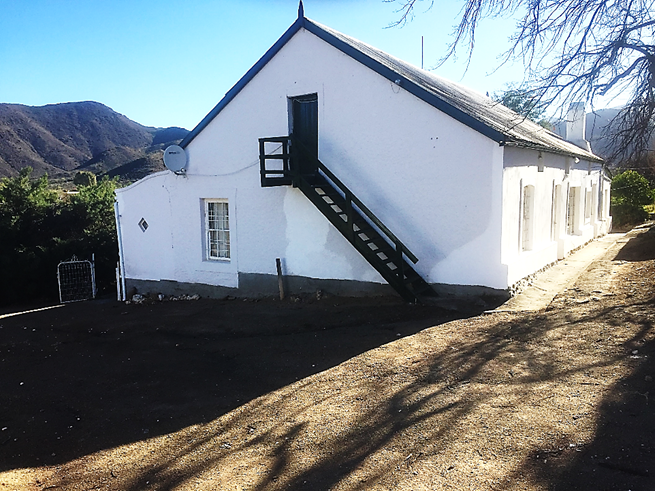
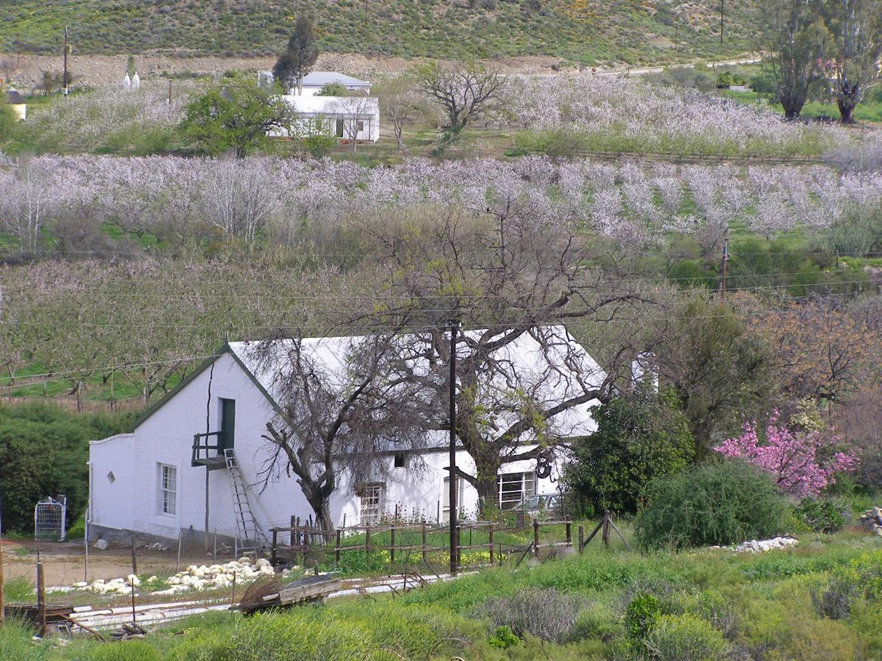
The original Kriel farmhouse at Mooi Erfenis
CHAPTER 18
Winds of change
In the 1960s British Prime Minister Harold McMillan, during a visit to the Cape parliament, said: “The winds of change are blowing over Southern Africa”, and today we know about everything that happened. Our farm itself has undergone great changes.
The era of white education here ended in 1965, but through years-long intervention by the Missionary Church and especially rev. Jan Carstens, a start was made with the construction of a proper Coloured school. He sacrificed a lot of time and energy to acquire the donation of land on Vloershoogte from D.G. de Kock, and funds and approval by Community Building and Administration. When everything was in order, Jannie Kriel flattened the terrain a bit and a tender to the value of R6 347 was awarded to A.J. Odendaal, who was also educated on the farm. J.F.D Kriel, with the aid of the ward’s Coloured people, transported all the sand and water, especially on Saturdays. The names of the principal helpers were written up and noted on top of the front door’s frame. On 18 January 1967 Master Jan Swanepoel and his family moved into their house and into the school, with 60 new pupils, a year after the white school with a mere seven closed down. (Master Swanepoel was from our ward.) Master and his wife had a rough time, because there were only four or five children who could distinguish an “A” from a “B”.
The inauguration took place on Saturday, 4 February 1967, in the presence of about 350 Coloured and 30 white people. Rev. J.D.A. Conradie, the fellow missionary minister, opened with reading scripture and a prayer of dedication, after which Rev. Jan Carstens welcomed everyone and thanked D.G. de Kock in particular for donating the piece of land.
To focus the attention of the Coloured audience, oom Dawid recalled a few interesting stories of the earlier generation of Coloureds and their share in the early development of the farm. Among others he recalled old Hendrik Hardloper, who one morning was sent over the mountain via the Patatsfontein footpath with a letter to oom Koos de Kock at Touw. He arrived back at the farm the evening, shortly before dusk, with his dog under his arm. Asked by his employer why he is carrying the dog, the guy retorted: “Boss, he collapsed of fatigue nearby at Dassieskloof and refused to get up again, so I had to carry him”. Hendrik covered close to 85km by foot on that day.
The piece on old Hottie Filander was even more interesting. A snake bit someone in the grass near the Tasse’s family house and after the wound was treated, his employer gave him a solid tod of witblits. Old Hottie, who stood and watched the affair play out, quietly rolled up his trousers and started dancing around in the long grass, hoping the snake would bite him too so that he could also get a toddy.
Then the principal of the high school, dr. Kellerman, addressed the gathering on behalf of the education institutions. Inspectors Dreyer and Terblanche’s messages of encouragement were followed by elder Soontjie Januarie, who urged the Coloureds to appreciate what has been done for them.
After J. Kriel also spoke a few words, Rev. Carstens gave a short thanks to everyone and continued to hand out snacks and 25 boxes of soft drinks.
A large void was now filled, because missionary services were held in our school up to 1950 and the whites attended it as regularly as our own services, but thereafter it was held in the author’s wagon house, while funeral services in wagon houses were held closer to the Coloured cemetery. Already with the first external service in the school, a wedding of a couple with older children took place, namely old Salmon Kiewiet and Jannetjie Swanepoel (Oumeid), while two couples, Sewes and Lenie van Wyk, and Maarman and Roos Swart, were the first parents to baptise.
Master, who could sing very beautifully himself, had the great task to teach the inexperienced group and had them sing often, because singing is in this people’s blood. His attempt bore fruit well enough that with year’s end in December he could hold a cute concert for the community.
After Master and his wife worked here for five years and adorned the school encampment with trees and rose gardens, he accepted a post in Kraaifontein and two white women stood in for the next three years, before Master Dawid Pekeur and his wife took over again. In collaboration with the author, Master Pekeur was given approval by Waterworks for a nominal fee for the construction of a rugby pitch and netball court on his property. In July they could participate in inter-school sport at Laatsrivier.
We must now continue to highlight the further developments mentioned at the start of the chapter. By the end of 1967 D.G. de Kock, Sr. bought the remainder of Pietersfontein from the four Tasse family members still living, but they retained a life right which ended in May 1977 when Alexander, the last surviving member, moved to the old age home. Oom D.G. sold the remainder of Katreintjie-se-land, full of thorn trees, to A.F. Kriel and in April 1968 Nuweland and Fonteinsdrif to A.J. Odendaal, who later also bought Hanniesplaas from J.A. de Kock. The consequence of this was that the remainder shrunk by about 80 hectares and was consolidated with Lot 1. The Kriel brothers of Grootland disbanded their years-long partnership in 1967, since Piet only had daughters and Alexander already had two sons who wanted to go into farming. Piet then began building on Non-se-land, where he still resides currently, but Alexander transferred to his sons and first moved to the farm and then to town in 1968. In 1977 the boys sold to Kriel Partners for R57 000. Dawid (Basie) moved out with the Waterworks when the state dam was completed. Frikkie Conradie sold Cedraskloof to Jan Roux and moved down to the farm and Jan Stemmet, now also deceased, moved from Fick’s place to his own on the other side. From April 1978 Kriel Partners took Patties under leasehold. Andries leased his place to Tys and began working as a manager at Ashton Canning. Martha Frikkie moved to Ashton as well and Martha Stemmet moved in with her children. The houses on the other side are all empty.
CHAPTER 19
Nature and important dates in my diary
Our beautiful farm, located below the Waboomsberg at the start of the Little Karoo, has grown accustomed to the periodic droughts, storms and freak events over the years, but damage due to hail is nearly unheard of.
Earlier we made mention of the storm over Groenland-se-hoogte which flushed away old Aunt Marie Jordaan’s wattle-and-daub hut prior to 1800.
The next famous storm happened on the afternoon of 9 March 1867, when the two daughters of Grootjie waiting anxiously at home (later oom Dries’ house) for the arrival of their first-born sons. The afternoon around four o’clock it became so dark that the lamps had to be lit up. The water flowed so strongly around the house that the men frequently popped out to see if they could make it through when the babies wanted to come, but my father and his cousin Stoffel van Zyl arrived safely in the world.
1888, on the other hand, was a very dry year ‒ to such a degree that hungry Coloureds walked around the veld to kill animals already near death for meat.
A furious storm in the mountains in December 1895 flushed away a line of vineyard of our almond trees, as well as farming land at Katreintjie-se-land and quite a number of horses and oxen along the river. The land then got overtaken by thorns so extensively, loads of silt got stuck here when floodwaters passed. When the people from Grootland bought it in 1968, the area got cleared and new vineyards were planted.
My older informants agreed that 1906 was the wettest year in memory, when molehills turned into springs for months on end, where children could imagine they played with dams. At the start of the 1920s I know it was so dry one year that only seven goat lambs were born!
During the drought and depression years of the 1930s, when the state provided work for unemployed white people, two new dams were built here ‒ the one at dear oom Dawid at Vloershoogte and one at Andries at Doornkloof-se-hoogte, and ours was enlarged thanks to a subsidy system.
One night in November 1942 the weather turned grey and humid, but without rain, so I was shocked the next morning when I visited the goat kraal. Nineteen goats lay bloated in the zinc shed, hit by lightning. We butchered a couple for the skins and took about six to Doornkloof for their Coloureds. However, the meat went off rather quickly.
On a Sunday in 1943 a cloudburst on top of Krakadouw flushed away two of Lewies Conradie’s milking cows. The one washed out at Doornkloof, but the other one made it to Otterbank. As previously mentioned, it was these waters that finally threw and kept the gates open all along the river.
In August 1950 Grootland, D.G. de Kock, J.F.D. en G.J. Kriel were connected on the 1800 telephone line, at rent of R16 per year, and it was no longer necessary to drive to Tweerivier to have access to a phone. We were grateful to oom Gielie Jordaan, who had to bring so many obituaries our way. Cedraskloof, Krakadouw and Doornkloof were connected a few years later and by 1966 every house, bar one, had a telephone.
1945 was an excellent year for rain, which produced a great harvest in 1946, but the new moon of October 1947 brought a destructive frost that hit our vineyards very hard. 1951 was bone dry, but a thunderstorm in the mountain in September completely flushed away the dam in Waterkloof and consequently we took the decision to construct a cement dam wall.
On 3 December 1951 the entire western Cape Province was hit by a destructive wind storm which blew out thousands of bags of grain, ruined fruit and grapes and to top it all off, damaged the church towers in Robertson and McGregor. The river farmers only managed a third of their usual vineyard harvests and 1952’s harvest was even worse due to drought that left the boreholes empty. Even December’s great rains could not save the harvest.
In April 1953 we received 44mm rain, but only the Doornkloof River came down. Against all expectations, the frost hit hard around 16 and 17 October, but the Koo’s fruits were hit even harder. Luckily we received good rains and a lot of snow on the mountain only eight days later, but again too little water landed in the river. The Keisie’s river managed to flow for a month.
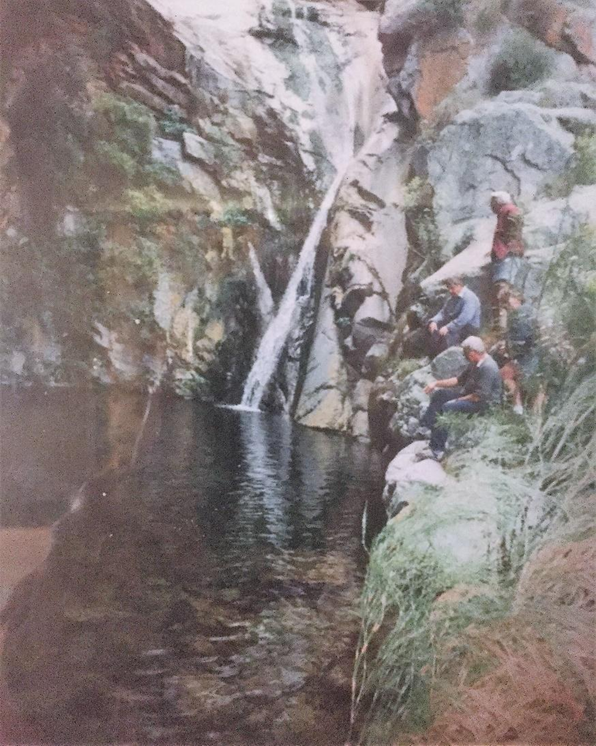
A natural source of water in Pietersfontein. The waterfall is located in the ravine from where Pietersfontein gets its permanent water and is a very popular place to visit for nature lovers.
On Friday, 30 October a hail storm came down at the top of Krakadouw, over Doornkloof, the Keisie and town, but the most damage was inflicted at Derdeheuwel. Our farm was spared. The damage due to frost and hail in our district was estimated to be R250 000.
The densest fog in the history of our farm occurred on 12 November.
In March 1954 a cloudburst over Groenland-se-hoogte brought 37mm down in 15 minutes, flushing away big chunks of the cemetery ravine as well as a lot of vineyard land into the river.
1954 was a great year for rain, so the farmers on the river could leach out their vineyards, because the river flowed uninterrupted for a year and by times cut us off from town. A lot of grain was winnowed next to the river.
1955 was truly a year of freakish nature, and it played out like this: on the evening of 31 May, lightning split the gigantic tall oak tree on the other side of the river, from its crown to its foot. At that moment I was almost below the tree, because I was on my way to close off the dam on the other side of it. After a relatively dry winter, October brought wind, bad weather and rainless cold. We luckily sidestepped the frost of the new moon on 16 October, but Keisie, Baden and Paddavlei had significant damage, but then we got hit hard on the night of 21 October, so that the frost-burnt shoots stunk for days. 25 October we were white from the frost, but no additional damage was inflicted.
The harvest of 1956 was very late. Even though it was only half of the normal harvest, I only transported the last batch of muscadel on 3 April, which was still white from being covered by frost earlier in the morning. At Doornkloof the harvest was only done by 12 April.
The evening of 11 October 1958 the first Russian satellite, launched on 3 October, was spotted by our domestic, Hannah Swart, and for a time it was quite charming to try and spot it at night.
In October 1958 the first jackal trial camp was started here.
In November the wind blew over quite a few young apricot trees, among others 90 trees in one vineyard alone belonging to Jannie Kriel.
Heavy frost hit on 29 October 1958 that destroyed a chunk of vineyard.
Census statistics for 1960 for the Pietersfontein bazaar ward was as follows:
| Whites (older than 10 years) | 33 Men and 29 Women |
| Coloureds | 51 Men and 42 Women |
| The numbers for 1970 were: | |
| Whites | 20 Men and 16 Women |
| Coloureds | 45 Men and 32 Women |
1960 was a particularly dry year, with only 87,1mm (abour 3,43”) falling. I had to start pumping in August already to get water to the vineyard, but at pressing time the sugar levels were good.
A vicious thunderstorm passed over the farm in the direction of Patatsfontein in November 1961, which flushed away a lot of arable land.
After a few normal years the farmers had a big fright in 1963 with the first invasion of the fruit piercing moth (“suigmot”), which destroyed peaches by the tonnes.
The morning of 17 July 1964 a sudden gust tore off the flatroof of the Boonsteland house (built in 1910) and dropped it on the riverbank.
A furious thunderstorm inflicted a lot of damage on 5 November 1964 and, among others, pushed over Kriekheuwel’s big rock wall.
1964 was, however, a good year for rain, and we had an early pressing season. Even though lightning flashed across the sky every night for a week, it didn’t rain at all during the pressing time.
After intervention by the Montagu Farmers’ Association, Serbie Mostert was nominated by our ward, Agter Keisieshoogte, to buy as many electricity points as possible, so that an Eskom line could be worthwhile. His attempts succeeded and on 22 December 1967 the electricity was switched on.
Our farm thoroughly felt the earthquake on 30 September 1969 that lay much of Tulbagh, Ceres and Wolseley’s buildings in ruin. However, we didn’t suffer any noteworthy damages, but actually benefitted, because our mountain stream was halfway stronger than normal for the next six months, despite the drought, before it gradually returned to normal flow.
1970 was much drier ‒ to such a degree that Jannie Kriel had to remove over half of his farm’s trees and Piet Kriel (Non) had to let his little spot lie fallow for 3 months and go work elsewhere. During pressing time a heavy thunderstorm pulled through the hills, completely flushing away Patatsfontein’s road, forcing Tys Conradie to take a detour around here with a harvested load of grapes to town.
1972 and 1973 were even more dismal, forcing Jannie Kriel to implement an irrigation system to make better use of the weakened boreholes. Our congregation held three prayer services in one summer.
November 1976 was all four seasons rolled into one: Stormy winter weather with snow, light hail and then on the 26th, frost; furthermore, hot, humid weather which caused serious downy mildew in the Boland which reared its head here after the 1977 pressing period. However, we hope and trust that our generally hot and dry climate will prevent the downy mildew from wreaking destructive havoc.
To conclude, here is a summary of the rainfall from 1958:
| 1958 | 11,93″ | 1959 | 9,24″ | 1960 | 3,43″ | 1961 | 10,83″ |
| 1963 | 10,26″ | 1964 | 10,52″ | 1965 | 7,8″ | 1966 | 3,88″ |
| 1967 | 7,25″ | 1968 | 5,98″ | 1969 | 5,92″ | 1970 | 5,86″ |
| 1971 | 2,04″ | 1972 | 4,36″ | 1973 | 3,94″ | 1974 | 10,90″ |
| 1975 | 7,4″ | 1976 | 8,21″ | 1977 | 10,09″ | 1978 | 5,36″. |
(Note: There were no numbers for the year 1962 in the original document.)
Damages due to frost and storms hit us hard in the past, but none of my informants know of any significant hail damage. I, myself, know of a little hail shower that crossed a narrow sliver of our ripened grain and which slightly damaged the last half a load of grapes in pressing time, while our neighbouring farms were hard hit at times by hail.
IN CONCLUSION
Dear reader, I think by now you realise why our old farm is so dear to us and why someone gave the distinguishing name of Mooi Erfenis (“Beautiful Heritage”) to her. That’s because up to the present day not one stranger, bar one Mr. Klopper for a year or two at Boonsteland, helped as owner to develop the farm. Since 1845 it has only been one family, of which the fifth and sixth generation of M.J. de Kock and H.B. de Kock (Triefeiszen) has begun farming. We know how difficult the early years were. Many were pushed out by subdivision, but those who remain live a good life.
We hope that this writing will serve as information and a jealous love to retain what is our own ‒ also for future generations. We know each others’ corns and faults and acknowledge each others’ real beacons and know precisely where Lensieland, Meul-se-land, Skelmnek, Roubrood-se-drif or Moedverloor are situated. All places that were christened by our ancestors.
We dedicate the peaceful guardianship over our farm in the future to the Pharaoh mummy landscape lying on its back on the horizon of Grootsaal and has up to now so faithfully held the watch.
The pharaoh mummy: from right to left, on the horizon is its forehead, nose, chin, chest and at the bottom left its toe.
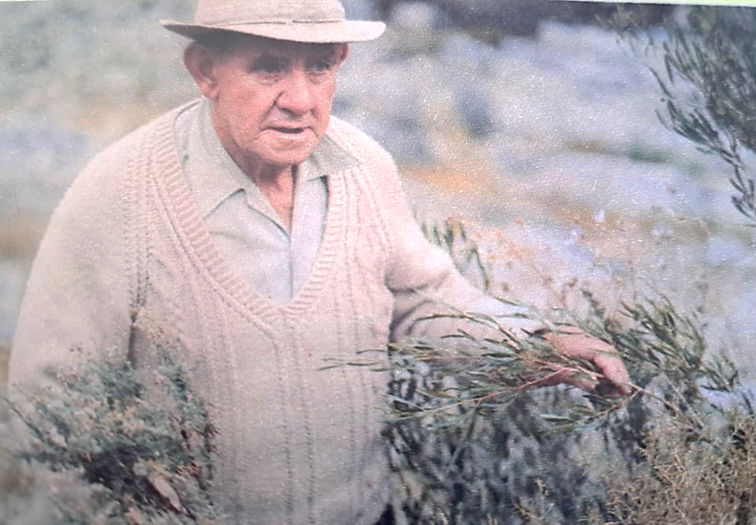
J.F.D., thank you that you took the time to write your story down so that people can enjoy another world.
Rudi Allmayer, 2023
Contributions: Irma Jordaan, Elmarie Kriel, Kobus Smit, Sarie van Wyk, and Ernie Oosthuizen
