
151.(Part 2) The Pietersfontein Chronicles Part 2 of 3 (English)


The Afrikaans version of this story has already been posted. Please see Part 2 of story number 72 by using the link below
https://montagumuseum.co.za/montagu-stories/pietersfontein-deel-2-van-3/
Covers Chapters 4 to 9
Pietersfontein Chronicles continued
CHAPTER 4
Ostrich farming
During this time the ostrich farming started playing an increasingly important role, but since alfalfa was still being cultivated on a small scale, aloe leaves were carved up as supplementary feed for breeding birds. The first alfalfa was brought to the farm in the early 1880s by Oupa Kriel. The alfalfa seed was sown in Patatsfontein’s seed bed, where the little plants were carefully extracted and replanted in tidy rows here at the rock wall, so it could be hoed. It is a pity that we couldn’t determine the prices per one hundred plants. The Tasse family planted the second acre of alfalfa below Trappieswal and this was only plowed out at the start of 1960. The first sowed alfalfa was sown on the hill on the far side of Lensieland, where it was plowed out in 1950 and later replaced again. The first alfalfa was cut solely by hand and when it dried out, was bound in sheaves and stored. The first alfalfa cutting machine used and pulled by horses was an Osborne brought here in 1913.
Talking about ostriches ‒ at the time, during the breeding season of the ostriches, one had to tread carefully for an angry male ostrich who can jump out from behind a bush! You had to ensure you won the race to the nearest tree or wire fence, if you wanted to sidestep its dangerous toe. One time dad’s difficult old female ostrich trampled over brother Alewyn, then still a young school boy, and sat on him! Luckily oom Maarman was there in a second to drive the old female away.
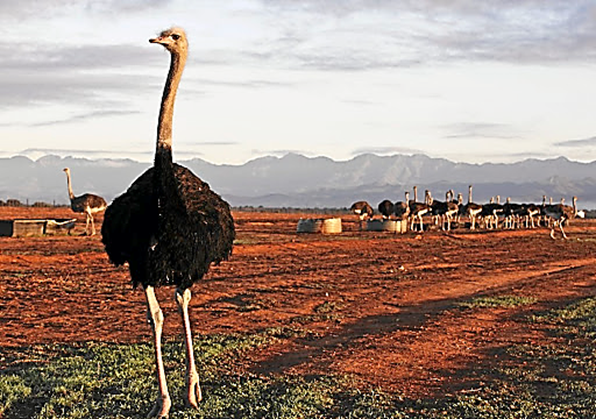
At the time the Jewish traders crisscrossed our district with their horses and carts on the lookout for ostrich feathers. The children bartered the feathers they picked up and collected in the grazing camps, especially where a couple of males battled it out. The farmers made good money from the feathers, but suffered greatly as well after the collapse of the feather price in 1918. Afterwards grape vines got a big push. At Krakadouw’s highland, where oom Johannes Conradie put up an encampment fence between him and oom Giel for his ostriches, we still have evidence that the old scabby toe of the ostrich could clear out a piece of land. After nearly 60 years the barren, naked rock tracks are still visible on both sides of the fence, with a line of bushes below the fence or where the fence used to stand. Today it is one of our farm’s points of interest I like to show to visitors.
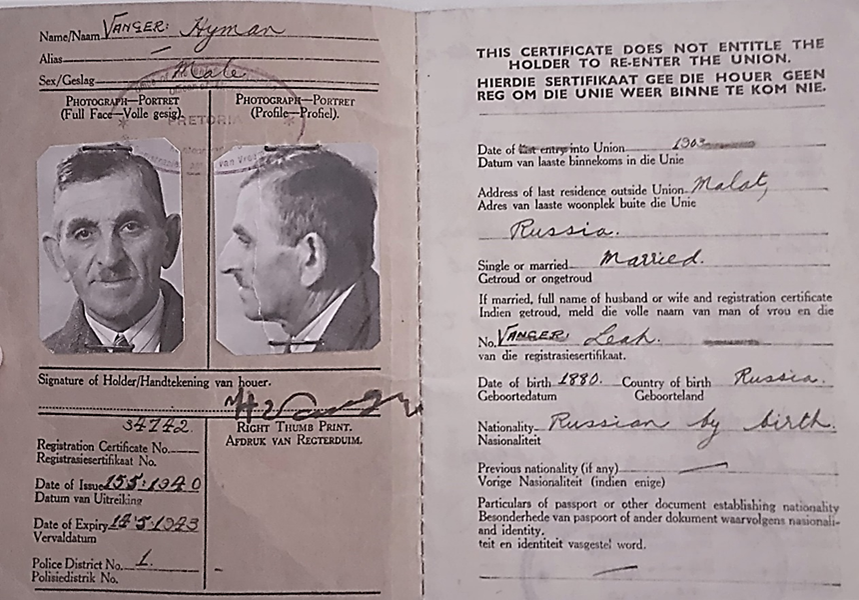
Just one more ostrich story ‒ no, wait, two more! The farmers made use of three or four Jewish-traders, of which the best known was called Vanger (“Catcher”) and who always showed up at plucking time to get some feathers, they simply tendered on a piece of paper for a bundle of feathers, and it was an experience to see how one attempted to see his competitor’s price and then be all nervous. Everyone badly wanted the bundle, but were terrified that they would tender a lot more or just above their opponent’s price.
One morning a male ostrich made a farmer from Derdeheuwel climb a tree very quickly and then kept an eye on him so that he couldn’t climb down, and no one could hear him shouting for help ‒ but a farmer makes a plan when hunger begins to set in. The man took a good look at the tree and then noticed a narrow-forked low branch. He then pretended to climb down and when the ostrich pecked at him, the old man grabbed the ostrich’s head and pulled it through the branch’s fork. The bird was stuck. The farmer climbed down and went to find something to eat before he came back to free the bird, but alas, the bird was dead and the farmer made biltong from the unfortunate ostrich. The farmers usually made use of a thorn branch as a weapon of self-defense to enter the bird’s breeding camp.
Isn’t it funny how memories of your youth remain with you? When I think of the era of the ostrich today, the first thought that comes to mind is how we had to lubricate our hands with ostrich fat ‒ yellow and thin like chicken fat, when we collected green figs in the month of November, to neutralise the itching of the fig milk. (The farmers always used the green fig money, normally 50 cent or less per sack to pay the harvesting workers.)
CHAPTER 5
Tobacco farming at Pietersfontein
To do justice to our now-defunct tobacco industry, I feel it is only correct to not leave it with a few remarks on tobacco at the beginning of the book, but more has to be said about the entire process until the roll lands on the transport wagon or at the shops.
Since tobacco is very sensitive to frost, the very fine seeds are mixed with sand and sown in beds in August, covered with thorn branches against frost and are further nurtured with fertiliser and anti-snail spray, until it is ready to be planted out in thick ground fertilised by goat droppings at the end of October.
If nature played along, the plants can grow up to about 1.8m (6 feet) high, but as soon as it is fully grown, the small shoots appear behind the leaves and must be picked off regularly. It is this work that is especially tough for the non-smoker, because the tobacco smell on a hot day makes him sick. The other issue is the snails who eat holes in the leaves; they had to be killed by hand, because the farmers did not want to use spray at this late stage.
When the tobacco flowers have fully bloomed, they are cut off, bar a few which are left-on for seed production. Just as the seed pods begin breaking open, the flower pods are covered with a little bag, so that the fine seeds can’t fall out and be lost. When the tobacco is ready for cutting ‒ it becomes slightly yellow with little lumps on the leaf ‒ it is cut off on a hot day with a curved bladed vine knife and placed carefully in rows. When the leaves are properly wilted, it is carried to the tobacco scaffolding. The Tasse family had theirs under a very big pear tree, reminiscent of the original tenants, while the others had theirs in their attics running over the rooster beams, where it was tied in pairs with pressed string-mat rope across wooden spars or beams to dry out. Then the drying of the leaves and the pressing could then be concluded.
After pressing-time when the tobacco leaves are dry it is sprayed with water or, for those hanging outside, taken off after the rain, and the flower pods are picked off. The lye ash produced by burning various salsola aphylla ( saltbush, lye ganna or gannabos) together, is now added to a big pot of water and boiled until it becomes a strong lye extract which is removed carefully from the sediment. A bunch with powdery mildew and torn-up tobacco leaves are now added to the water pot and are boiled with the clean lye water until it becomes a dark brown extract, enough to make a piece of tobacco wet. The picked leaves are dunked in the hot caustic tobacco water with both hands and packed in the tobacco tub to sweat. The next day they are taken out again and thrown in heaps on the rock floor lubricated with cattle manure to aerate. After about half a day in the sun, it is carried back and stomped on in the tub. The next day the aeration process is repeated, but, on the third day the heaps are thinly scattered and the yard animals have to be kept away to prevent pollution. After a while in the sun and testing with the sensitive hand and nose of a tobacco expert, it is picked up again and stomped on in the tub. After this a lot of tobacco crumbs are left behind, which are gathered by the farm labourers and sneaky-smokers for chewing-tobacco or smoking tobacco. The first few whiffs on a reed pipe stuffed with chewing-tobacco have made many a schoolboy hallucinate before he bent over from nausea.
My one brother sneakily began smoking as a schoolboy and when my mother discovered his hidden pipe one day, she had a bunch of chewing-tobacco bought, took him to the outbuilding and forced him to smoke as the blows came down. After a while he was so drunk and miserable from the smoking and being disciplined, my mom left him alone in the hope that he would stay true to his promise to néver smoke again. The temptation was however too strong and when he forgot about the nausea, he made himself a new pipe to puff on.
After two or three scatterings and depending on the weather, the leaves were stomped in the tub one last time and covered to prevent further drying out. The tobacco twister’s assistant then begins to sort the leaves and it is placed next to the twister. Those with holes are merely pulled straight, but the good-looking leaves are neatly ironed open and flat by the hand on the knee and hung over the back of the chair the twister is sitting on. The crumpled leaves, which determines the thickness of the tobacco string, are neatly wrapped up in the smooth leaves. Tobacco twisting is a fine art and one must guard against leaving too many lumps in twisting the string of tobacco, because then it looks like a snake that swallowed a couple of mice. Just as an aside, oom Dries used a very old stink-wood chair of which the uppermost crossbar was worn hollow at the point where the tobacco string was pulled through over the years. The chair is still in use by his granddaughter and we hope to one day see it in the Montagu Museum.
If the pile of tobacco grows too high, tobacco rolls are made, of which the heads are pinned with bamboo pins and the rolls are ready for the transport wagon to the Roggeveld, or it was simply taken to town in the little cart chest. The older folk back-then gave their bosses special orders to bring home some of Pietersfontein’s peach-soup-tobacco, because its taste lingered longer in the cheek than the Heidelberg tobacco.
Mr. Abramowitz local general dealer in Montagu was the biggest buyer of tobacco. The prices ranged from 9 to 10 cent per pound and was sold at 2½ cent per bundle. On the road it was frequently bartered ‒ a roll of tobacco for something from the butcher.
Like with so many things in the circle of life, tobacco farming on our farm also came to an end in the 1950s, with oom Jan de Kock at Kriekheuwel as the last grower, just like with the oranges in the 1950s and nuts in the late 1960s. As I write this there are only eight pecan nut trees left on the entire farm.
CHAPTER 6
Harvest time at Pietersfontein in the early 1920s
The Great Giver let the winter rains fall early and my dad could sow his wheat at the end of May and June, after the land was properly watered first by flood irrigation via two aqueducts, it looked like the water was pouring through a sieve. At the time the farmers believed that even if it rained 100mm in one big downpour, you still had to wet your sow land, so that the wheat could hold out until the water reaches the pipe, before the aqueduct is started up again for one or two more irrigations.
The wheat is swaying gracefully, but when it starts to flower, the worst cat’s ears, wild oats and mustard still have to be properly weeded. For this work we children who assisted were properly compensated at 2½c or 3c per afternoon. Goodness, for that amount one could have bought six long sweets at oom Kotie de Kock’s little shop at Kriekheuwel, where mom’s chicken eggs were also regularly bartered for a sharply twisted paper bag filled with “ghoemela” lumps.
Ghoemala (or Ghomala) is an old Cape sweet, especially known among older generations in the Western Cape.
What is it?
It is like a sticky caramel/fudge-like candy
Made from sugar, syrup (or molasses), sometimes butter
Is pulled out and folded as it cools, which makes it lighter in color and sticky
Finally it is broken or cut into pieces
How does it taste?
Sweet and slightly burnt
Chewy, you chew it for a long time
Many people remember it as something that sticks to the teeth
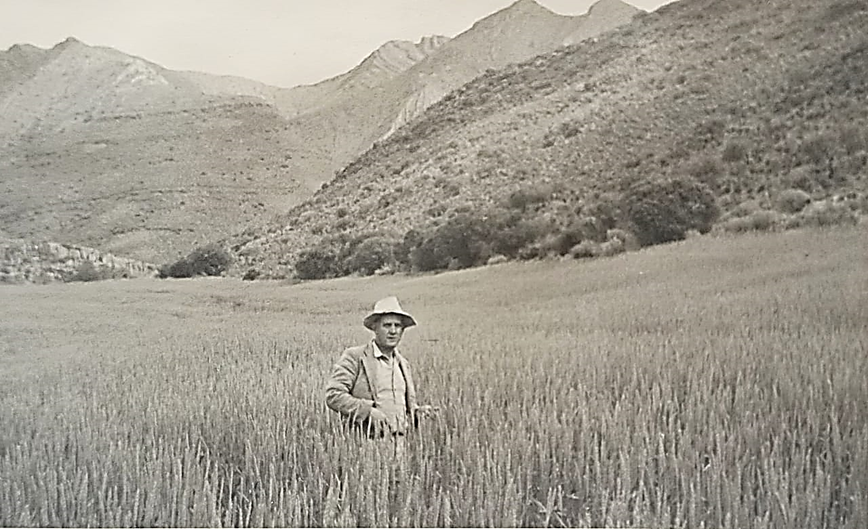
J.F.D. in the wheat fields, 1955
November arrived and our farm looked like a patchwork blanket with its various colour shades, from the green vineyard, garden and trees to the ripe wheat, which swayed serenely in the rays of the setting sun.
One morning around mid-November my dad gave the orders that Kareebos-se-land’s wheat needed to be patched, in other words, the ripe parts had to be cut out, because labour was scarce and we couldn’t wait for the entire field to ripen. My brother fetched his little wooden sickle from where he stored it the previous year and fastened it to his belt to carry it to the harvest land. Now his hands were free and the sickle could not cut his belt. Oom’s Maarman, Booi and Ruiter merely hooked their sickles around their necks and the men walked ‒ not drove ‒ to the harvest land with sickles, a water calabash and a wine calabash to keep dry throats hydrated and cool down a bit in the hot sun.
Maarman and Ruiter cleared out the centre of the acre, while Booi and my brother worked from the sides of the acre. The sun beetles buzzed, but the sickles moved rhythmically through the dry wheat and the cutters left two rows of small heaps in their wake. “Clear out the centre, let it run to the right, the left comes naturally”, it could be heard from the team when they got in the groove of things. Early tomorrow morning as the dawn breaks, these heaps must be merged into bigger heaps by the cutters and then tied by a binder with a handful of green stems or dry long wheat bands splashed wet to make a sheaf. The art of making a good-looking, tight sheaf with a band that doesn’t untwist itself can’t be done by everybody. The handful of a band is taken, the ear side is stomped flat, then divided into two, the right hand’s straw is then taken over the left hand and pressed tightly with the left thumb. The right hand unclenches and takes the crossed ears from below and the hands move simultaneously to twist the ear sides around in one go. With the twisted ear side in his left hand, the man stands to the right (if he is right handed) of the sheaf, with his face to the stubble side, puts on the band with both hands around the sheaf, brings together the two stubble sides below the sheaf with the left hand, twists the sheaf, and takes the two stubble sides a little further away from the band so that the band can be tight when the two hands go past each other to pull it tighter. It is best to give the sheaf a bump with the left knee at the same moment you are pulling. Push the band in the right hand through below the left hand. The left hand pinches the band, the right hand lets go and then takes its band over the left hand again and together the two hands twist the bands one more time. The left hand takes a hold of the roll again and the right hand gives the roll one or two twists and ‒ if done correctly, the roll doesn’t untwist itself, but if it does, the guys will quickly let you know about it. If long enough wheat or rye straws were not available to produce a band, string-mat rope could also be used, after it was stomped.
It was quite possible that in the early binding process one could tie a Cape coral snake (“nagslang”) or a puff adder into the sheaf. One morning Maarman suddenly grasped the tip of his trousers’ pocket and yelled: “Boss! Snake – cut if off!” My brother didn’t simply want to cut, but took off the guy’s suspenders and with the snake still tightly gripped, they got him out of his pants and tossed it to the side. No snake slithered from the pants, and at closer investigation it emerged that it was a sack of prune chew that dropped through a hole in his pocket and slid down his leg. Maarman was dripping from the sweat, but utterly relieved and unfazed by the others teasing him, joining in the laughter.
To pass the test of a quick sheaf binder, a binder gets the chance to take the band in his hand the right way and must bind the sheaf in the time it takes someone to throw their hat in the air and before the hat lands on the ground.
Oh my! The first morning after a day like this, bending down on the harvest land, a man’s body feels finished, because you had to stoop and bend in all directions. It frequently happened that the team could only harvest in the morning and in the afternoon had to hoe the irrigated vineyard. After 14 days the wheat fields were done being cleared and binded into sheaves. It was just a pleasure to wake the farm folk on a couple of mornings before four o’clock to go carry the sheaves into a heap, because when the sun gets hot, the ears start popping out too much. When we walked through the poplar grove, the rooster already announced on the yard the day was about to break, and the red-chested cuckoo (“Piet-my-vrou”) and his partner, in unison with the turtle dove and Cape sparrows (“mossies”), made their songs count as well. Now that is life on a farm!
After the sheaves were brought together in a heap, the wagon and rigs were prepared, because Fouche’s wheat makes a mess if you don’t attend to it early. The wagon gets sticks at the front and at the back which fits in the ring claws of the box styles, orphan tree branches are attached length-wise to the top ends of the sheaves with an ox-strap, as well as two wooden side panels to attach on both sides of the cargo, because a bulging wheat sheaf is a slippery thing on a bumpy road. When a couple of sheaves fall off, you quickly hear a shout from behind “The mare has foaled!”, followed by “Is it a small one or a big one?” from the front. On the fields the wooden panels are attached to the back of the wagon with the orphan tree straps (keurbbom) and we children using it as a riding horse from the one heap of sheaves to the next.
When the wagon arrives at the threshing floor, the sheaves are pulled down in a circular pattern with a six-piece whip or an ox-strap and the packing of the stack begins. Dear heavens! When the first cargo was unloaded, I got the bitter orders to keep watch and keep the chickens and yard animals away from the stack. When the stack reaches the height of a man, I could rejoin the others.
With the sheaves in a stack and a couple of corrugated iron sheets, cowhides and striped bags on hand for cover in case rain fell, we first finished hoeing the vineyard and then redundant labourers are dismissed to go help harvest with a sickle in the backfield for 25c per day and food from our house.
Then the orders would come from my dad to my brother: “You must get the floor ready today so we can start stomping.” The circular stomping floor’s surface is cleaned, while a couple of men closed off the floor walls with wire mesh. A small stream of water is directed to the manure dam next to the floor and everyone who can carry a bucket of water, are ordered to wet the floor surface in the late afternoon ‒ usually a Friday afternoon, so that the children are free on Saturday morning to help the goats stomp the wet floor. I also invited some of my classmates to come and help chase the goats.
The herd of goats are chased to the floor quite early; the gate at the front is closed and what follows is a cacophony of screaming, rattling tins and whips cracking and sjamboks cutting through aloe leaves. At this point the herdsman must say which of the old goat ewes are the meanest and identifies it by the whiplash. The first 30 minutes or so the herd moves in a nice circular fashion, but later a rebellious old ewe only blinks as she makes a u-turn and bumps you into the ground if you are in her way, to get behind those chasing from behind so she can rest until the rest of the herd completes their round. The circular movement continues until the floor was relatively dry and the thousand tracks stepped into the clay at the start have been flattened and polished. It could also happen that the floor got too much water and the surface struggled to get polished from getting stepped on, and then the goats are chased off to go graze for about an hour giving it time to dry.. They are then brought back to polish their tracks.
When the process is completed, the cattle manure gathered over the previous couple of days, is brought closer and the floor is neatly lubricated with brooms dunked in liquefied manure, which has quite a pleasant smell. Now the floor is left alone for about a day to properly dry out, otherwise the wheat grains get stuck on the surface. When the floor has sufficiently dried out, the sheaves are thrown on the floor in the morning and laid down, in other words, thrown in rows in a circular fashion, until the floor is completely covered ‒ about 400 wheat sheaves. Afterwards the bands are cut with knives and the sheaves are shaken loose with pitchforks. The horses and mules are linked in packs of two or three next to each other, with the tamest one on the inside. The packs are led in and the circling begins, with the men holding the straps. The first half an hour it is usually a struggle to get the packs to properly jog behind each other, because they easily start in random directions or bump into each other, especially if there is a young horse in the pack. The exercise has to be paused and the packs uncoupled to get them back in their proper order. After about an hour of stomping, a couple of men with wooden pitchforks come and turn over the straw and properly shake it loose and then the stomping in circles continues. At one point the lumps get stomped off the bands and the children are tasked to run behind the horses and remove the lumps so that the horses don’t unnecessarily step on it. When the sheaves are properly dry, the stomping is usually completed by eleven o’clock and the horses are tired and sun-burnt, to not even speak of the person at the centre who has to hold the stomping straps and continuously drive the animals in the hot sun.
Now the slider, rakes, pitchforks and brooms are brought closer and the finely stomped wheat is pushed in one heap in an east-west direction, because our stomping wind usually blows from the south this time of year. Usually at noon the adults have lunch and take a rest, and it is the school children’s job to take turns to keep the chickens, birds and other yard animals away from the floor. After nap-time is over, or if the wind has picked up nicely during nap-time, the winnowing begins, because you never know how long the wind will blow. When the wind is pushing along nicely, three or four throwers tackle the heap with pitchforks and forks with a wooden pan attached and you only see chaff fly through the air. The band lumps and horse manure are removed from the wheat heap by hand or raked off the heap with the loose straw and ears with a cap-rake, with its bamboo tangs sitting closer together than a manure-rake. It could easily happen that a stomped mix lays on the floor for three days or longer due to a lack of wind. The idle time is then used to make a little windmill and it is placed on a pole so it can indicate when the wind is blowing in the right direction.
After the wheat is winnowed, it is not clean enough to sell, and will first be thrown in sacks and packed in a stack next to the floor, because the chaff must still be stored in the rondavel chaff cage next to the floor and the floor must still be lubricated for tomorrow’s stomping if everything goes well. Should unexpected rain arrive and half the stack can’t be covered in time, the stomping is delayed for quite a while, because now all the wet sheaves must stand on the floor on their stubble side to dry out. After the wheat stack has gone through four or five stompings, the floor is properly lubricated again and now the half-filled wheat sacks are shaken out two at a time on a heap and one or two men have to use pans to throw the wheat against the wind to extract the last few straws and horse manure. The heap is frequently swept clean with a winnowing-fan (a long-stemmed flat broom made of shrubs). The flat broom removes all the impurities from the heap, which are lightly raked to the sides with the cap-rake, so that as little as possible wheat grains are raked away. When the four or five sacks have been winnowed thoroughly, the heap of wheat is weighed again, and three bushels leveled with the slider, a sack works out to a weight of two hundred pounds-90kgs. (A sharply piled heap of wheat, with a circumference of ten feet, will produce ten 100lb-45kg sacks.)
Next, our 20 sacks of trading wheat for bread and seed are tied with thorn bark (the bark of young thorn trees or stomped-off string mat rope was used for tying sacks, because it served the purpose just as well as sisal rope, which certainly wasn’t readily available in our vicinity) and carried up to the attic. From there it will be carried down one for one, when necessary, to the horse cart or wagon to get milled in town. The flour is carried up again tonight – it builds muscles! Everything over 20 sacks is sold.
The barley is stomped in the same way, except when straw is stomped for mattress stuffing. Then, starting from the centre of the floor, the sheaves are laid down in a circle, the stubble side of the one sheaf touching the ear of the next, up to the rock rims. The barley bands are cut and pulled out to lay on top, then the sheaves are sprayed wet in the evening so that the straw can get clammy through the night. The ears remain dry, because it lays below the stubble side and are not shaken loose. Early at dawn tomorrow the horses must be fed, because they must start moving before the sun moves up high. The horses turn against the stubble side and that way stomp off the straw from the dry ears. After half an hour of stomping, the pitchforks are brought in and the loose straws are extracted. (It is among these straw stacks where the farm’s young men eagerly went to sleep on hot evenings and got up to so much mischief.) When enough straw was extracted, the rest is winnowed, worked into a heap, and like the wheat, cleared by tossing it up in the air. If the wind remains absent, we whistle to get the wind’s attention and an eye is kept on the windmill.
Early morning already my mother had the straw in the mattresses shaken out and the mattress slips washed and hung up to dry. In the afternoon around five o’clock the stuffing has to happen, because the openings where the straw was shaken out and stuffed in again must be sewn up. When a mattress is overstuffed, it keeps the light sleeper awake at night. A couple of sacks filled to the brim with fragrant straw is stored for a later time when the mattresses need some new stuffing.
In the days of horse carts as mode of transport and thatched roof houses, rye was an essential grain crop, because no other grain crop could give a pack of animals the same stamina on the long road than rye for kernel feed. Additionally, rye straw was an indispensable house-covering material before zinc was commonly used, and moor reed (“heiriet”) from Albertinia was too far to fetch. Pietersfontein’s five oldest houses were covered with rye straw.
When a house’s roof needed straw, the rye sheaves were whipped up as follows. The floor is lubricated. Two heaps of 20 to 30 rye sheaves each are tightly fixed with ox straps. The bundles are set up as far as possible from each other as the wagon’s fall ladders or other long boards can reach. Now the fall ladders are fixed above the rye heaps and forms the whipping bench. At the one side of the bench a rake with thick pens is fastened securely and the preparations are done. A couple of rye sheaves are thrown down on the floor. Two or three men, as many as can fit behind the bench, each takes a sheaf, unties the band, takes a good double hand full of straw out of the sheaf, stomps the ears flat on the ground with light bumps, take the other side and pulls the stubble side through the rake to comb out the leaves off the straw. Now firmly take the stubble side and flatten the fat ears on the bench. When the ears’ grains are all removed, the straws are carefully put down and later tied up in straw bushels and are ready for use on a thatched roof. The combed-out straw crumbs are then stomped and winnowed like the other grain types. It is a big mess when a floor is left with all the leftovers and a thunderstorm hits, but having a farmer’s blood in your veins just makes you tough it out.
The first Ransom threshing machines with a fire engine for steam production arrived here during the Anglo Boer War,(1899-1902) because the farmers’ animals were commandeered to such an extent that they didn’t have sufficient pulling animals. Around 1920 another Ransom thresher arrived here, but it was only after the introduction of the metal machines from the mid 1930s that our farm frequently got to use a machine if the farm’s harvest amounted to 50 to 60 sacks. The first and only self-binder cutting machine was only bought by G. and J. Kriel in 1945. The first winnowing machine was only bought by my father in 1929 and is still in use today. It greatly facilitated the final clearing of the grain. Today the trees and vineyards have taken over the sowing lands to such an extent that it only makes sense to sow in good rain years, and then only fodder crops.
POSTSCRIPT:
Oom Gertjie de Kock of our farm said that, due to a shortage of bread in the Anglo Boer War, he knocked out his first couple of wheat sheaves with a flail, or, like he called it, “the mare with the foal”, and carried the wheat container about 4,8km (three miles) to Groenland’s water mill to have it milled.
CHAPTER 7
Fruit farming
Two other main products dating from even before the ostrich and tobacco eras, were pitted oranges and peaches which were dried. The oranges and a couple of naartjies and even peaches were sold to hawkers at 20c to 25c per paraffin case, who then distributed it. In town the oranges were sold on the square for 10c to 15c per 100. My father and oom Dries even grew navel oranges in the late 1920s, but root cancer and weak prices also halted this offshoot in the late 1930s. I just want to mention that in the early 1930s one Mr. Rabinowitz of Paarl came to load our orange harvest for export. Root cancer later wiped out nut and orange farming and Alberta peaches became more common, because one Mr. Jones of Paarl paid 25c per case for canning. (Prior to Alberta’s, the yellow apricot peach and white pavia peaches were the common peach for drying.)
Walnuts and almonds, as well as a couple of Cape chestnuts (“eetkastaiings”), were also among the first trees planted here by Kok and Pieterse, because when oom Grootjie arrived here in 1844, the Tasse’s couple of old trees had been harvested quite a few times. During the war years in the early 1940s, the nuts provided a good income ‒ at 37½c per 500 gram.
As a schoolboy I climbed through the nut trees to pick the nuts left after the harvest and so earned my savings. I was bursting with pride in 1925 when I could get on the horse cart to town to invest my first £5 (R10) at the Post Office. I wonder how many times on the road I had to check my pockets to be sure the money was still there. I got a mere 5c per 500g.
Allow me a little “nut” anecdote! Cleaning walnuts turns especially one’s index fingers pitch black and no chemical substance could remove it ‒ it had to come off by itself. One day an oom with a white beard decided he wanted to dye his beard pitch black and tackled his beard with green walnut shells, but ‒ oh dear! ‒ he succeeded in turning his white beard green, not black!
In 1945 oom David made £354 from nuts and peaches on the 3 /4 morgan (6500 sqm), 30-feet (10m) wide Onderste Tuin, where the biggest nut trees in the Cape Province grew. When nut farming ceased to be profitable, due to codling moths and weak bearing, the just-married Nico Kriel of Derdeheuwel cut down the tree and had it sawed for furniture.
Oom Lang Sarel sitting 2nd from the right
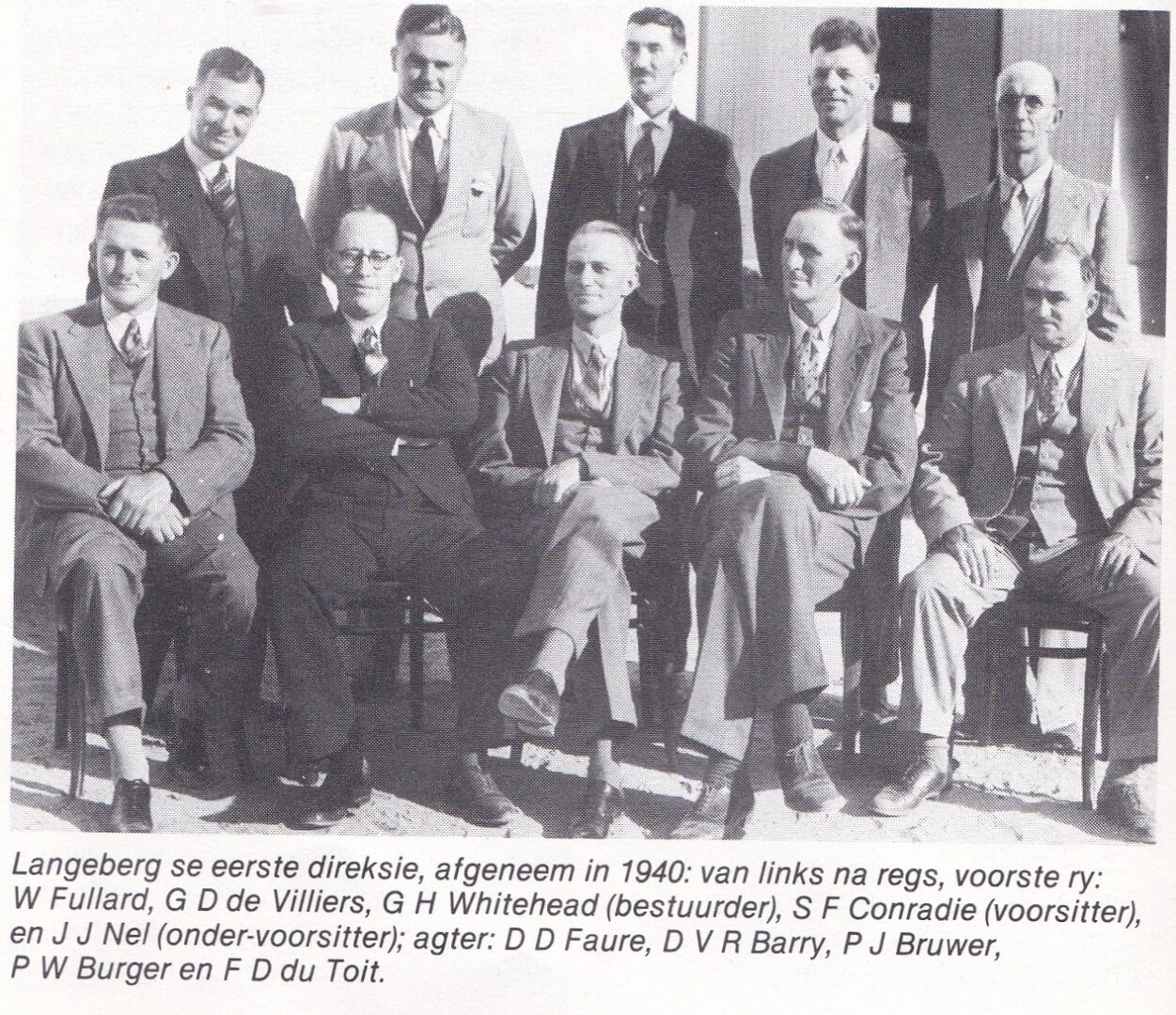
The big progress with soft fruit farming came with the establishment of the Cooperative Langeberg Factory in 1939. On 1 July 1940 the first sod was dug and the first canned fruit tinned rolled off the conveyor belt in December of the same year. Pietersfontein’s ripe Cape Figs (“bruinvy”) were among these canned tins. The famous Kakamas peach, discovered by one Mr. Collins, a teacher, quickly spread here and in the 1950s completely pushed out nut farming. Mr. Pierre Marais was the first guidance official to demonstrate how to prune trees. In the early years of the factory we also cultivated quite a lot of gooseberries (“appelliefies”) and will try again next year, as I write this. As an aside, I just want to mention that the man who started the rollout of the factory plan was oom Sarel Conradie, widely known as oom “Lang Sarel”, who was the namesake of an early clingstone variety. He was an avid tree cultivator. The oom went on holiday to the seaside and one night dreamt of a big, white building with a long, smoking chimney and women clothed in white walking around the building. The dream was oom Sarel’s motivation and the building from the dream arose two years later, with Mr. George Whitehead as manager. The events were fittingly summed up in a little poem of the first work manager, Mr. Daantjie Viljoen, loosely translated here:
One year oom Sarel went to the sea
and Aunt Sarah also went with him.
Lazily on the beach, next to the sea
the two lay, with their heads in their hands.
The old man then began dreaming –
He said it himself and didn’t hesitate.
His mind’s eye looked far again
and clearly the sleepiness evaporated.
The vision was a building with a long chimney
and then oom Sarel knew what everything meant.
A fruit factory must now be opened in Ashton
They looked for a man who was young but also clever.
The news is spread and shares are sold
The factory was built and named LKB.
The farmers kept planting and the industry grew
Sometimes a little collusion is needed here and there.
Workers are recruited and they move this side
Homes are built, many loans are taken out
oom Sarel also contributed his bit –
but keep it quiet – maybe it makes him mad.
The area is dusty and the water is scarce
But the bigwigs maintain they know what they’re doing.
Some of us are also deeply in debt
But old man George only asks for time and patience.
L is for “Langeberg”, but we are not scared
K is for “Koöperasie” – it sometimes gives us the jitters
B is for “Beperk”, the hours are long and the work is a lot.
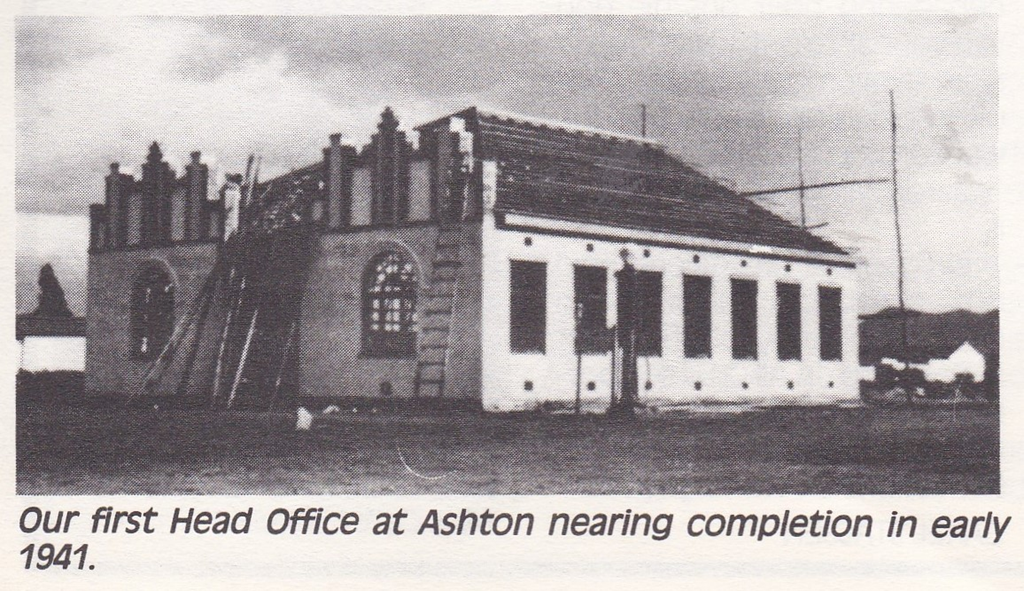
Langeberg Canning Factory was followed by Brinks Factory and later Ashton Canning, and so far things are going well for us fruit farmers. (Just like oom Sarel, some farmers also produced something out of poplar wood and sold it to LKB as the first fruit cases). oom Sarel made a fortune out of his tree cultivation and the selling of Conradiedorp(Ashton) plots.
Droughts and Water
Droughts, which since the Creation probably had its cycle, now hitting here, then hitting there, especially hit hard the farmers next to the river. So much so that they had to dig sand holes in the river bed for drinking water. Grootland’s residents transported their drinking water from the farm with a half-file in the belly of their horse cart. Their cows exclusively survived on sweet-thorn tree mistletoe (voelent), which their owner managed to cut off with a ladder and a claw. Chaff was transported from town at 30c per sack. The good-looking muscadel vineyard was so barren one year, my nephews merely pressed the bunch of berries by hand. Two rows were enough to dump a filled hat’s worth in a basket. In those years of the late 1920s quite a few of the younger farmers, among others oom Dawid, A.F. & P.J. Kriel and Stoffel de Kock, built a road for the Divisional Council to earn money for taxes and a living. They were paid with tin money, submitted to the office in exchange for hard cash.
The farmers did not lose faith in looking up at the sky for rains, but when Paul la Grange brought a drilling machine here in 1938, all the farmers next to the river and oom Dries on the farm had holes drilled to help them through times of crisis. If this deliverance didn’t occur, the lowest two rows of the Hannies’ muscadel vineyard (now belonging to Odendaal), already planted in 1895, would not have been able to still produce so well today. The amount of drilling holes obviously increased later and the water levels decreased, to such a degree that today it is futile to dig a sand hole and the gorgeous sweet-thorn trees died off in their numbers. Here on the farm itself the source water sometimes threatened to come to a halt in the long ground furrows full of scrape marks. The turn sluice for the eastern and western farmers was at the upper side of Boonsteland’s muscadel vineyard (once at the sluice a fellow wanted to hit my brother Alewyn with a shovel when he attempted to dam the water), from where it was directed with a long, twisty ground furrow and with three corrugated iron gutters over ravines to reach our dam two kilometers away. At the time our turn started at six o’clock in the evening and in summer the water only arrived in our dam by the next morning at five o’clock. (It was under one of the gutters where the farm’s young men regularly took a shower on Sunday mornings, by blocking the gutter with a rock so that the water overflowed.)
It was during this time of water scarcity that oom Andries (Hetta) requested from Aunt Nonnie, a bad-tempered land-owning spinster, to loan him water to let his clay pit fill up, otherwise the brick production for building his house would come to a halt before his turn came around again. The old lady bluntly refused this, but a visiting guest, one Mr. Fourie, chipped in, telling her that scooping water was legal. “I will fill up the clay pit from the furrow.” The filling up didn’t progress very far before aunt Nonnie arrived with a shovel on her shoulder, looking for her water, but before she could give the men an earful, Fourie put down his bucket and remarked: “I will show you what to do with a woman like this,” started loosening his belt and was about to unbutton his fly when the old tannie took her shovel and retreated.
For clearing the ditches every owner had to provide a man for a day or night’s worth of water, or deposit 25c into a furrow fund. I still possess a photo of 1906, showing nine of the twelve furrow cleaners digging on the sides or at the lower end of the hole – only the Tasse family members were absent as the men didn’t like getting photographed. Prior to 1930 a water hole in the furrow was the water supply for domestic use if it was the turn of the people on the opposite side. But, if a willful pig decided to use the hole to cool down in, the housewife and her children had to pick up buckets and go fetch water wherever the water was flowing. Aunt Triena had a rolling barrel with which she transported water. (She was the first to have a cement dam built.) My mother had a big, white enamel bucket which she filled up and carried on her head. I still look after the old bucket. Today all the households have tanks and access to water inside the house.
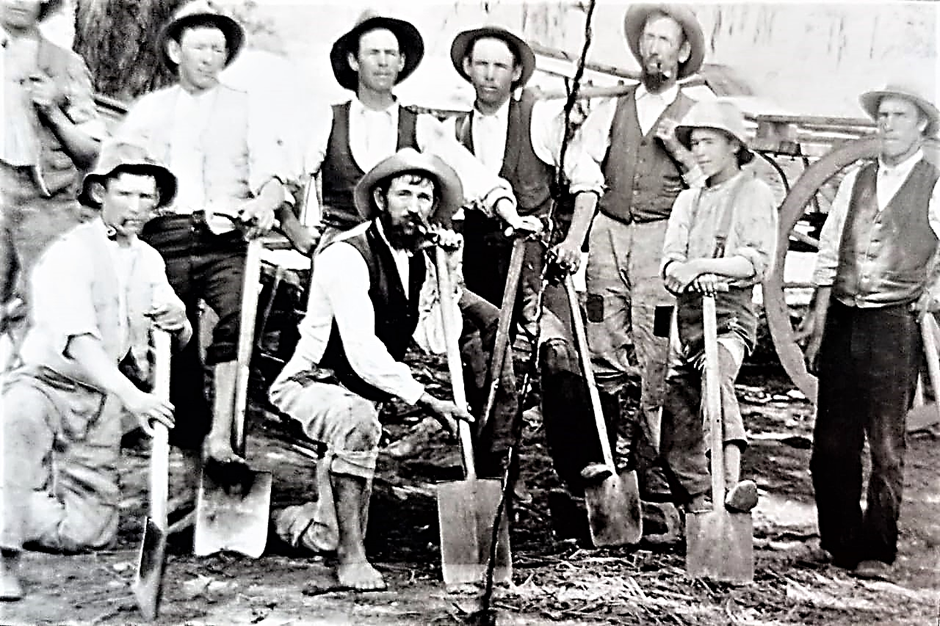
The furrow cleaners
In 1928, when water became too much of a limiting factor in the advancement of the farm, the turn owners decided to build a cement ditch from the Waterkloof, which is still in service today in 1977, but is in need of maintenance. A couple of 7-inch (about 18cm) wooden pipes were bought at 35c per foot to direct the water to the construction site and everyone had to do their part. The sand was washed and a hundred barrels of cement of four hundred pounds (180kg), at R1,60 per barrel, were used. The empty barrels were then used for desperately needed pressing tubs. The team’s lunch (bean soup and kabu mealies) and four o’clock coffee had to be sent up. The construction sometimes progressed at a slow pace, but eventually it was completed up to Sleepad’s sluice in August 1930. There oom Vaas de Kock, the chief builder and man in charge of the spirit level, wrote the date in the cement and Ambros, the labourer who had to look for flat rocks and carry it to the floor, made his hand imprint. When the ditch was still half complete, the water’s flow was strong enough that oom Alewyn, during his day turn, one afternoon at four o’clock ecstatically called out: “Now I have watered the entire world and I will just have to begin from scratch again, while I put a harness/valve on the water so that the most essential stuff in the garden gets water in one day.”
The four farmers on the other side immediately continued with the construction of an extra bit of cement ditch, and laid a wooden pipeline costing R200 through the river, and the Sleepad sluice could replace the Boonsteland sluice. These wooden pipes did well until 1963, when a couple dropped into the river and washed away. It was immediately covered with a few older wooden pipes, but in the same year everite pipeline were laid at a cost of R530,70. Three pipes washed away again in 1967. In 1974 the line was extended to Sleepad’s sluice. From the 1960s to 1973 the ditch on the other side was also replaced piece for piece by a cement ditch. To make even better use of the water, Kriel Partners put five acres of Boonsteland under drip irrigation in 1973.

The water source
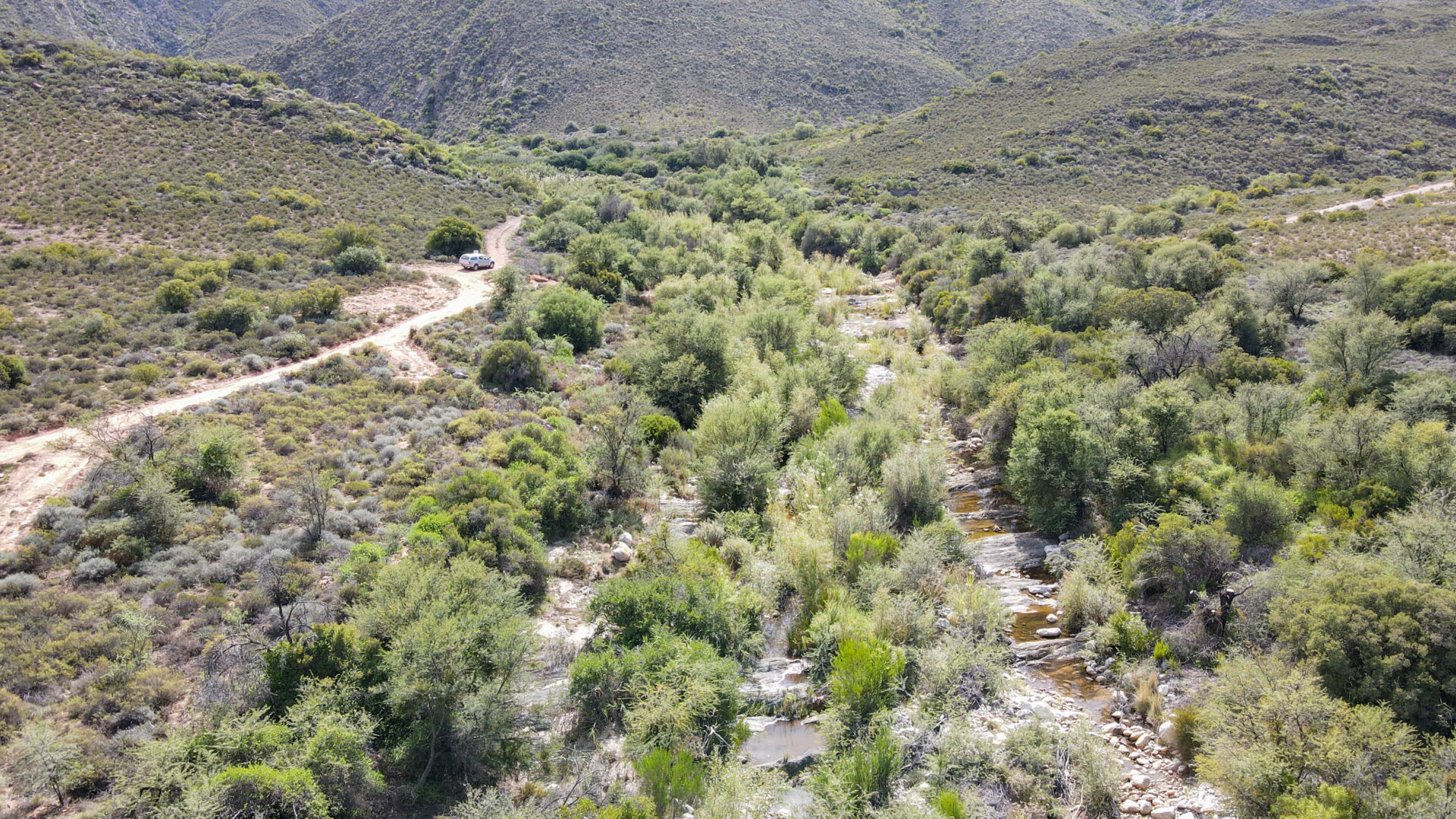

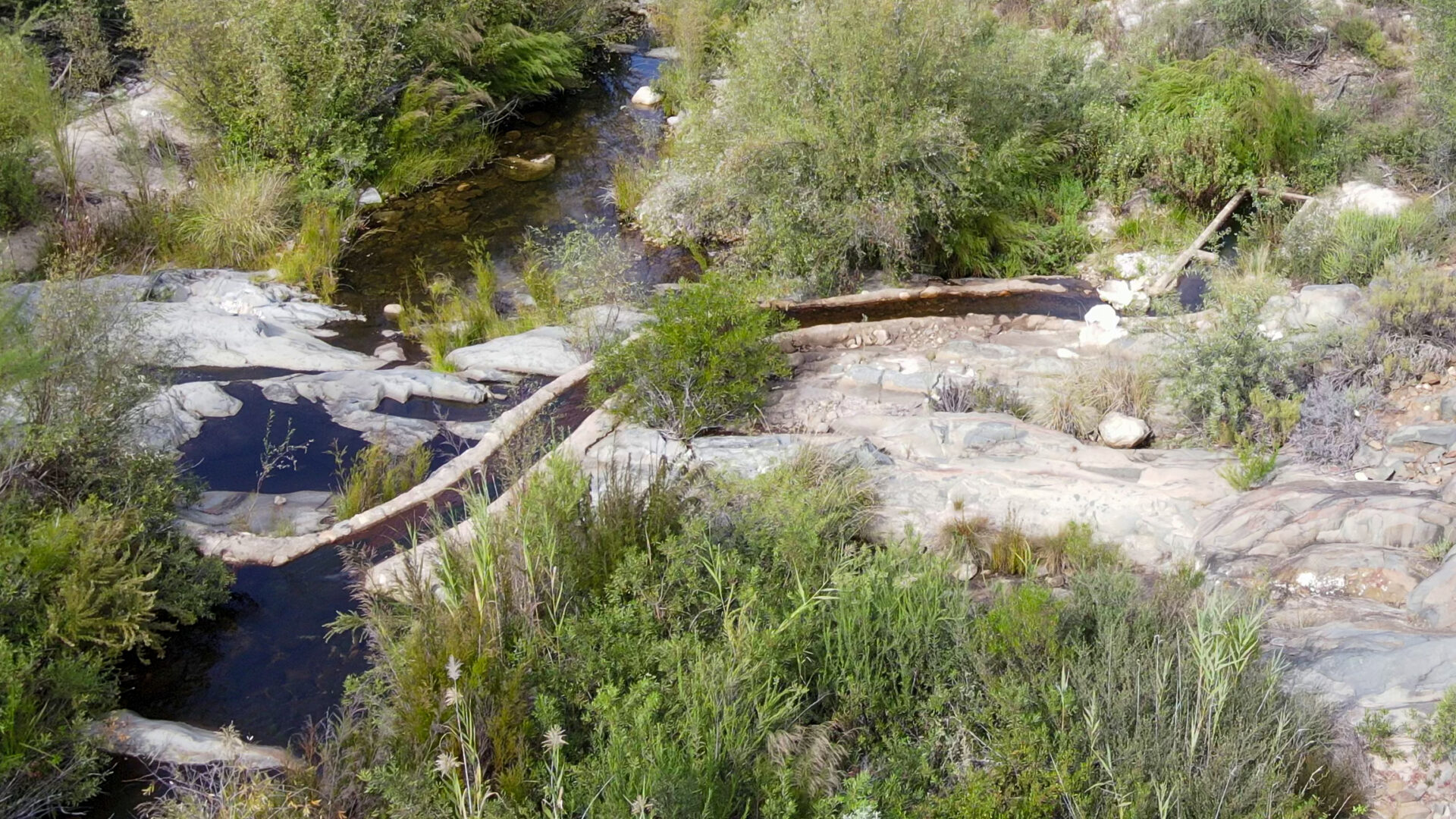
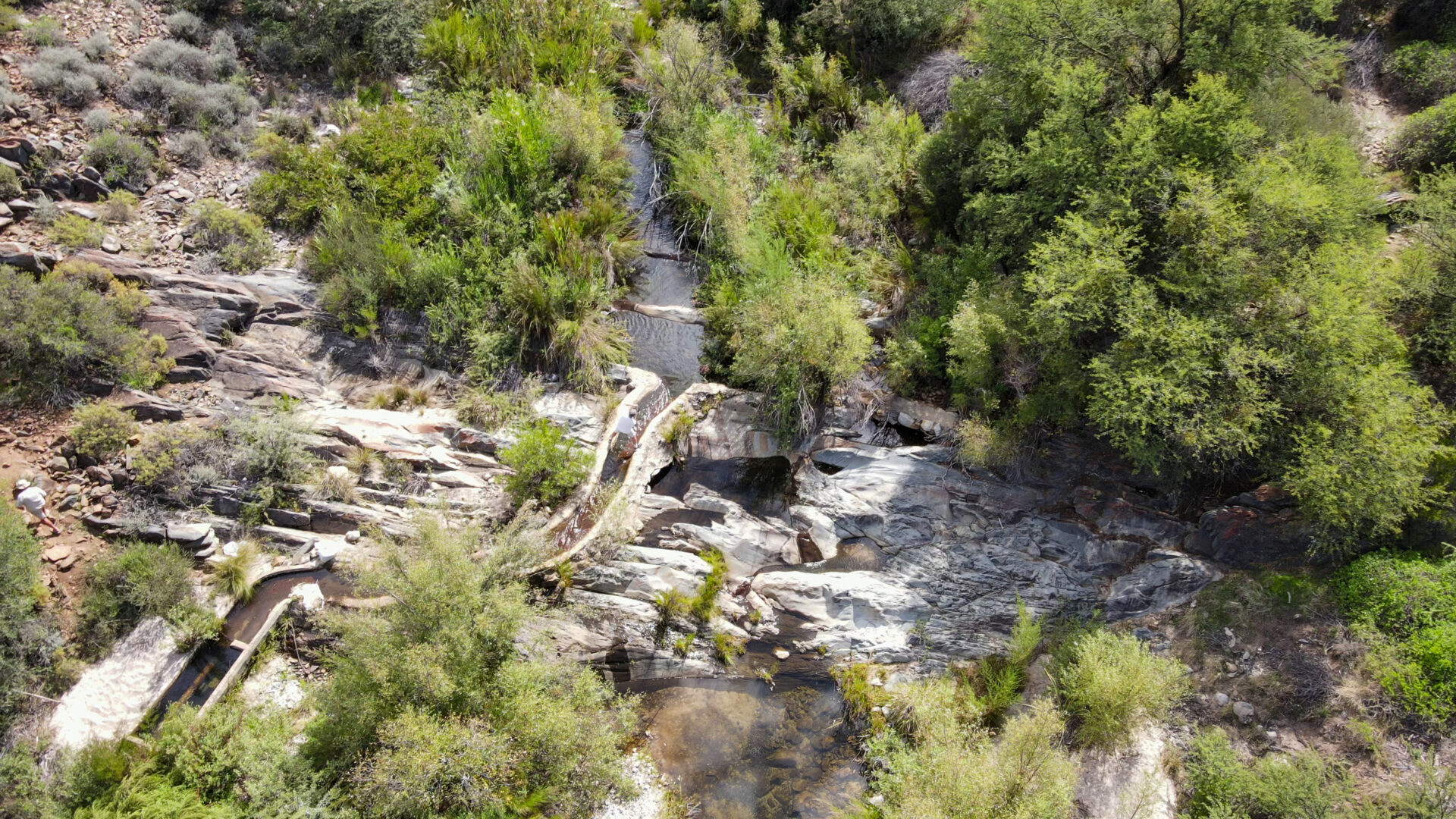
A mountain spring brings life giving water to Mooi Erfenis
Pictures: Peter Visser
CHAPTER 8
Viticulture
Earlier we wrote about farming activities that have already disappeared, but since the vine has been established here for such a long time, prior to 1850 already, it would be fitting to also shed-light on this.
Before the arrival of the grape mill, grapes were stomped to pieces in a stomping tub with a false bottom and then put into another tub to ferment. Due to transport and marketing problems the fermented must and skins were stoked together ‒ probably before legislation on boilers was passed in 1878. Long before 1900 there was already three small boilers/stills here which could produce 33,6 litre brandy per boiler filled with stilling must, but my grandfather A.P. acquired a filing boiler shortly after 1900, which could produce 16 gallons (80 litre) of witblits. After the arrival of the wine press the skins were distilled separately for custom brandy. The workers got a tot of this in a little Vaseline pot in the morning and in the evening during winter. The distilling continued through the day and night, and it is certainly in one of the clever stories told next to the boiler where one of our farm’s most popular waltz picnic songs originated (loosely translated).
“Pietersfontein is a pleasant fountain,
The brandy runs as thick as your thumb.
Courted her for seven years
In the eighth year she cheated on me.”
All the farmers produced a little vat of Jerepigo for themselves for domestic use. They merely neutralised the fermentation of the syrupy sweet Muscadel must with brandy instead of today’s spirits. The annual boiler/still registration fee was 50c and the distilling licence 25c.
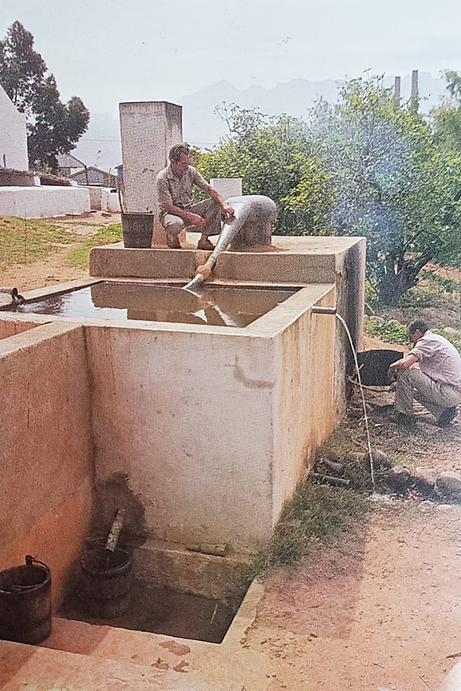
The distilling boiler is similar to the one J.F.D. had and which washed away during the Laingsburg floods.
After I abandoned the distilling a few years ago ‒ because the farmers could already get their 15 gallons of brandy from the K.W.V. in exchange for must or grapes, I put the boiler back in action in 1957 and invited Miss Du Toit and her school children to come and view the process. After this the distilling ceased, but at least I still have a gallon of witblits in a clay jug and a ½ gallon runoff, a great means of lubrication in memory of the era that has passed. The boiler still stands bricked in, but the licence may not be transferred to another owner and I registered the boiler for the last time on 17 January 1966. The boiler was disabled by the customs officials in 1967 by hitting a few holes in the pot and hood. The boiler was described as a “pot boiler with a copper pot, hood and spiral”.
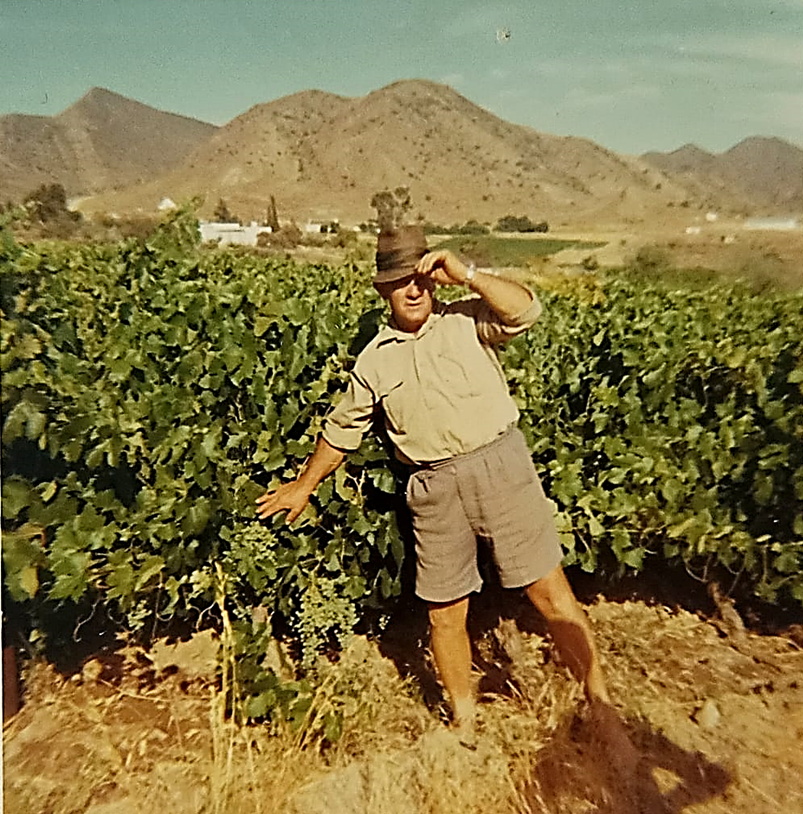
J.F.D. and his Palomino Fino grapes (“Fransdruiwe”), 1972
According to the book “Kohler van die K.W.V.”, the phylloxera pest began killing off vineyards from 1884, but on the Hannies’ farm next to the river the older variety of Muscadel was planted in 1895 already and is still producing. Although Mr. John X. Merriman, then the Cape’s Minister of Agriculture, in 1885 already imported wild rootstock for grafting purposes, we only started planting grafted vine from 1925 at R20 per 1 000, and as I write the price varies between R200 and R400 per 1 000 vines.
Around 1900 prices were on the low side, until Mr. Kohler, an energetic farmer from Paarl, took up the baton with a farmers’ march to Parliament in April 1909. Shortly thereafter a representative meeting of wine farmers in Paarl took place, leading to the establishment of the Cooperative Vintners Association (“Koöperatiewe Wijnbouwers Vereniging” or K.W.V.) on 8 January 1910. In his book Mr. Kohler says that prior to the K.W.V., the price was a mere R5 per 5,7 hectolitre (1HL=100L) and shortly afterwards it went up to R8. Mr. Piet le Roux of Baden was our first director. Prices immediately improved and in 1920 it shot up to R60 per HL, without determination of strength. However, this led to a lot of cheating, because some farmers increased their must by adding water.
That wine price gave our farmers a good kick, because my father’s income booklet indicates a profit of R1 410,07 plus a bonus of R250, for which Brink Bros. awarded shares. The next year the wine prices collapsed and my father’s booklet indicated an income of R550,94 and a downside balance of 0,83 cent.
In 1923 nearly half of the liquor harvest was declared a surplus and destroyed ‒ to great delight of our labourers, who took everything that was hollow (probably also their stomachs) to fill with the streams of must. Ruiter, one of our workers, initially helped us to pump out here and then went to assist our neighbour, but when he was done there by dusk, all the tasting throughout the day left his brain in a haze and he decided to lay down on an empty wine barrel for a bit. During the night he woke up, still spaced out, and walked home, but got lost and stepped off a high embankment. Luckily his joints were so lubricated that he didn’t suffer any injuries. That night even the yard animals were thoroughly hammered. An intoxicated pig is a comical sight!
That year the farmers also merely dried a lot of their Muscadel grapes in the vineyards. The dry product was received by the traders, controlled by the K.W.V., and the farmer could buy it back at 75c per striped sack for feed and the children could freely snack on the sweet Muscadel raisins.
However, Kohler and his K.W.V. board were tough fighters and better times came around again. From the early 1940s more and more cooperative wine cellars were established and pressing on the farm became a relic of the past. All our farm’s producers now belong to the Montagu Muscadel Farmers’ Cooperative and everyone delivers their grapes themselves at about R100 per gross ton.
Unfortunately Downy Mildew broke out in the Boland in 1969 and sporadically made its presence felt; eventually, in 1977, it arrived on our farm as well, luckily after pressing time. It will however push up the costs of production, while the economic recession and high customs tax threatens to diminish demand and cause a surplus.
I nearly forgot to mention that, with the weak wine prices in the 1920s, especially the farmers next to the river made their Palomino Fino must into syrupy sweet must jam for the market, at R2 for a four gallon lamp oil tin canister. It was also a demanding job to stand next to the boiling pot full of jam throughout the day during March, but it had to be done to get the best prices.
Pressing time in Pietersfontein in the 1920s
Pressing techniques have changed and improved so much over the past 40 years, it is almost not comparable to that of the 1920s and early 1930s. It’s almost only cutting the grape off the vine that is still the same, but even for this a harvesting machine is in development. The grape baskets are now loaded directly onto the pressing container and transported to the Co-op cellar, where a couple of switches are operated to take the process further. One has to wonder sometimes if a child of about 5 years old today will experience such great progress in medical, mechanical and technological fields as someone of 70 years old has in his lifetime. The use of brute physical force is needed less and less to bring about the end product. It is this old pressing process of the late 1920s in Pietersfontein that I want to highlight a bit, because the vine not only put down its roots early in the western Cape Province, but also deep into Montagu’s alluvial soil. The vine especially rose as the chief income for many farmers after the collapse of the ostrich feather market in 1918.
Our red brick cellar, built in 1900 and plastered over in 1942, was the first proper building constructed on grandpa’s part of the farm. In the beginning there were two rows of four tubs placed on crossed wooden beams and two five-file barrels (2x5x116L=1,160 Lit). Around 1910 an additional two underground wine tanks (we called them “holes”) of twenty rows each were made. (11,520 Lit) There was also a traditional vinegar barrel (150 litre Scottish whisky vat) on one side against the wall. The 20 pressing tubs (wooden vats in which building cement was sold earlier) were stored in the wine holes for the remainder of the year.
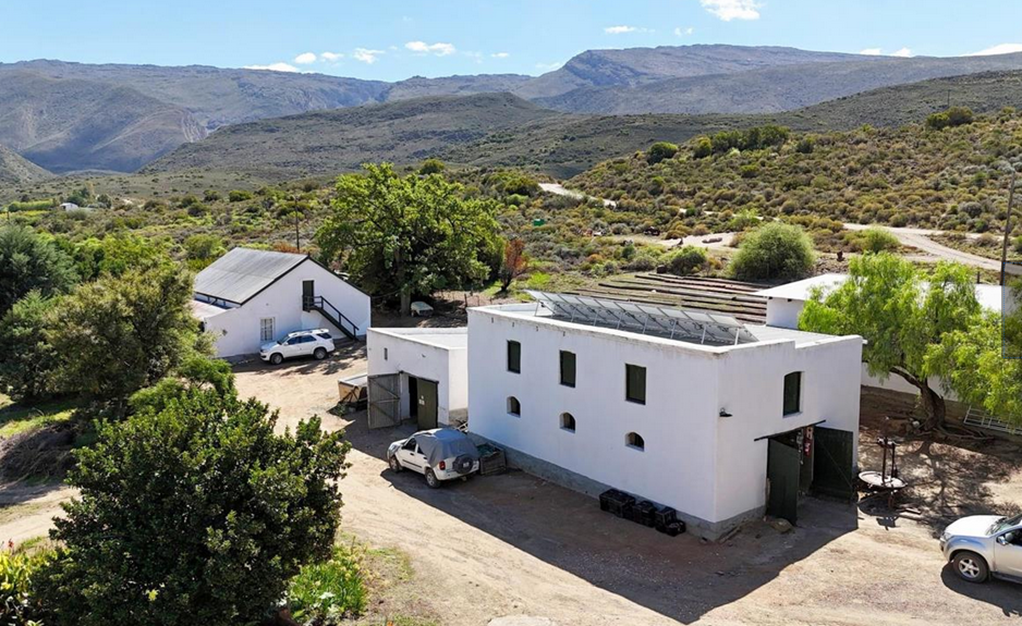
The old cellar building(with solar panels on the roof) 2025
Picture: Peter Visser
During the last week of February the cellar is thoroughly cleaned out. The two wine holes, barrels and pressing tubs are thoroughly scrubbed from the inside and given sulphur kernels. The domes/lids of all these containers must be floated up and kept wet so they could expand up nicely prior to pressing.
Usually on the Monday closest to 1 March the empty press tubs and baskets are transported in loads of eight on a horse cart to the vineyard. The four or five cutters are given knives and they walk to the vineyard to start the work.
As long as it takes to fill up the tubs with the cuttings, the stomping tub is placed on blocks next to a cistern tub, with the grape machine on top of the stomping tub. We already had a grape machine around 1900 and stomping on grapes in the stomping tub became a thing of the past. A step is constructed which is elevated enough so that the tub carrier can empty the tub into the grape machine. When the tubs are almost full, the cart is used and the full tubs are transported in loads of four. In front of the cellar the horses have to reverse the cart up to the crossbar. The press cart driver hangs a beanie on his head with extra material just over his shoulder, to give some protection to his back and clothes against the weight and friction of the tub with its three or four baskets of grapes. The tub is carried as high as possible on the back, the carrier goes up the step and empties the tub in the machine container. Now the crank is pulled with some effort to push the grapes through the rollers to pulverise it. When everything was offloaded, the tubs were put on the cart again, maybe with a few children inside or with the youngsters hanging onto the cart’s axle. It is utter joy for a child to drive on the pressing cart. If the cart driver is too slow for the team of workers, he can get a machine turner to help. After five loads the stomping tub is full and two men have to empty the tub with buckets and throw the contents into the cistern tub. In the meantime the guys in the vineyards keep themselves busy with small talk. I remember oom Maarman always filled his basket with pressed grapes only on the one side and carefully placed it on the side to not let the grapes get stuck, in order to fill the basket quicker.
The cistern tub is pressed up to about 300mm. from the top, so that there is enough space for the must and shells/skins to rise when fermentation begins. It did sometimes happen that the must spewed/fermented out, especially if there was a thunderstorm afoot.
I must note my memory of how, after the cistern tub was fully pressed on a Saturday afternoon. Next day my brother stood in front of the cellar on the Sunday morning and noticed the fermented must spilling out below the door and the froth standing almost 450mm. high on top of the tub. Any hollow item had to be gathered to tap off the must so that the contents in the tub could settle. When the tempestuous fermentation calmed down, the tapped must was thrown back in the tub.
When the second cistern tub was also fully pressed, the grape mill was placed over one of the wine holes (underground tanks) on top of two tubs full of rocks standing on opposite sides of the hole’s rim. Now it still takes another week to fill up the hole with pressed grapes, but at least the tub carrier does not have to climb stairs and the slower the pressing fills up a cistern tub or hole, the better the fermenting must.
When the three things are filled up with pressed grapes, a couple of must jam jars are quickly cooked. For that a false bottom is placed in the stomping tub and twelve tubs of sweet and healthy Palomino Fino grapes are twisted off into it. Usually it was done after four o’clock in the afternoon. The must and shells/skins start to ferment during the night and when the shells/skins start pushing up early the next morning, the must is tapped off and thrown through a sieve into jam pot. The old people always said the must should prick your tongue like ginger beer and be clear, before you tap it off. When the jar is full, a fire is started to heat up the must. When the must is properly lukewarm, it is strewn with four cups of powdered chalk, which lets all impurities sag down to the bottom then the jam is scooped out. Now the big froth spatula is brought closer to scoop off the ugly, black froth starting to accumulate at the surface. A pot with a volume of 220 litres can produce up to 15 litres of foul froth.
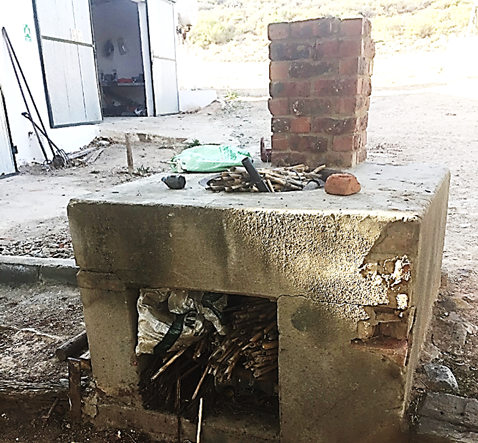
The old “still” on Mooi Erfenis
After 1½ to 2 hours the pot will begin to boil, but the must will not have risen. It must be checked continuously, because if the must starts to rise, it must regularly be juggled with a jam shell, a sawn-through head calabash tied to a long stick, otherwise it will boil over. Then, for taste, ginger or aniseed is tied to a rag and thrown into the boiling must. From the initial white must it begins to turn increasingly brown, and the juggler gets fewer opportunities to look around. After about 4 or 5 hours a saucer is brought closer to frequently scoop a little jam to test its viscosity. The jam droplets have to form a thread when it drops off your finger, in other words, it should not just drop off, but make a little tail, then the jam is thick enough. Taste also plays a role in the testing. If the jam has the right viscosity, it is scooped out with a big bowl as quickly as possible and thrown in iron canisters to cool off and settle.
After about 14 days the jam is carefully removed from the sediment by a sieve over a bath tub, and then put back in the cleanly washed canister. Now you can add it to sweet potatoes, fish or bacon along with the farmer’s bread and butter.
When the cistern tub’s must and skins are fermented after about four days, the must is drained and thrown in the barrels and empty underground wine hole. The skins are thrown in baskets and carried to the wine press, where the children had to stomp on it. The wet skins clean any dirty feet. The tub placed at the bottom for the drainage of the must from the cistern tub, is now placed under the press’ runoff spout to collect the pressed must. When the press’ wooden frame baskets are full, two half-crescent false wooden bottoms are placed over it, fitting around the central bolt on the inside of the baskets.
Next, ten black ironwood blocks are put in place. A big nut with an iron lever, pushed from one side to the other, is slowly lowered on the blocks and the must is pressed out. The must is then added to the other batch. When the cistern tubs are empty, the pressing may continue again.
The wine hole that has been pressed to the brim, is closed off with its cement lid and sealed shut, so that the must stops fermenting, because all the air has to be removed. Otherwise, if it waits too long to be transported, the must will become acidic.
When the farmers began transporting the must to town, all the must was distilled first, and most of the farmers with a still took out a distilling licence to distill the allowable 75-litre brandy themselves. Our labourers, if they used up all the must they kept for themselves, got a tot of this brandy in the morning and in the evening throughout the winter months. The little tot chalice was an empty Vaseline jar. The must measurement was a head calabash’s sawed-off head which filled the jar 3 times.
When it’s time to transport the must, the wagon load of half-files (58 litres each) were fetched at the K.W.V. The wine hole with the clear must is opened first. A strap is tied to the handle of a paraffin container and it is used to scoop the must from the top (at the time a pump was not available yet) and the half-files were filled up one at a time. If the must sagged to such an extent that a ladder could stand upright, the ladder is placed inside so that the must scooper could get in and the filling process could progress at a quicker pace. It takes a lot of courage to climb into a wine hole that was closed shut for so long, especially if it was still half full. When a hole (underground tank) is opened, a match or a lantern is used to test the gas before a man can climb in as long as the light goes out in the hole. The carbon dioxide makes it very dangerous and deadly
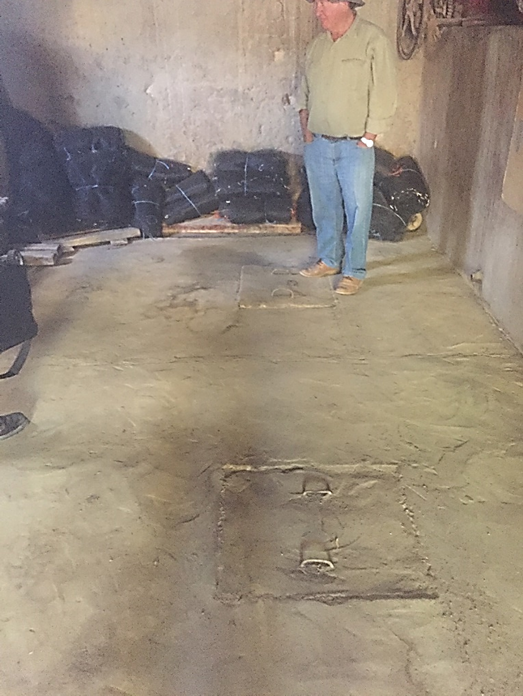
The two entry points to the old wine holes on Mooi Erfenis
I nearly suffocated myself one evening. I climbed in the wine hole too quickly and just as I began scooping, it turned black around me, but luckily I could still yell: “Pull!” My brother grabbed my one hand and pulled me and my scoop of must out of the hole. My brain already seized up and didn’t think to let go of the bucket. They say I lay next to the hole for a number of minutes, white as a sheet, before I regained consciousness. We abandoned the attempt at scooping and left the hole open until the next morning. By that time the lantern could remain burning in the hole. It was notable that a drinker could work longer in a pungent must hole than a non-drinker. Most holes and tanks, have however, claimed many lives.
The very next year a hand pump, the type that people initially used on wells and water tanks, was bought. At first we pumped by hand, after which we linked the pump to a 1928 4-cylinder Chevrolet motor engine on wheels.
When the five half-files were filled with approximately 260 litres total the wagon’s rear set, of which the axles were already lubricated, was pushed into the cellar door and the barrels were rolled up onto the wagon with two long wooden bars. Three stand up and two are on their side. As a rule the barrel laying next to those standing, is tied up and a crossbar is placed behind the barrel at the back. The sack of feed is tied to the bars, the straps are thrown over and the six horses can be harnessed early in the morning for the drive to town.
Usually I got up at three o’clock in the morning, fed the horses, made coffee and called my bridle holder, while ma packed the food basket. We departed at four o’clock on a route of 24km, interspersed with 8 gates down the kloof. The gates and fords quickly teaches one to brake to prevent the wagon turning to the side and sometimes it was so dark you could not see when the horses at the front made contact with the gate, and then they had to turn to the side to not be pinned down. After the team got a breather at six fixed parking spots on the way to town, we usually arrived in Long Street, in front of the homes of oom Bella van der Merwe (now Barry’s Garage) and Boet le Roux (Erf no. 38), a tad before seven o’clock. Then we had to sit and wait for the K.W.V. siren to go off at seven o’clock. By this time you already walked past the wagons in front of you to see how many there were, so that you know where to fall in line for your placement ticket. With the ticket in your hand, you can go relax in the Brink’s backyard under the big old Eucalyptus tree, where the storehouse now is. Back in the day we offloaded in the old wine storehouse right in front of the hostel that was built later, and each barrel was separately weighed empty and full, which obviously was very time-consuming. When the first vehicle scale was installed, the offloading proceeded more smoothly, but frequently a wagon had to go around the block three times when a rebellious ass at the back pulled the wagon to the side over the scale, because the scale’s hollow echo from below irritated its belly.
The early morning noise emanating from the farmers in the street didn’t amuse the townsfolk for long, and after requests the Municipality moved the inner limits for parking for the wagons from Badshoogte to the old Power Station, today the police station, and for the Langberg wagons at the Van der Merwe bridge. So now we waited for K.W.V.’s seven o’clock siren, and then it was a dangerous race down to Long Street. Duiker, my ass at the back left, was very rebellious the year after the first road was tarred, not liking the hard tar surface, not to speak of attempting to run on it.
One morning it happened that the resistant Duiker slipped, fell and with his rear set landed under the wagon’s front seat before the rest of the team came to a standstill. Luckily the brake strap pants didn’t break, otherwise the wagon would have trampled him. As long as it was only wagons travelling to town, the odds were excellent that you could keep your place in line, or to even improve it on the way to Long Street, but with the proliferation of motorised trucks in the 1930s, the struggle for a spot became too unfair. At the start of the line the wagon may be second or third, but at the destination you somehow fell back to eighth place. It’s because of this that a farmer from the Keisie, old Fankie, hit the road at dawn, and put his bridle holder on a bicycle to pedal from the location to the K.W.V. to get a ticket while his boss was still relaxing.
Sometimes Brinks and P.J. Joubert also received distilled wine from their client farmers to deliver to the K.W.V. in exchange for spirits for their wine-making process, and this way the offloading at least went a bit quicker. Joubert had a rare swinging jib mounted on the storehouse’s veranda which could hook, lift up and swing around the half-file barrel with two hooks in the rims of the barrel on the wagon, onto the veranda via a crank turned by hand.
When the new K.W.V. distillery and pressing cellars were erected in 1944, trucks were so common that the offloading facilities only complied with truck requirements. My brother and I abandoned our wagon and bought a truck in 1945. The Coop pressing cellars by then had also begun processing muscadel grapes.
My goodness, how many of us farmers wished that, after Bath Street got tarred, the tar could just reach Badshoogte, too, because sometimes it felt like your insides would hop out sitting on a wagon over a wobbly gravel road. A jar with cream in the pantry box below the front seat would probably be butter and buttermilk by the time it traveled to and from Baden’s road. All good things eventually arrive, however. Before we stopped using the horse cart, we could start driving on tar from Badshoogte. Today one drives to Pietersfontein on about 10km tarred road and 11km well-maintained gravel road with air tire vehicles, without having to open one gate in the dark. As I write you get R300 or more per metric ton of grapes without having to apply brute force, while the above mentioned annoyance which was accompanied by so much brute force, eating dust and getting wet in the rain, brought you a mere R7 or less for a file of must in your pocket.
Things that were my reality, must sound like unbelievable bedtime stories for today’s youth.
CHAPTER 9
History of the dam
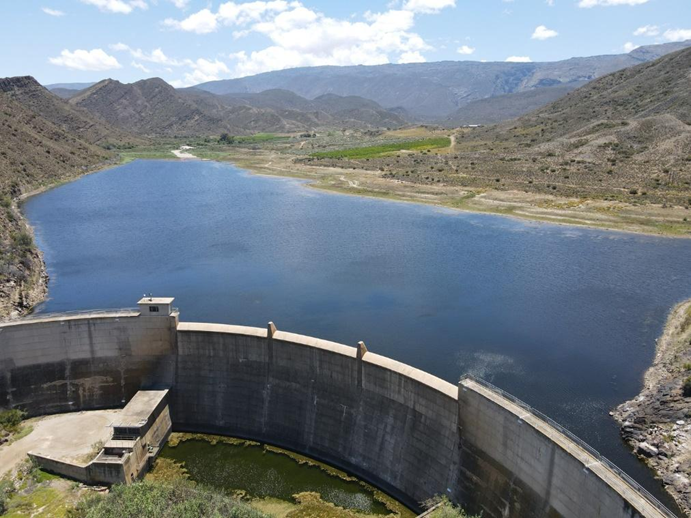

The Pietersfontein Dam during the good and bad times
Water awakes nearly the same desire in a farmer than most people with money, because without water a farmer can’t earn an income. With the periodic droughts there was already speculation about building a state dam early in the century, in 1912, but nothing happened before 1956. After much correspondence with Swellendam MP, Mr. Izak van der Vyver, he brought in Mr. P.K. Goosen, director of irrigation, to investigate the possibility of a dam in the Poort. Mr. Goosen’s remark to the couple of farmers present was: “This is surely not the best location for a dam”, but the farmers retorted: “The best locations in the country has been created and now the second best must come to dam the flood water”. After Mr. George Brink of Brink Brothers Ltd. also got involved, a drill was brought to sink a few test holes. The ball was rolling and on 3 May 1962 it was announced on the radio’s regional news bulletin that the White Paper (in the author’s possession) on the Pietersfontein Keisie State Water Scheme, at an estimated cost of R400 000, was tabled in Parliament by Minister P.M.K. le Roux. Eventually the amount would be much higher.
At the start of June 1965 a second test drill arrived and in July 1965 the construction site was laid out under the supervision of an engineer named Mr. Mallory, and Mr. Herbst as work foreman. A year later, on 16 July 1966, the first 600 holes for the foundation were blasted open. On Friday, 16 June 1967 our access road was permanently closed and everyone had to travel via Groenland-se-hoogte (more on this later), and in July the first stream of murky waters trickled through the lower sluice of the dam. The dam was completed in May 1968. In September 1966 the Agricultural Credit Board arrived for appraisal, at an average of R2 000 per morgan. In September and October 1969 the Department of Water paid out R42 645 to four farmers whose land fell in the dam’s outline, namely D.G. de Kock, the Tasse family, the Ficks and myself. This is to say, the separate costs were: Road – R36 875; Land bought out – R42 645; Dam construction – R554 922. (Referenced total was provided by the Resident Engineer of the Western Cape Province.)
After the completion of the dam, most of the rubble was sold to the farmers on tender. Most of the construction sand was transported from the Karoo, at 10c per kilometer, and the stone was brought from Robertson.
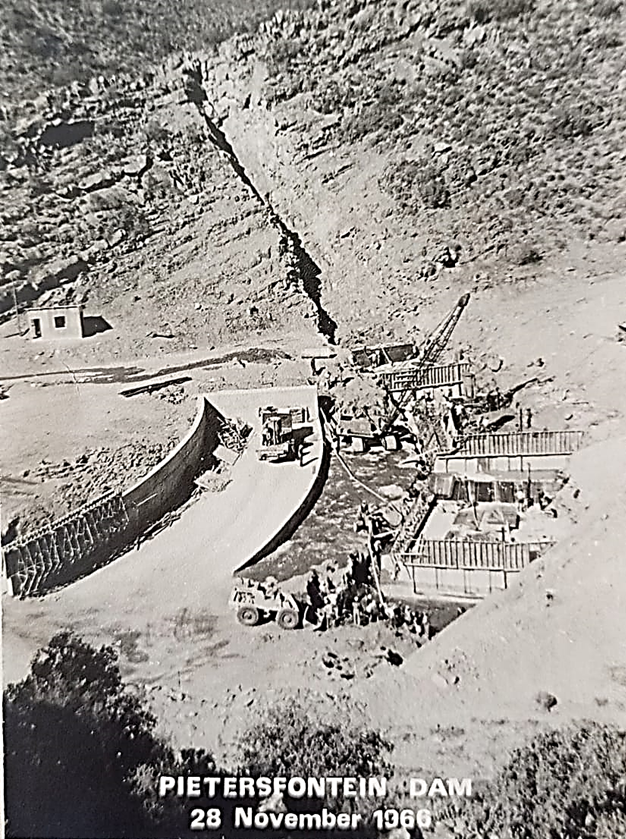
The dam was pretty unlucky from the start in relation to its catchment, because it only received the first significant 15½ feet of water in April 1969, and on the afternoon of 22 November 1971 the sluices were opened for the first time for Baden. Weirdly enough, since the completion of the dam, Groenland’s river received more water than ours. Discord quickly reared its head between the four farmers surrounding the dam and the farmers lower down, because the four farmers had contract water rights, an integral part of Pietersfontein’s source turns. As a result the Irrigation Board was suspended and the State itself provided preferential water to the upper Group 1 farmers, but oh, the periodical droughts frequently pinched to such a degree that boreholes keep increasing. Currently 25 boreholes are operational and eight are on standby for pumps when needed.
The Irrigation Board was re-established in May 1978.
The Divisional Council and our road
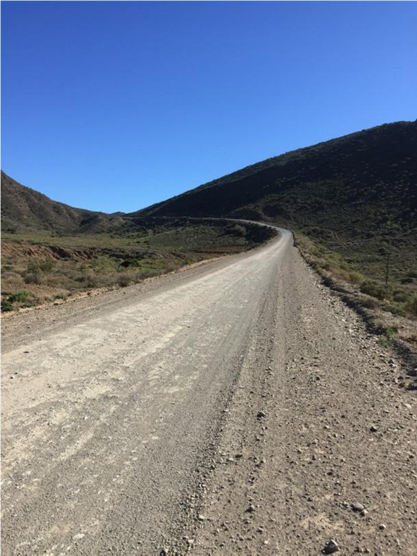
Prior to 1900 the farmers were mostly themselves responsible for the layout and maintenance of their roads. For example, in 1756 Kok and Pieterse had to lay out their own route here through the Karoo, or go over Ouhoogtes, or Koeniekraal, or through the then still uninhabited Doornkloof, when they arrived to establish Pietersfontein. Usually the roads went up and down in the ravines where the sides of the embankment were too skew. Downhill you just had to make use of a brake pad. A brake pad was later picked up on the steep Groenland-se-hoogte and can now be viewed in the Montagu Museum. The wagons all had wooden axles at the time.
From the second half of the 19th century there at least was a Central Road Board, although they did next to nothing. The Divisional Council system was established in 1855. Montagu initially fell under Swellendam, later under Robertson, and in 1897 it split off as an independent fiscal division. On 15 August 1905 the first preliminary Divisional Council meeting was held, but in the Minutes of 9 January 1906 it was still referred to as the “newly created fiscal division of Montagu”, with magistrate John Caldicot Stevens[1] (known among the farmers as “Bare-assed Stevens”) as chairperson. Three of the first members were oom Jan Kriel of Derdeheuwel, attorney Gideon van Zyl and oom Frikkie van Zyl of the Keisie, while Mr. James Thomson served as secretary at £60 (R120) per year. Mr. James Thomson served in this position until 1945. (Reference: The Minutes of the Divisional Council)
The Council, with oom Vasie de Kock of Pietersfontein as road foreman, had to try and maintain the roads with Scotch carts, wheelbarrows and pick-axes.
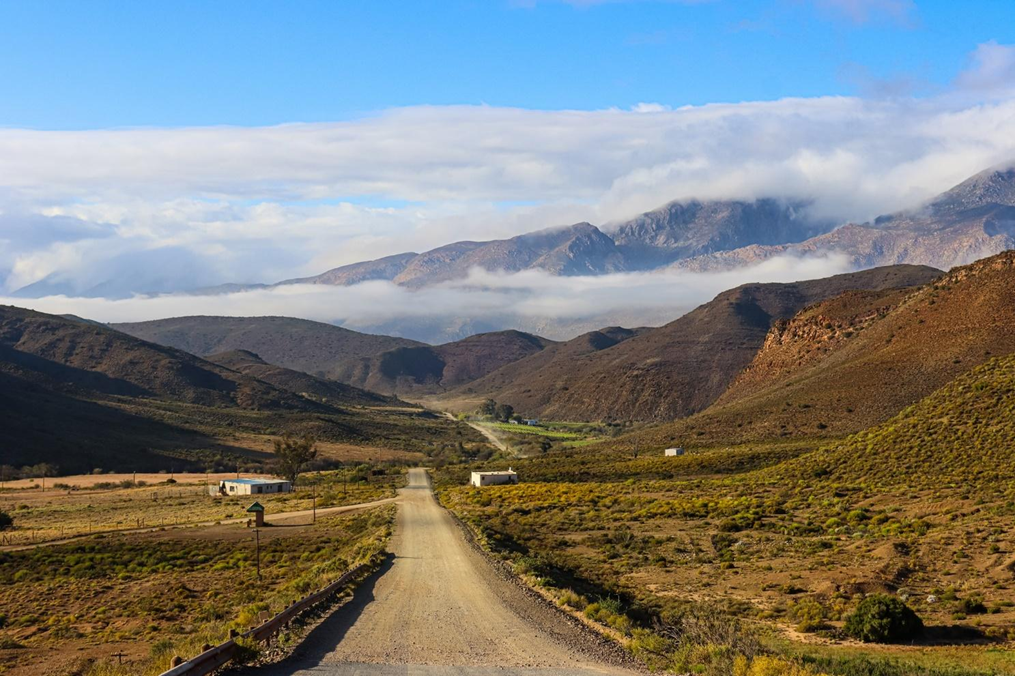
The road towards Montagu with the turnoff to Patatsfontein on the left
Our road was proclaimed up to Tweerivier in 1912. The farmers had to make a plan themselves over Groenland-se-hoogte and due to the steep climb from both sides, the farmers frequently took a load of products to the first highland in the afternoon, so that they could harness their animals early the next morning for the trip to town.
I quickly want to highlight two incidents in Groenland-se-hoogte. During the Anglo Boer War, due to a lack of stomping animals, the farmers succeeded in acquiring a Ransom threshing machine with a steam boiler for threshing purposes, but the ten crumbs of pulling animals the English didn’t bother to seize for the war effort, were too weak and lopsided to transport the container up and over the blue hillsides. By the time the pump-handles and harnesses were in pieces, they decided to go ask Noupad’s farmer, oom Jan “Looier” Kriel, for his two half-breed Afrikaner oxen to hook in front of the wagons. When the oom arrived at the scene, he first told them to unharness their animals, so that the oxen could try on their own. So ordered, so executed. The fellow hooked his two half-breeds, stood next to them, cracked the whip and called their names. The oxen bent against the yoke and dragged the container up the hill onto the highland, and then went back for the boiler, and also moved this up the hill to the top. The farmers could not believe their eyes!
A second incident was downhill with a cargo of nuts and potatoes. Oom Dawid, who himself told me the story, was the rear brake turner (the front brake was not available yet). Dawid turned and turned. It went well until about halfway down from the highland, but a man must stop turning before the last twist ‒ and when he pressed against the brake one more time, the brake pads gave way, and the wagon started rolling down! In unison the bridle holder and the driver screamed at the animals. The driver let go of his whip to take the rear reins. Oom Willie, who usually didn’t have all his ducks in a row, calmly sat on top of the load at the back and yelled “Bring the whip with you!” at oom Dawid, who was struggling to keep up with the accelerating wagon. Luckily not one horse fell on the way down and after a nicely done turn at the bottom near the cemetery, the bridle holder brought the bewildered travel companions to a halt. The front axle was bent to such an extent that the team had to unharness right there and load the cargo and the bent axle on the wagon from Groenland.
Because the road was so difficult, the Council proclaimed the road in 1918 all along the river up to the Huisrivier on our land. The road became much easier to navigate, but goodness, the nine gates and seven fords ‒ which were usually washed out, were quite annoying, especially if one was alone on a horse cart with a couple of lively horses. It made many a man quickly bolt to catch the bridles when the horses began running while he was still busy closing another gate, and when gasoline-powered transport entered the picture after 1930, the gates were even more of an irritation!
The district members of the first Divisional Council had to measure their own inspection distances. They did this by tying a white cloth to a cart spoke, counting the revolutions of the wheel and multiply this with the diameter of the wheel. The compensation for inspection was 5 shillings for 6 miles (50c for 9,3km) and R1,50 per meeting.
The first elevated masoned road through the Waterkloof was constructed only at the start of 1900 by the Looier Kriels of Krakadouw, who had to reach town via Patatsfontein. One day there was very nearly a gruesome accident here. The road was so steep that my cousin Michiel Cedraskloof had to offload a couple of bags of potato at the foot of the highland, have the wagon pulled up to the top and then carry up the bags and reload it onto the wagon. One day, just as he arrived at the wagon with the last bag, his animals began moving, just when oom Johannes Krakadouw approached in a motor vehicle and he stopped the horses. When the wagon came to a standstill, they saw that the front right wheel hung over the outer edge of the masoned rock; only a few centimeters further, the wagon would have dropped down the precipice with animals and all. Consequently oom Giel and the Conradies in the 1920s constructed a masoned road lower down. Giel was a masonry fixer ‒ a job that today still testifies of thoroughness. He was very unlucky when, shortly before the road was completed, he overturned his cart further down and lost his leg, but his zeal for work never diminished.
During the construction of the road quite a lot of dynamite was used. During a weekend a couple of youngsters fiddled with a cap and when the cap exploded, the unfortunate soul holding it lost three of his fingers ‒ which earned him the nickname Jonas Stompvinger (“Jonas Stubby Finger”). The masoned road was broadened a bit by the Council in 1951, as well as replacing the road running past the top of my house over the little escarpment ‒ which was still constructed by the farmers themselves, to the other side of my house. I still remember it well how my dad, in the morning before the workday started, worked with the pick-axe on the new road.
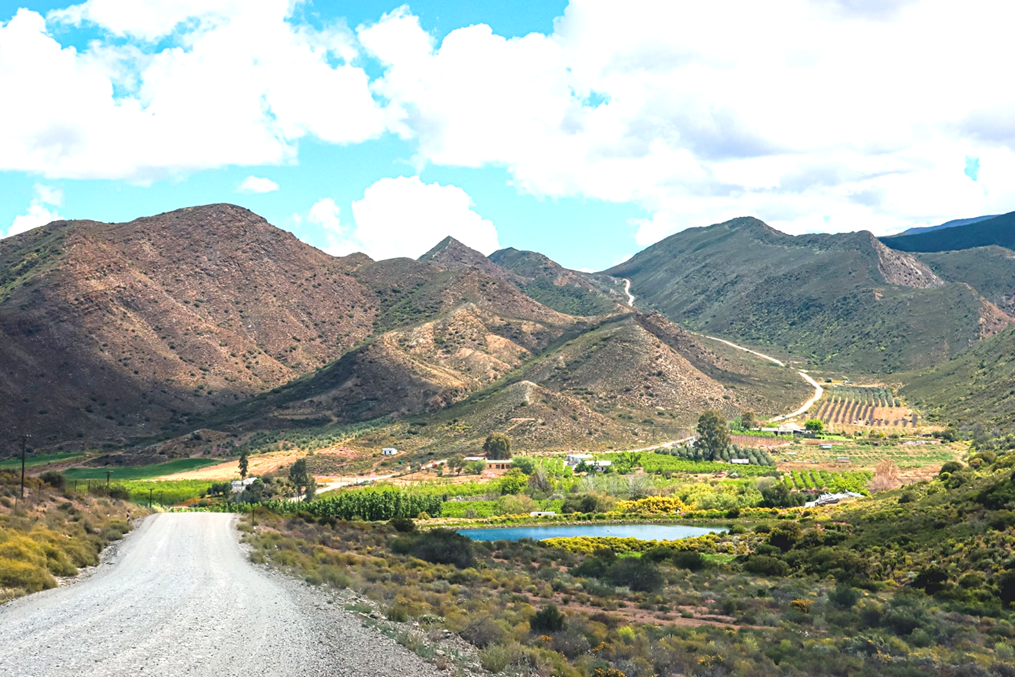
Arriving in Pietersfontein
All good things arrive eventually. The Divisional Council provided the farmers with barbed wire in 1943 to install next to the road and eliminate the gates, but a couple of gates refused to remain open, until floodwater violently forced it open in 1944.
As mentioned earlier, the construction of the dam forced the Divisional Council to return to using old routes. With the closure of the road over the highland, the farmers here directed a petition to the Department of Water, dated 24 November 1964, to provide us with a well constructed road and, if possible, exclude the bend of the Kriekheuwel Chestnut Ridge:
The Chairman
Pietersfontein Keisie Irrigation Board
Dear Sir
We, the undersigned land owners, residents and users of the Pietersfontein-Montagu Road, wish to bring a couple of issues under your Board’s attention.
It came under our attention that your Board is planning to keep the costs of the proposed road over the highland as low as possible, which is acceptable from your point of view, because it goes hand in hand with your expensive irrigation project. Another reason that made the rounds, is that the Divisional Council owes us a proper road and that the Board can build the road according to standard. Now you must understand us very well that we, the undersigned, have up to date not strongly demanded a standard road along the river from the Divisional Council, because the river farmers, who hopefully will benefit the most from the dam, would have to cede too much of their previous cultivation land. Now, however, the proposed new road will run through pasture and possibly a small piece of cultivation land. Your Board should however be thoroughly aware that the new route, at best, would remain a difficult route compared to the one down the river. The Doornkloof and Krakadouw farmers are already driving a demanding road to Pietersfontein and now the new difficult route will be added to further increase gasoline usage and wear and tear.
The only thing we politely, yet urgently, ask the Board, is to provide us with a standard road with the correct construction which at the very least will comply with the requirements of the Provincial Administration, so that the latter will recognise it as a B-road.
We will also certainly refuse to let our aforementioned road be closed before the new road complies with provincial requirements, because the Irrigation Board gets the benefit from the dam and we get the disadvantage of increased wear and tear on the new road. Should you desire it, we are willing to discuss the issue with the Board.
Please pay urgent attention to this issue and supply us with an answer soon.
Sincerely yours
J.F.D. KRIEL
OWNERS:
J.M. Conradie, Krakadouw
A.B. Conradie, Krakadouw
Conradie Brothers, Cedraskloof
J.F. Kriel, Doornkloof
J.F. Kriel PG/sn, Doornkloof
P.G. Kriel, Doornkloof
D.G. de Kock, Pietersfontein
J.A.T. de Kock, Pietersfontein
J.F. Stemmet, Pietersfontein
De Kock Brothers, Pietersfontein
Fick Sisters, Pietersfontein
J.S. Roux, Pietersfontein
J.F.D. Kriel, “Mooi Erfenis”
The Department of Water was also responsible for the financing of the telephone line extensions.
The Divisional Council built the road with better equipment than what was used to make the road along the river back in the day. An agreement was reached with the Tasse and Patties and voila, a good-looking, almost straight road, with a bridge to boot, was completed on Tuesday, 18 October 1966. One Taljaard was the builder in charge. I inaugurated the road with a cargo of wood. The new road was proclaimed on 21 October 1966 and the old road de-proclaimed. In total the costs were R36 875, of which R11 800 was the bridge alone.
The members of the Council were treated to a reception on Thursday, 17 November 1966 at the residence of J.F.D. Kriel to show the community’s gratitude. The author incidentally in his thank you speech remarked that we are very happy over the new road now, but a certain kind of homesickness clung to the old road on which most of us grew up with. Not only the scenery with the thorn trees, but all the place names that popped up one after the other, gave a charm and tradition of history to the road, which is still lacking with the new “through the veld road”. For example, there is Vloershoogte with its old threshing floor just as you drive out from the farm and at Blouhoogte you had to get out and open the gate. Shortly thereafter you arrived at Brandewynsdraai. There, as told by a family members, oom Gertjie Roux of Rooi Koppie in Doornkloof ‒ who transported the brandy of oom Hans Conradie (Dysel) for an income, dropped a vat of brandy through the actions of a rebellious ass at the back. All the expensive fortified fluids spilt out. Oom Hans was so incensed about the damage, he demanded half a morgan cultivation land from oom Gertjie as compensation.
Then came Eerste Water, which could badly wash out before the cement floor of the drift was cast. Here my brothers attempted to cross on horseback through a strong stream after a thunder storm, but brother Alewyn’s horse got washed out from under him and both started floating down the river. About 50 feet further he could luckily grab a tree branch and managed to get himself out.
Next in line was the Poort with its gate, where three farms’ corner beacons stood on a big rock next to the river, so that everyone had drinking access to the river. The dam wall now stands just to the upper side of the big rock. Another hundred feet further was Katreintjie-se-land. Here oom Andries and his wife Katriena overturned their cart and she was pinned below the cart’s trunk. The startled fellow jumped up in the dust and loudly called Katreintjie’s name to check if she was still alive. When the very Katreintjie-se-land was cleared out, the housewife picked the site to care for her loved ones and erected a baking oven in the river embankment to the upper side of the ford, but the first bread she attempted was only half baked, and thus the place became known as Roubrood-se-drif. But let’s get back to the main story. After the ford you would come across Grootland’s gate, Jonas-se-tuin’s gate, Fonteinsdrif-se-land, Hanniesplaas, the Tasse’s Wineholes, Hans-se-land-se-poort and a bit further along the Rooidraai and then Gewelkrans, the south eastern most point of the Stylhoogte Annex of Pietersfontein where oom Verreyne planted his controversial corner beacon in 1811.
Together with thanking the Council we did not let the opportunity slip by to immediately ask them to attempt to make the route over the steepest hills at the back of the highland a little more manageable. One day when I complained to the kind Mr. George Brink over the steep ridges, he replied: “Hey man, you just have to accept it. This old life is also full of ridges, you know.”
End of Part 2 of 3
