
17d.The Community (Jewish Community) that Disappeared – Part 4

Updated: 26/12/2024
The Community that Disappeared – Part 4 of a 4 Part Series

THE COMMUNITY THAT DISAPPEARED
Part 4
Moss Family
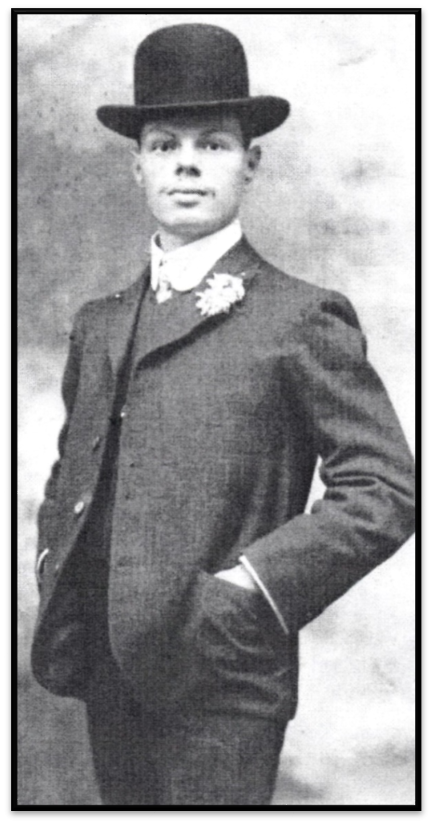
Abraham Joseph Moss
Picture: Montagu Mail
Around the beginning of the 20th century, a Jewish tailor named Abraham Joseph Moss (born 21 Aug 1879 Latvia ) moved to Montagu and set up a business in town. He married Annie (Anne Emily, nee Bernhardt born – 4 Dec 1879 Montagu). Her parents lived in Bath Street next to Brink Bros. She died in about 1974). Initially Joseph went to Oudtshoorn to try his luck in the ostrich feather industry but he failed rather badly and returned with bales of unsold feathers. He stored these in the loft above the garage in the hope that they would become fashionable once more. Joseph died in 1953.
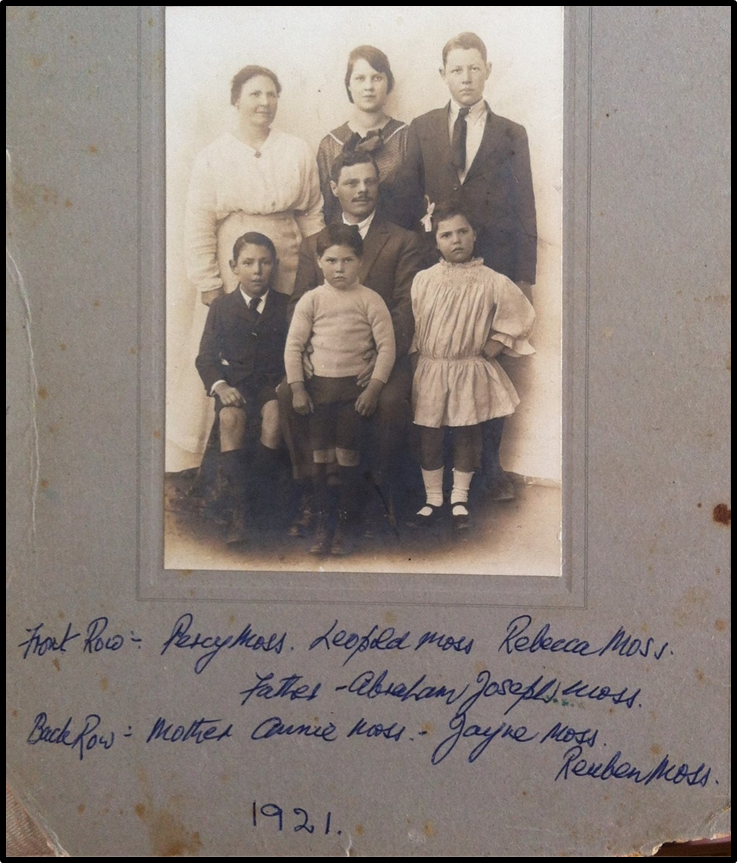
The Moss Family
Picture: Stanley Moss

The Tailor and his wife
Picture: Stanley Moss
Grandson Stanley Moss (son of Reuben) remembers going to the local cinema and confirms the story that his grandfather always sat in the same seat in the cinema. It was a known fact with the locals that Joseph Moss had his “reserved” seat. The cinema was in all probability the Alwyn (Parthenon) situated in Bath Street owned and built by a Greek businessman Mr. Theo. Stergianos.
According to grandson Stanley Moss his grandfather Joseph Moss and his family lived in two different houses while in Montagu. Their first home was in Du Toit Street next door to the Bussell family. They then moved to a home on the corner of Long and Church Streets known as 33 Long Street. The house in Long Street had a garage next door with a loft.
Grandson Stanley Moss confirmed the story that his grandfather stored his ostrich feathers in the loft with the hope that one day he could sell them at a profit. Sadly this never came to pass and he lost all the feathers to the elements.
Stanley also remembers a story when his grandfather came out into Du Toit Street at night and beat a pot making a noise that woke residents as a payback for the noisy parties that the Bussell family used to have.
Stanley and his wife Barbara also remember the magnificent food fair laid out by his grandmother Annie when they visited Montagu.

Stanley Moss and his son outside his grandfather’s old home at 33 Long Street
Picture: Stanley Moss
Joseph ran his tailor shop from premises in the Standard Bank building under the name of Joseph Moss Tailor.

The shop in Bath Street from which Joseph conducted his business
Picture: Montagu Museum

Advert from Montagu High School year book 1927
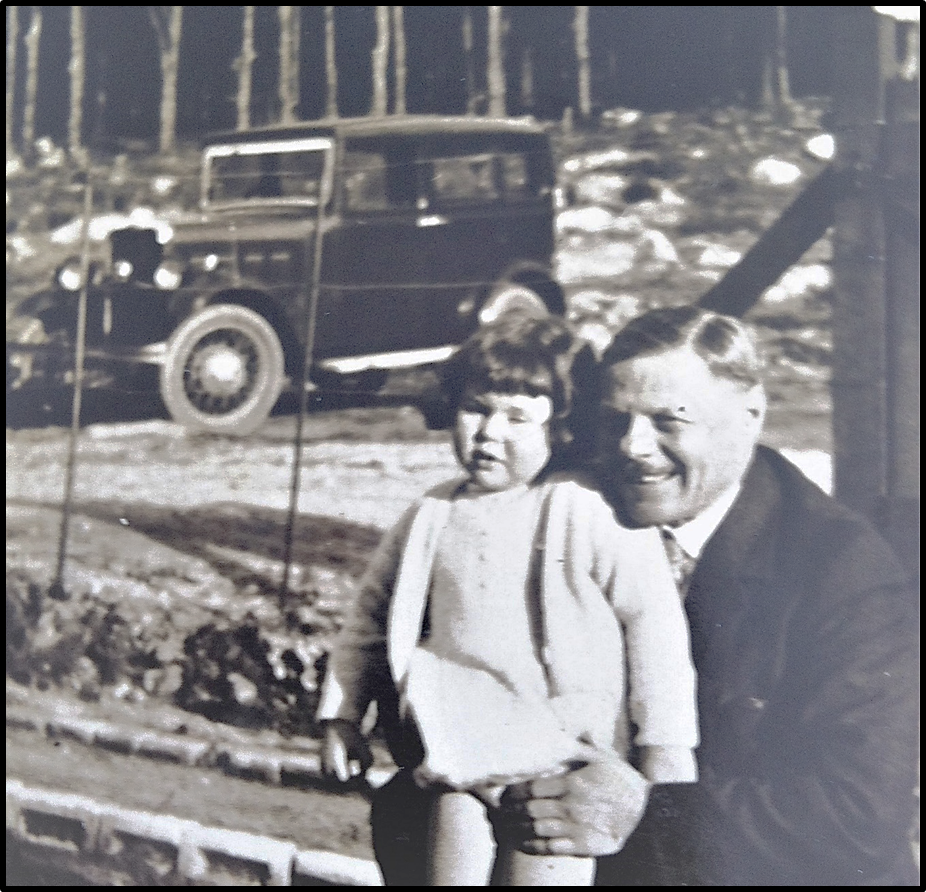
Joseph with his granddaughter Geraldine. His pride and joy a 1934 Morris is seen at the back
Picture: Stanley Moss
According to an article in the Montagu Mail Joseph and Annie had five children Reuben the eldest (b 26 Jun 1903 Montagu, married Bella nee Lipschitz from Hackney, London). Jayne, Percy, Rebecca and Leopold (Laby).
Records found show Jayne as attending Montagu High School in 1920, when she was in Standard 9.
Percy Moss Rendell obtained his matric Senior Certificate in 1926 as shown in the Montagu High School year book. He also went on to become president and life member of the Council of the Cape Town Jewish Reform Congregation. He also became president of the South African Union of Progressive Judaism. He was the only child to take the surname Moss Rendell.
Reuben worked for Woolworths in Cape Town. He started his own business a General Dealer called R Moss & Son in Port Elizabeth around 1952. They had a son Stanley Moss born in 1934. Stanley recalls that his earliest memories of Montagu date back to 1938, when he was four years old. The drive from Cape Town to Montagu was a long one, as one had to travel over Sir Lowry’s Pass, always stopping at a café at the top of the pass to admire the view. From there it was on to the farmlands of the Western Cape and Boland, passing Worcester, Robertson and Ashton. The highlight of the trip was the approach to the Montagu tunnel with the Anglo-Boer War fort on top. The tunnel was wide enough for only one car at a time, so you had to switch on your headlights and hoot until you were through.
Although electricity only came to Montagu in the early 1930’s Joseph and Annie never had it installed preferring to use paraffin lamps and a wood burning stove. The fridge was a cupboard with a block of ice on top, only used in summer. The butter, milk and cheese were put on the window sill in winter so that the draft could keep them cool.
At this time there was no sewerage system in Montagu and the toilet was in the yard. At night those who wanted to go to the toilet needed a lantern and had to go outside to a little hut. The buckets were collected only once a week by truck.
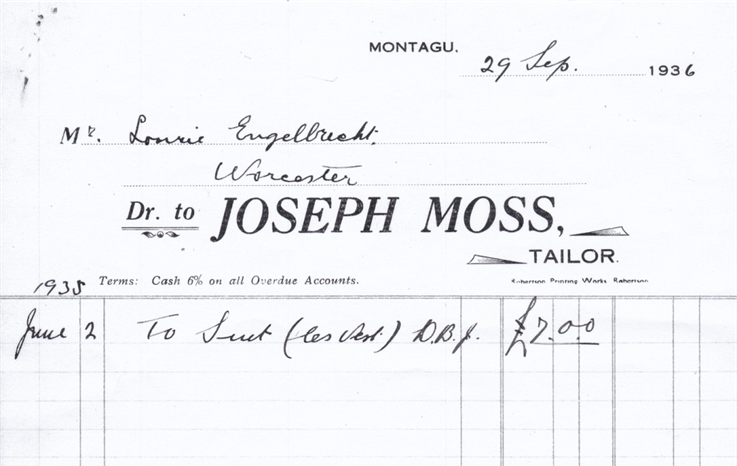
Joseph generates an invoice

Joseph has a problem
Documents: Montagu Museum
Philips Family
Sir Lionel Phillips 1855-1936 & Lady Dorothea Sarah Florence Alexandra nee Ortlepp 1863-1940. Lionel Phillips was an entrepreneur of some note and his wife who was known as Florrie was an extremely colourful person in her own right according to her biography written by Thelma Gutsche. Lionel was an acknowledged Jew by birth but does not to appear to have followed the Jewish faith during his life. Florrie was not Jewish.
The Phillips family were not permanent residents in Montagu. According to the biography Lionel actually hated the cottage in Montagu. Florrie was not a healthy women and she found the Hot Waters of Montagu helped her health condition. She however found the undeveloped hotel and general lack of facilities at the hot spring unacceptable and resolved to build a holiday home in Montagu which she duly did and spent long periods of time in Montagu.
According to an article written for the Montagu Mail by Dennis and Doreen Mynhardt dated January 2004, Lionel Phillips purchased a piece of ground from the NG Church for £50.00 in 1929 and then built his holiday home. He increased the size of his property by purchasing an adjacent piece of ground for £10 in 1938.
They were at the Montagu cottage in 1935 when Lionel celebrated his 80th birthday and their golden wedding anniversary. They did not however mention a word about both events to anyone.
The following extract from Florrie’s biography explains a typical Florrie in action:
The cottage in Montagu where Florrie hoped to maintain her own variable health,
was built. Swathed in veils and dust-coats, she would drive in her open Cadillac over
Sir Lowry’s Pass and Houw Hoek through Cogman’s Kloof to the site with Elsworth
at her side. Protected from the burning sun and wind, she chatted brightly to the
suffering architect who, hatless in the blast, was always painfully burnt. Florrie spent
much time at the cottage but Lionel hated it. The village of Montagu learnt to welcome her venerable open car followed by a farm lorry bearing the luggage and a little Dexter cow to provide fresh milk daily. After numerous alterations and additions, the cottage was finally completed.

The Philips holiday home on the left
Picture: Montagu Museum

A young Sir Lionel dressed as an Eastern potentate at a Ball in 1893
Picture: No Ordinary Woman by Thelma Gutsche

Sir Lionel Phillips
Picture: The Age of Uncertainty Blogspot
Plax Family
Compilers note: Tribute to Jack Plax who passed on 29 November 2020 at the age of 96 years. Jack was one of the first of the past Jewish Community to contact Montagu Stories early in 2018 and offer information. This led to regular telephonic contact and I shall always remember Jack as the 9pm caller. Never asked him why he always called at 9pm but I guess it was a time zone issue. Jack had an outstanding memory of his life in Montagu and regularly corrected information I had obtained on the old Montagu. He was always interested in any topic on Montagu and invariably could offer some snippet of unknown information on the topic under discussion. Thank you Jack your time and input were always appreciated and used appropriately.
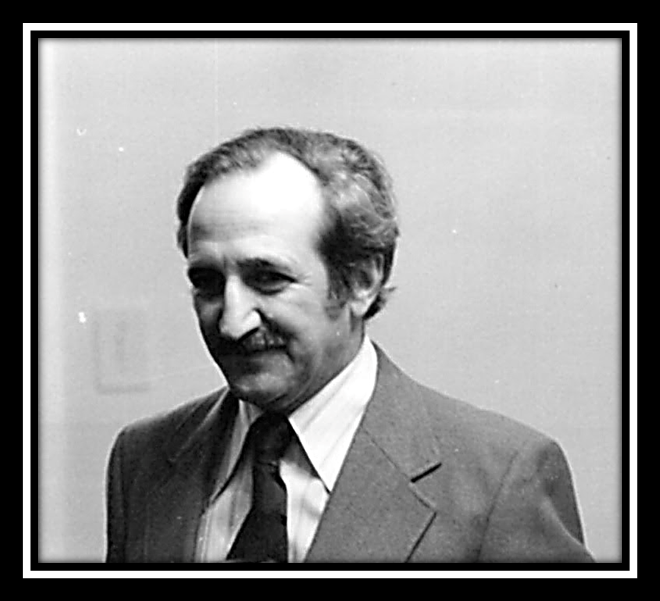
Jack Plax 06/12/1924 – 06/12/2020
Picture: Tali Walt
Jack and Cynthia (Toeks) Plax. Toeks remembered as an extremely attractive women. Jack was the local chemist. The chemist shop was situated in Bath Street over the road from the hotel (Goldblatts Corner). They arrived in Montagu in 1940 shortly after they got married and built a house across the road from the Remembrance Park number 86 Bath Street. Jack was 22 years old and Toeks was 18 years old when they arrived in Montagu. Jack was known for his saying “brandarm”. They were a very social family with large circle of friends. They had three children Julian, Brenda and Harvey who all moved to Cape Town. Toeks came from an Afrikaans background. She was also an office bearer for the local library.
They relocated to the USA and now live in Los Angeles.

Advert: Die Burger 2/10/1963

Picture: Cape Times Week-end Magazine October 30 1954


Pictures: Face Book page: Montagu History/Stefani Simons
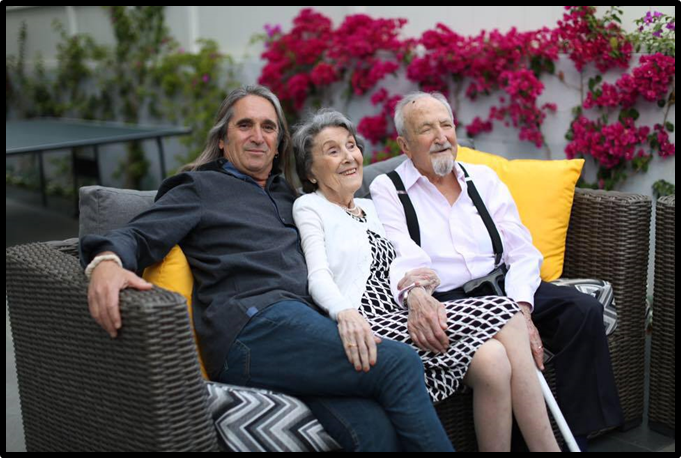
On the occasion of 70th wedding anniversary Jack and Toeks and Harvey
Picture: Face Book page: Harvey Plax.
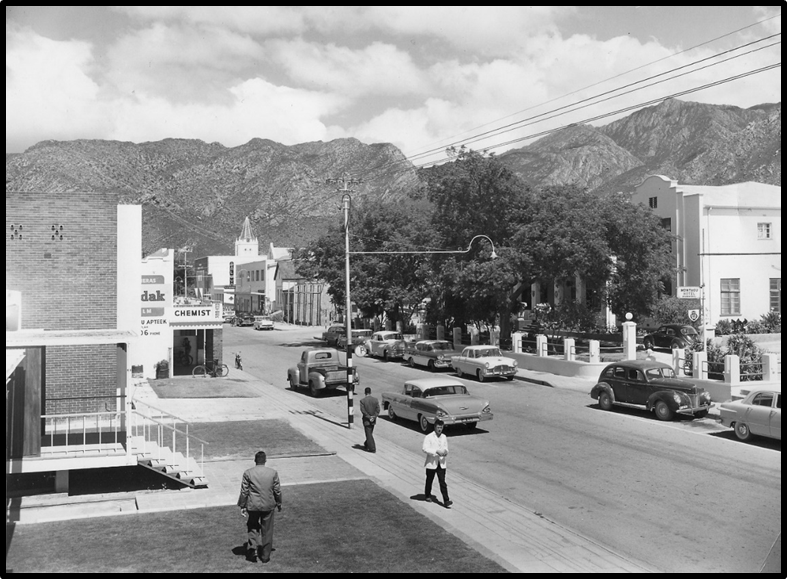
The Chemist shop owned by Jack Plax situated in Bath Street
Picture: Ronel Preston Collection

The Chemist shop taken around 1972
Picture: Kierie van Deventer Collection
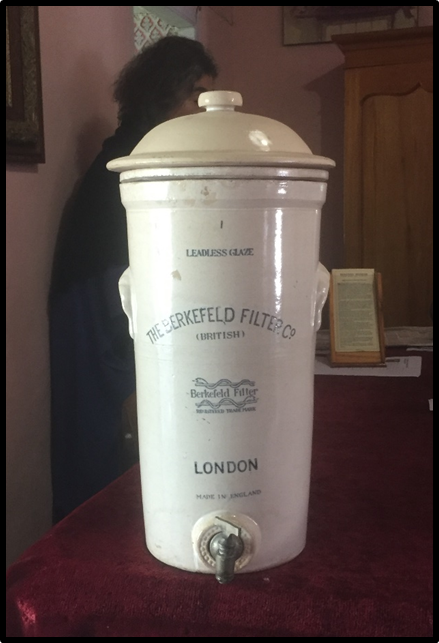
A water filter that Jack donated to the Montagu Museum. He used the water filter in his chemist shop to purify water which he used when preparing prescriptions. The filter is on display at the Joubert House campus.

Brenda, Jack & Toeks
Picture: Tali Walt

Mr. and Mrs. Jack Plax.
Pictures taken on the occasion of Mrs. Plax’s 90th birthday. (2018)

Pictures: Matthew Plax
Raises Family (M Raisers, Reisie, Races)
According to a handwritten document by J.F.D. Kriel found in the Montagu Museum a Mr. Raises did indeed have a shop in Montagu on the corner of Mark and Piet Retief Streets.
In his book Tokkie Bussell makes mention of a Mr. Rayces who lived in a house on the corner of Mark and Joubert Streets.
In an interview done in 1981 Annie Abramowitz who lived in Montagu for 40 years confirms that a Mr. Raises did indeed live in Montagu. The extract (page 22) from the interview is shown below in its original format.
“so there was a family living there, Races, he used to be a rabbi at Worcester but he gave it up and came to Montagu, it was in the ostrich feather time and opened a shop there and he slaughtered for himself, you see, so when he heard that I had such a lot of trouble, he said look, when I slaughter a sheep, you can come and take your meat and if you want chickens slaughtered so I switched over to him, and he was married to a Jewish woman from home and he had four daughters when they came to Montagu, she died in Montagu, and a few years later he got married to a Petticoat Lane, an English woman with two girls, so it was six girls, and she was very jealous of me, so when she used to see my girl come with a chicken or two she used to say Mr. Raysh is not at home and you see if she used to pass my house and see I had friends, and her husband used to say should I go and slaughter tomorrow, she said no because she knew that I depended on the meat.”
A book belonging to a past Principal of Montagu High School which recorded exam marks during 1920/21 was found in the Montagu Museum Archives by Irma Jordaan and shows at least three of the Raises girls. Ellen, Toby and Reb.
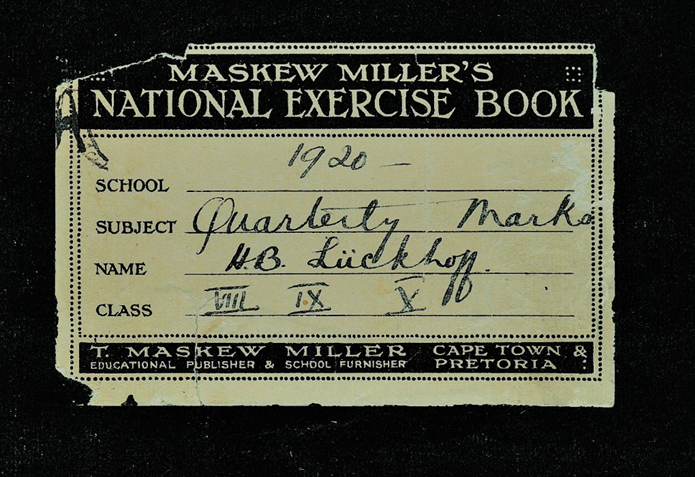

Extract from exam book showing Reb. Raises 4th from bottom.

Extract of exam book showing Ellen and Toby number 11 and 12 on list. The list also shows that Rose Buirski was in the same class.
Book: Montagu Museum
A Mr. M Raises is documented in the publication Jewish Life in South African Country Communities as the first president of the Montagu Zionist Association.
It has not been possible to confirm the correct spelling of the surname as a number of versions have been found. The version used in the heading comes from the Montagu High School exam marks book.
Records found by Rabbi Stuart Serwator in 2018 confirm that Mr. Raisers lived in Worcester from 1906 to 1907 where he also acted as a Shochet.
Sandler Family
David and Rae Sandler, David was a lawyer who arrived and set up his practice in 1930. The Sandler family built a home at 28 Van Riebeeck Street. In his book Tokkie Bussell remembers him as having a thriving practice which was situated at 58 Bath Street. Rae Sandler was known for her cooking skills as well as being a keen bowler who played at the Avalon Springs green.
David was a member of the Montagu Brick Co. (Pty) Ltd. During World War 2 he served in the Montagu National Reserve of Volunteers.
They had a son, Darryl (born 1941/died 1982) and daughter, Cecily. Darryl left the Montagu High School in 1958. He worked as an apprentice mechanic at Roelou Barry Montagu who was the local Ford agent in Long Street. He is mentioned in the school year book as being the first past pupil to donate one pound towards the school year book for 1959 and 1960.
Due to ill health David Sandler was forced to sell his business in Montagu. His daughter also became a lawyer.

Left to right Johan Eden Magistrate, Servaas Hofmeyr (Koffie) Attorney, David Sandler Attorney, Montie Hofmeyr Attorney standing in front of the new magistrates’ court in Montagu. The new court house was opened on the 12th November 1971.
Picture: Montagu Museum
Schachat Family

Advert from Montagu High School Year Book 1927
The Schachat family lived in Montagu around 1927. They had a General Dealer store. From what Eunice Movsowitz can remember her parents bought Goldblatt’s corner from the Schachat family.
Mr. Schachat is remembered by one time Montagu resident Dawie Du Toit as a “Traveler”. He used to arrive on their farm in an old Austin bakkie with his assistant. Mr. Schachat always had a room for the night on the farm and his assistant used to sleep in the vehicle. Dawie remembers him trading haberdashery.
The Schachat family also had an account with Frank Swart the local shoemaker.

Picture: Taken from ledger of local shoemaker Frank Swart. Ledger in archive Montagu Museum.
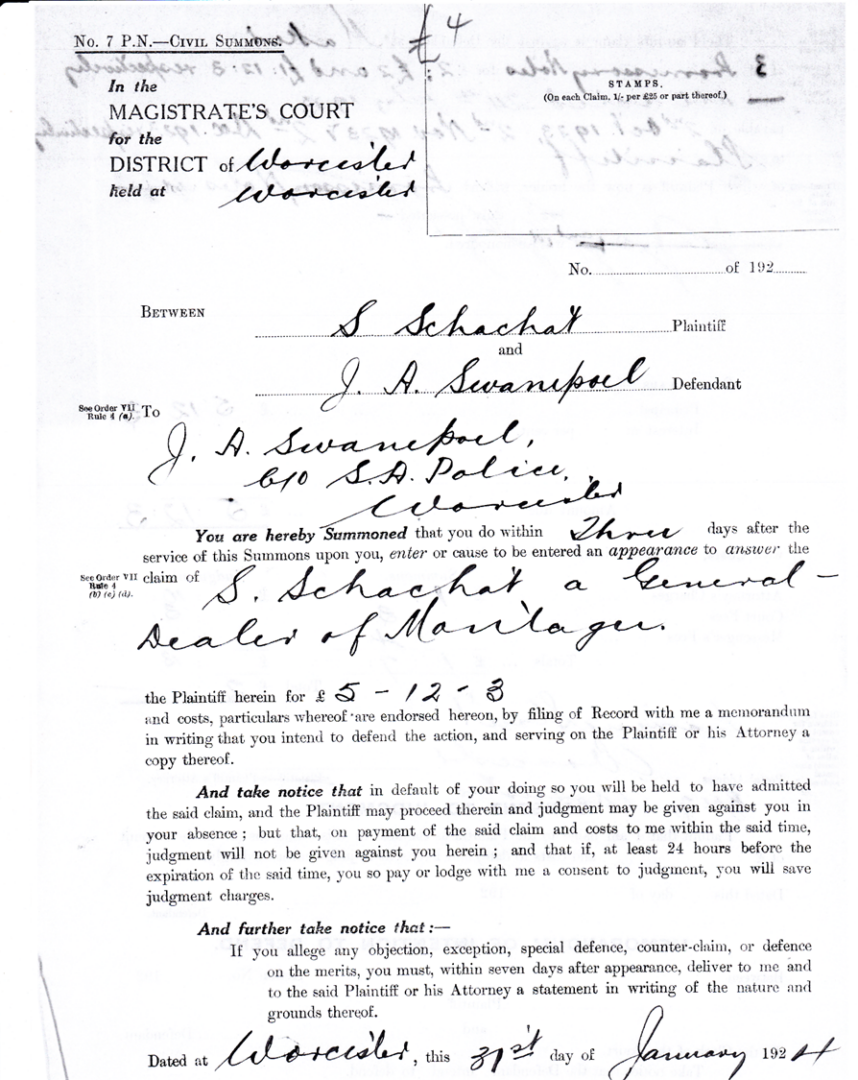
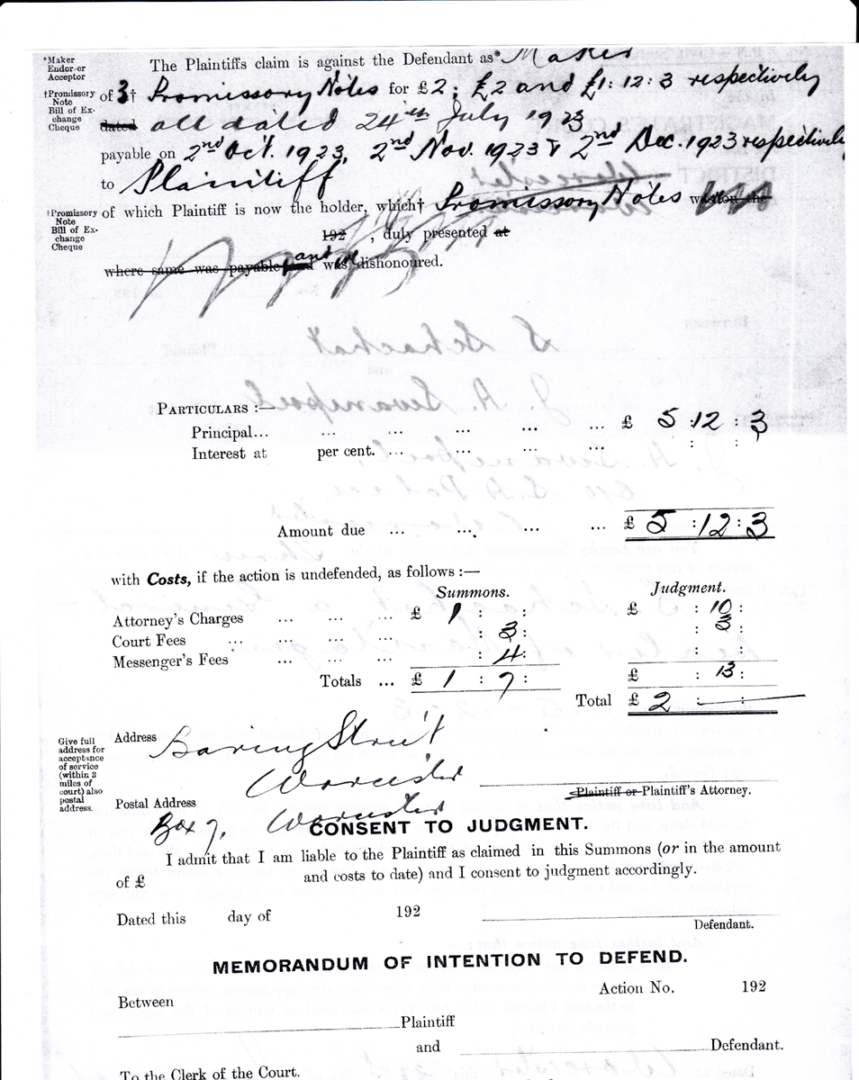
Mr. Schachat issues a summons
Document: Montagu Museum
Schlesinger Family

Caesar Schlesinger
Picture: Sheila Boswell
Caesar and Florence built and lived in a house called QUI – SI – SANA. House built on road to Touws River just outside municipal boundary. Caused a stir as municipality of the day refused water and electricity connections. Local resident Ernie Oosthuizen recalls that the Schlesinger family then built a structure inside the municipal boundary and pumped water to their home. Ernie the son of the local Doctor used to accompany his father to QUI-SI-SANA as a child and remembers being treated with ice cream on these visits. Ernie also confirms that the Schlesinger family had a large smart car.
The house burnt down and was rebuilt.
Florence was an American who is remembered as a serious bridge player. She was known for changing the colour of her hair and this even lead to bets being placed by the locals on what the colour of her hair would be when she was next seen.
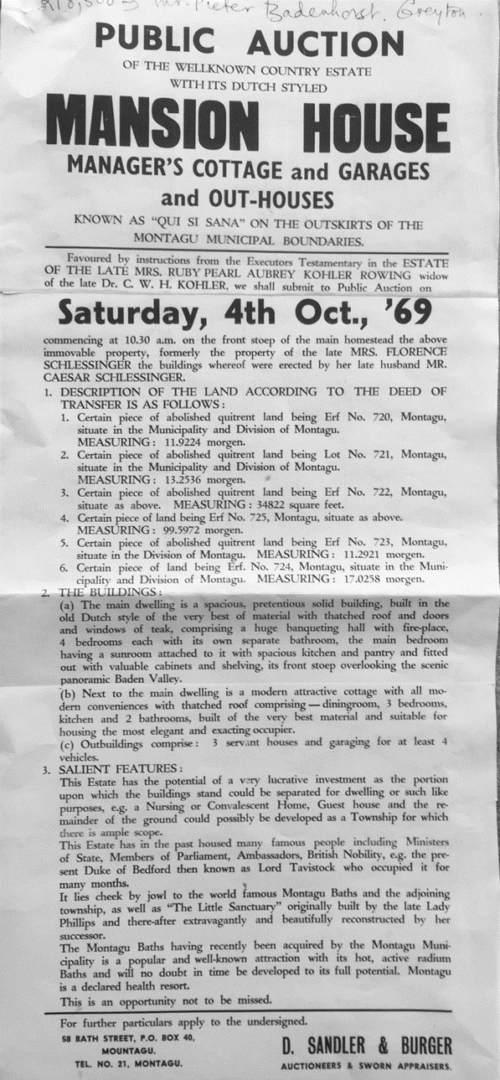
QUI– SI–SANA goes under the hammer.
Document: Montagu Museum
The original Qui Si Sana on fire
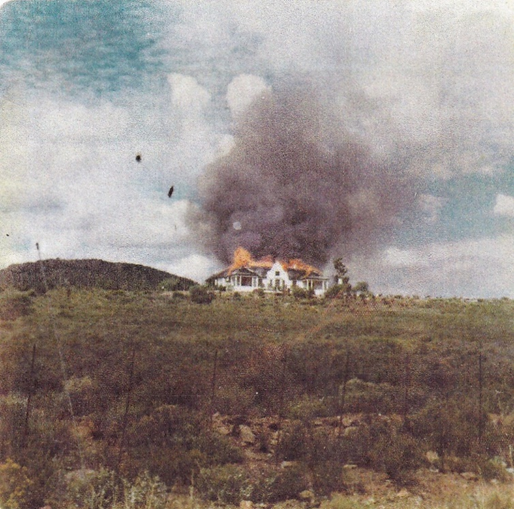
Picture: Montagu Museum
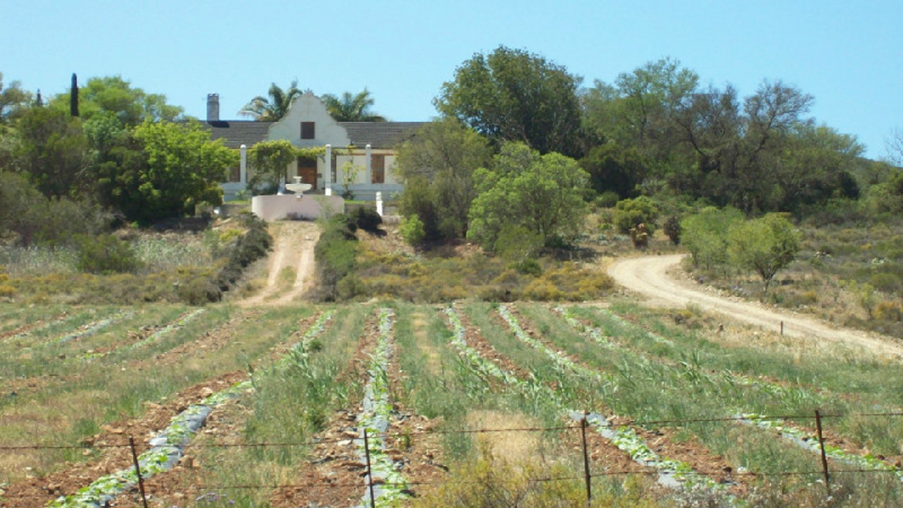
Qui Si Sana after the rebuild. Picture taken in 2018
Stein Family
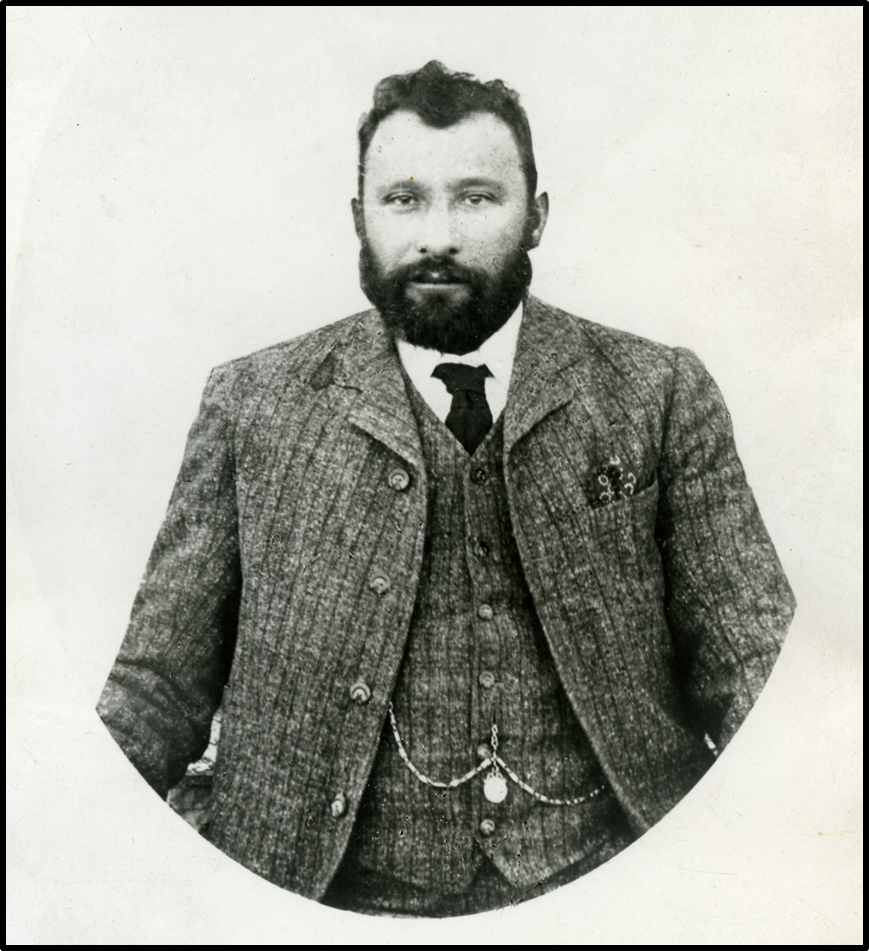
Solomon Zebulin Stein came to South Africa in 1890. He was born in 1860 in Sveksna or Memel, Lithuania, died on 11 Jun 1909 in Montagu.His wife Soroh Leah and children followed him some year’s later around 1899. Solomon was the brother of Mary Millin. They had five children Rachel, Minnie, Bessie, Dinah and Philip.
Picture: geni.com

Montagu Jewish cemetery. It appears an error in the spelling of Solomon’s name was made on his headstone.
In his memoirs only son Philip had the following to say: “My father met our ship and took us to his sister, Mary Millin, who had left Montague and was living in Cape Town. I didn’t know my father and never really got to know him or develop any attachment to him. I was an infant when he left for South Africa now I was eight or nine years old, and as I was the youngest of his children he was approaching fifty. He was a big man, about six foot tall and at this time he was stout and weighed nearly lb 250. He was of an easy-going disposition not good at making decisions. I think I resemble him in that respect. But I had this advantage over him in that I had an unusual aptitude for mathematics, and could build my life and my livelihood around that. My father was fated to be a business man. My father was a smouser or peddler. He loaded his Cape-cart with cloth and trinkets and travelled round the isolated farms. The country was thinly scattered with villages and the ‘smouser’ was a welcome visitor to the farm-folk. The goods were sold on long credits. He had two regular beats and made two visits per annum at each farm. He also did bartering for ostrich feathers and skins. His headquarters was in a village called Montague. When we came to South Africa we first went to live in Montague. There was a small Jewish community there but my mother was the first Jewish woman to come and live there. Jewish emigrants from Russia were mainly young bachelors and many of them had married Boer girls. My mother’s arrival caused some stir. Some of the more simple-minded Boer women had a vague idea that Jews had only sons, never daughters. They came to call on mother, the first Jewish woman they had ever heard about. Ansel, mentioned earlier, had married a Boer girl and so had Nathan Millin. After much trouble Nathan had succeeded in getting his wife converted. The Rabbinate in South Africa wanted to discourage intermarriage and made difficulties about conversions. It was a genuine conversion. His wife tried hard to marry his children off to Jews. She succeeded with her daughter, but not with her son.
There is a small Jewish cemetery in Montague, Nathan’s wife was one of the first persons to be buried there. My father is buried there too. When my mother, my sisters, Minnie and Bessie, and I went to lay a stone on father’s grave we found a number of nameless graves, Jewish soldiers in the British army who had died while in camp in Montague during the Boer war. (Both Nathan Millin and Ansel, as well as P, Stein’s father, are buried, under well preserved gravestones, in this cemetery, ..wds addition)
The Boer war broke out shortly after our arrival in South Africa. The war put a stop to father’s business. However when father arrived from his trip he found there was a brisk traffic in re-mounts for the British army. As he had money on him he was roped into a Company that was doing this trade. It didn’t last long as the British Government started requisitioning the horses and each owner who brought a horse that was acceptable was paid direct. The share of his profits from this trade must have been considerable, for we lived in comfort for two years with father not working and then had enough money left to buy a dairy farm in a suburb of Cape Town.
I started going to school in Montague. I was well versed in Hebrew culture for my age, but knew nothing of the R’s and had never handled a pen or pencil as my learning was always oral. I, and my sister Dinah, went into the baby class. Bessie and Minnie went into Standard 2. The teaching was in the English medium. My fellow students were mainly Afrikaans speaking. I, of course, was equally ignorant of both languages but Afrikaans being a German dialect was not greatly dissimilar to Yiddish.
There was a larger Jewish population at a larger village than Montague, called Robertson. They had a synagogue, a kosher butchery, and a Minister, and mother persuaded father, after one year, to move over to Robertson. Being nine years old on arrival in Montague and a clever boy in addition, I succeeded in passing the two baby classes and Standard 1 in the one year. On arriving at the Robertson school, it was decided that I should miss Standard 11 and try for Standard 111. The attempt was a success and I was top of Standard 111 within a week or so. Having done the three or four years schooling in one year I was of average age in my class.
After a year in Robertson and two years with my father not working the family, probably my mother, decided it was time to make a move. Father and mother left for Cape Town, bought a dairy farm in Ysterplaats – now called Brooklyn – and we left Robertson.“
“We were truly and really bankrupt. Our small assets including the homestead were sold and we had to leave Ysterplaats and go and live in Cape Town. My father went back to Montague to see what he could scrape together for a living. A year or two later he fell ill while in Montague. My mother and Bessie went over. He died. That was in 1908. (1909 on the tombstone…wds) We were then literally destitute.”
Memoir made available by grandson: Wilfred Stein
Vanger Family
Hyman Vanger was one of the first Jewish pioneers to settle in Montagu at the beginning of the 1900 century. He was an ostrich-feather trader/smous. He married Lea. They had two daughters Kate and Dora. The family lived in a large Victorian house behind the Montagu Hotel in Piet Retief Street. (Now the annex to the hotel)
According to a document found in the Montagu Museum, Mr. Vanger used to present each farmer who sold him feathers with a valuable gift after he purchased the farmers annual harvest of feathers. On one occasion he presented Mr. F. Alexander Kriel with a whole sack of raw coffee beans. On another occasion a big clock just over 2 feet long. The document is not dated but it states that the clock was still in perfect working order on the farm Derdeheuwel.
The Vangers left Montagu to settle in Cape Town to get an education for their daughters.
According to Leon Shienbar husband of granddaughter Sandra (interviewed 2018) the Vangers had an arranged marriage which was par for the course in the early days. Granddaughter Sandra remembers Lea Vanger as an excellent seamstress who first lived and worked in Cape Town before moving to Montagu. Lea was also a very heavy smoker.
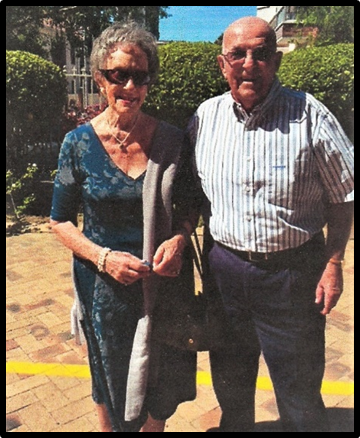
Sandra and Leon Shienbar
Lea and Hyman Vanger


Lea Vanger
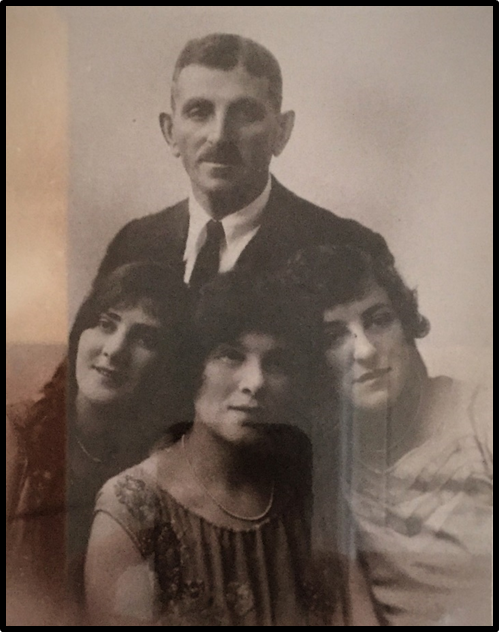
The Vanger Family. Hyman, Lea and daughters Kate (R) and Dora (L).
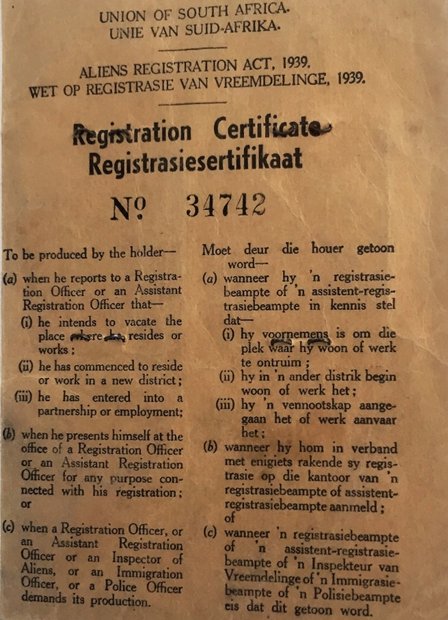
A document required by all non-citizens living in the Union of South Africa in the early days.

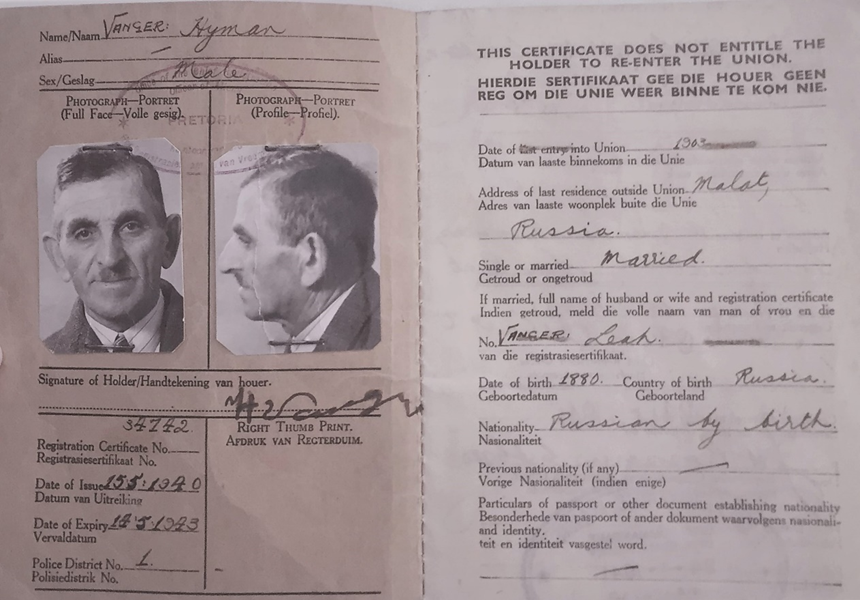
Pictures/Documents: Sandra and Leon Shienbar
Contributions/Assistance
Avrell Beck: Millin family member
Emile Badenhorst: Montagu Museum Manager
Ruth and Bernie Belonsky: Millin family members
Beverley: wife
Clive Biden: Montagu resident
Tokkie Bussell: Soos die Dorp was Vanaf my Kinderdae/Montagu se Joodse Gemeenskap
Yvonne Bussell: Die Joodse Vroue wat ek onthou van Montagu 1900 – 2000
Judith Clare: Millin family member
Dianne Coetzee: Robertson Museum Manager
Lemmy David: Montagu resident. Made video of talk given at Museum on 15th May 2018
Ar De Vries: Montagu resident
Tessa Epstein: Cape Jewish Chronicle
Schalk Esterhuyse: Montagu resident
Irma Jordaan: Montagu resident/ Volunteer Worker Montagu Museum Archives
Clive Kirkwood: University of Cape Town/Special Collections
Dillis Knox Davies: Montagu resident
Ernie Oosthuizen: Montagu resident
Dawie Du Toit: Past Montagu resident
Keith Koonin: Koonin family
Pamela Koonin: Koonin family
Lulu Levine: Goldberg family
Elaine Millin: Millin family member
Stanley and Barbara Moss Grandson of Joseph Moss
Debbie Murray local Montagu resident
Montagu Mail: Various articles
Thelma Gutsche: No Ordinary Woman
Peter Millin: Millin family member
Eunice Movsowitz (nee Goldblatt): Past Montagu resident
Jack Plax: Retired Chemist and past Montagu resident
Matthew Plax: Grandson of Jack Plax
N. (Becky) Saacks: past Robertson Museum Manager
Moira Schneider: Jewish Report
Leon and Sandra Shienbar: Vanger family
Rabbi Stuart Serwator
Rabbi Moshe Silberhaft
Ronel Preston: Local Historian and past Montagu resident
Mr. and Mrs. Graffie Snyman: Montagu residents
Elona Steinfeld: Research Co-ordinator SA Friends of Beth Hatefutsoth
Professor W Stein: Stein family member
Jocelyn Stoch: Interested member of Jewish community
Charles Torrance: Local Historian and Montagu resident
Volume 3: Jewish Life in the South African Country Communities
Don Woodford: Local Historian and Montagu resident
