
114.From a Dutch Windmill to a Water Tower


Updated: 07/05/2026
A Story Correction
The Dutch Windmill of Montagu story has evolved into a historical learning experience of discovery. Assumptions were made based on documentation (article by Andrew Hofmeyr and Hennie Heydenrych see below) found in the Montagu Museum which time and technology has proved to be incorrect. During 2026 I happened to ask one of our regular contributors to Montagu Stories Gerald Batt if he could remember any stories about the Dutch Windmill as a child. Gerald grew up on the family farm in the Koo. In typical Gerald fashion he started digging for additional information on the windmill. At the same time I came across a rare gem of a picture (colour picture below) taken from Kanon Kop showing the structure of the “Dutch Windmill” which I sent to Gerald for comment. In addition to the two aforementioned articles Gerald also discovered that the third picture below showing what was originally thought to be the old windmill in the background was not the windmill structure but a chimney stack of a house behind the church.
Read what Gerald’s digging with the aid of current technology has delivered for us in his article below.
An extract from an article written by Andrew Hofmeyr
The article is not dated but Andrew Hofmeyr died in 1943 so the article would have been written sometime earlier.
Hier kan nog ‘n ou landmerk genoem word, naamlik ‘n ou windmeul wat jarelank gestaan het aan die voet van Kanonkop. Toe dit nie meer gebruik was nie, het daarin gewoon ‘n ou man met die naam van “Krom Jong”. Hy was ‘n ou slaaf en het meer as honderd jaar oud geword. Later het Dr. C.A. Wessels die eiedom waarop die meul was gekoop en toe die boonste gedeelte laat verwyder. Die onderste stuk kan nou nog daar gesien word aan die oostekant van die kindergarten-gebou.
Extract from an article written by Heinie Heydenrych for the October 2004 Montagu Mail
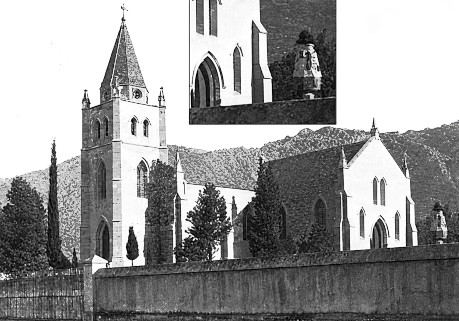
Photo enhancement: Gerald Batt
An interesting feature of this photograph is the Dutch windmill visible to the right behind the NG church Montagu, which can be seen in enlarged form in the inset picture. When enquiries were made among older members of the NG congregation recently, it appeared that there was no longer any person living who had seen the mill, but at least three people were aware that it had existed, Theo Kriel confirmed that Ben van Deventer (church koster) had mentioned the mill when he was already bedridden. The windmill stood immediately north of Joubert Street, about 20 metres west of the boundary of the present pre-primary school. The base of the windmill can be seen on the photograph below taken from Kanonkop in 1901, after the windmill had been broken down.

The windmill was most probably used for pumping water, as it is known that there is a strong underground water vein more or less where it stood. The fact that no portal containing the stairs to the gallery is visible on the eastern gable of the church, proves that the photograph was taken before the galleries were built into the east and west wings in 1906. lt is clear that the photograph must have been taken between 1881-82 and 1901, when the windmill was already gone.
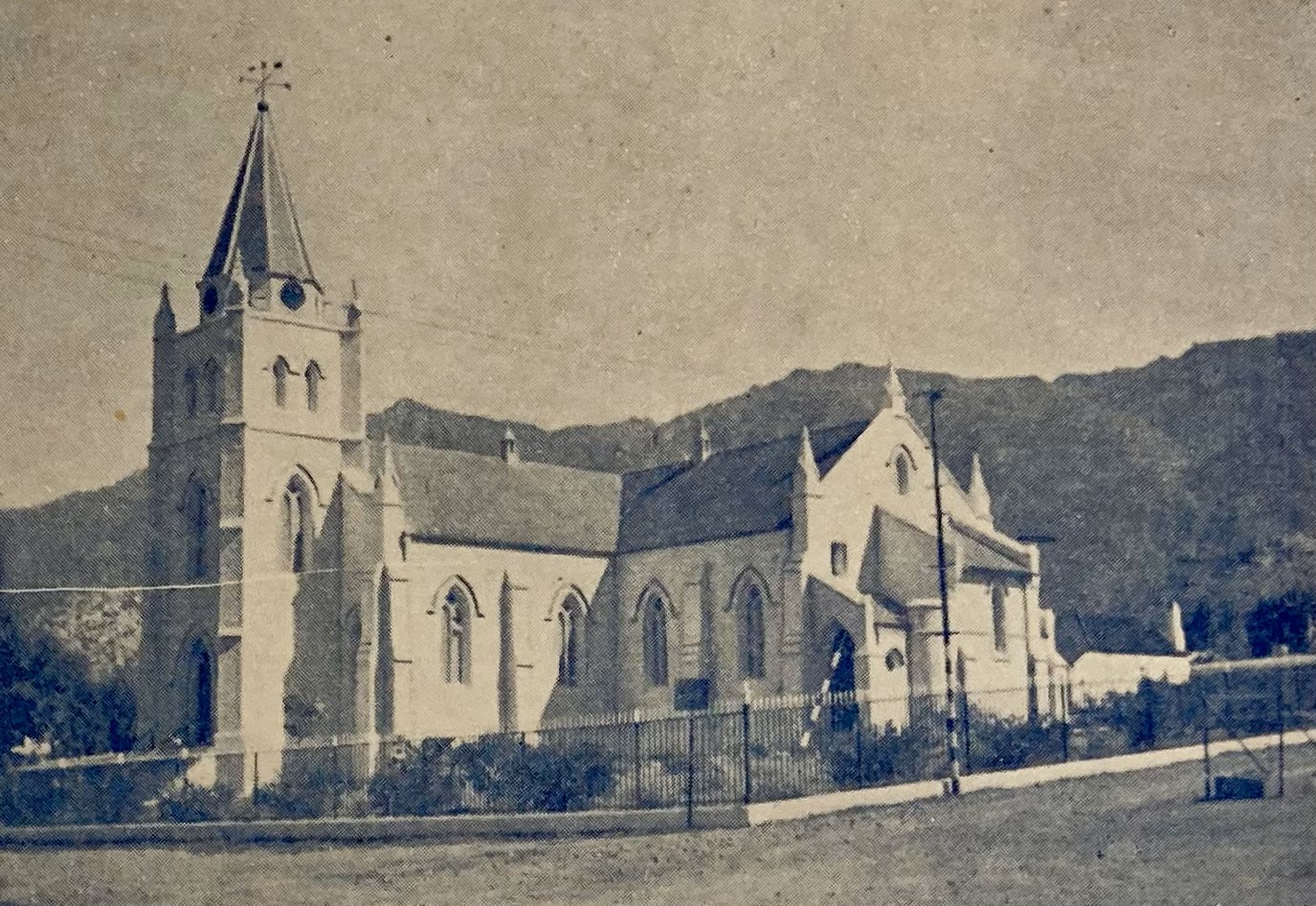
The above picture was found by accident in the NG church hall Montagu. Compare the first picture in the story and the above picture and you will notice that the church boundary wall has been removed.

Gerald’s discovery

The above picture has been photo-shopped to produce a better image
The tower in the bottom right of the photo is a 19th-century stone water tower. While it is often mistaken for a windmill, it was actually built as part of the Joubert House property to store and gravity-feed water for the local gardens and households.
The thick stone construction was quite functional for the region, as the thermal mass helped regulate water temperature against the heat of the Klein Karoo.
The Horizontal Line
The black horizontal line running through the top is a tension or stay-wire. This wire was used to stabilize the structure, especially to support the heavy iron tanks or the wind-pumping equipment that would have been mounted on top of the stone base.
Old water towers work by utilizing gravity to create water pressure, acting as a “giant gravity battery” to provide consistent flow. Water is pumped into an elevated tank—often at night when energy is cheap—and the height (roughly 0.43 PSI per foot of elevation) creates necessary pressure, storing water for high-demand periods or emergencies.
Gravity-Driven Pressure: By storing water at a high elevation, gravity pulls the water down into the piping system, providing consistent pressure to homes without needing constant, active pumping.
The Power of Height: Water towers are typically designed with tall supports to raise the water level. A 130-foot tower creates roughly 56 PSI (pounds per square inch), which is enough pressure for most standard building plumbing systems.
Energy Efficiency and Storage: Pumps lift water into the tower during low-demand hours (like night). During the day, when everyone uses water, the tower feeds the system, acting as a buffer that reduces the need for constant, energy-intensive pumping.
Emergency Supply: In the event of a power outage, the water stored in the elevated tank remains available, allowing water to flow via gravity even if the main pumps stop working.
Historical Context: Before modern electrical pumps were reliable, water towers were essential to ensure water reached the top floors of buildings and provided a steady, reliable flow for towns and firefighting purposes.
