
73.Flower Discoveries

Updated: 24/04/24
Montagu plant experts honoured for their discoveries
Twee plaaslike inwoners en hul belangrike plantontdekkings./Two local residents and their significant plant discoveries.
English version follows
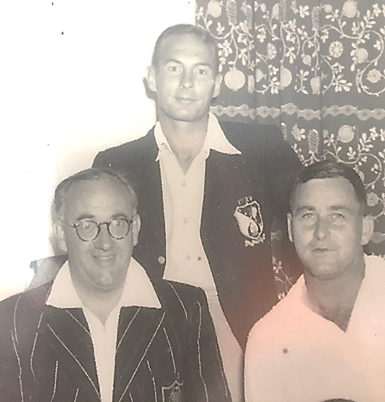
Stefa Pienaar (standing) and two colleagues, Piet Stemmet (left) and Koffie Hofmeyer. Stefa was a keen tennis player and his team pictures are still on display at the Montagu Tennis Club (2019).
Die Gladiolus stefaniae
deur Heinie Heydenrich
Mnr. Stefa Pienaar, destyds van Willem Lourenssingel in Montagu-Suid, is op die ouderdom van 92 oorlede. Hy was die ontdekker van ’n pragtige blom wat hy na sy dogter vernoem het.
Sowat 70 jaar tevore het Stefa, ’n ywerige bergklimmer, hoog op in die berge bokant Kalkoennes op ’n onbekende blomsoort afgekom. Nadat hy die blom gevind het, het iemand van die Suid-Afrikaanse Botaniese Vereniging in Kaapstad Montagu toe gekom om vas te stel of dit werklik ’n ongeïdentifiseerde plant was.Hy het dit bevestig, en daar is besluit om dit na Stefa se dogter, Stefanie, te vernoem: dus Gladiolus stefaniae.

Die blom groei net bokant 300 meter (1 000 voet) bo seespieӫl. Montagu is dus te laag geleӫ (230 meter bo seespieӫl ) maar in die hoӫr geleӫ Koo het Stefa wel van die blomplant se saad gesaai toe hy daar gewoon het.
Stefa Pienaar is in 1911 in Hermanus gebore. Toe hy ses jaar oud was het sy pa, wat ‘n sendeling was, in Montagu kom werk, en hier het Stefa sy skoolloopbaan tot matriek (1929) deurloop. Later het hy in Montagu in die bank gewerk, eers by die Standard Bank, toe by Volkskas en eindelik by Absa waarin Volkskas destyds opgeneem is. Hy was onder andere ook lank in die Strand gestasioneer, waar hy die 100ste tak van Volkskas geopen het.
Stefa se vrou, Sheila (dogter van wyle mnr. Willa Joubert), met wie hy 64 jaar getroud was, het in Montagu grootgeword. Na sy aftrede in 1971 het Stefa en Sheila op die plaas Tolbos in die Koo gaan woon waar hy onder andere met proteas geboer het.
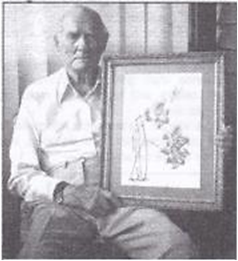
Die Pienaars tel onder die min mense wat ‘n oorspronklike skildery van die bekende Montagu skilder, Francois Krige, besit het. Dit is ’n stillewe van die Bergkatjiepiering (Leucadendron cordatum) wat Krige in 1972 geskilder het.
Sover bekend was Stefa een van net twee persone in Montagu wat ’n nuwe plantsoort in die omgewing ontdek het. Die ander is Pieter Mohr Burger, voorheen van die Koo.
English version
Mr. Stefa Pienaar, formerly of Willem Lourens Close in Montagu South, died at the age of 92. He discovered a beautiful flower which he named after his daughter.
Some 70 years before, Stefa, an avid mountaineer, happened upon an unknown flower in the mountains above Kalkoennes. After this discovery, a representative of the South African Botanical Society in Cape Town visited Montagu to determine whether it was indeed an unidentified plant. He confirmed that this was so. It was decided to name it after Stefa’s daughter, Stefanie: therefore Gladiolus stefaniae.
The flower grows just above 300 meters (1 000 feet) above sea level. Montagu is therefore located too low (230 meters above sea level) but when he lived in the higher altitude of the Koo, Stefa did indeed sow some of the seed of the plant.
Stefa Pienaar was born in Hermanus in 1911. When he was six years old, his father, who was a missionary, came to work in Montagu, where Stefa attended school. He matriculated in 1929. Later he worked in the bank in Montagu, first at Standard Bank, then at Volkskas and finally at Absa into which Volkskas was eventually incorporated. He also worked in The Strand for a long time, where he opened the 100th branch of Volkskas.
Stefa’s wife Sheila of 64 years (daughter of the late Mr. Willa Joubert), grew up in Montagu. After his retirement in 1971, Stefa and Sheila moved to the farm Tolbos in the Koo where he farmed with proteas amongst other things.
The Pienaars were among the few people who owned an original painting by the well-known Montagu painter, Francois Krige. This is the still life of the Bergkatjiepiering (Leucadendron cordatum) that Krige painted in 1972.
As far as is known, Stefa is one of only two people in Montagu who discovered a new plant species in the area. The other is Pieter Mohr Burger, formerly from the Koo.
Pieter Mohr Burger and the Pelargonium burgerianum
The South African Journal of Botany, 1994, 60(3): pp144-148 reported the discovery of a new species of Pelargonium section Campylia (Geraniaceae). The writer was the late Prof. J.J.A. van der Walt of the Department of Botany, University of Stellenbosch. The new species had been brought to his attention by Mr. Pieter Mohr Burger who at the time was a farmer in the Koo Valley district of Montagu, after whom the species was subsequently named.
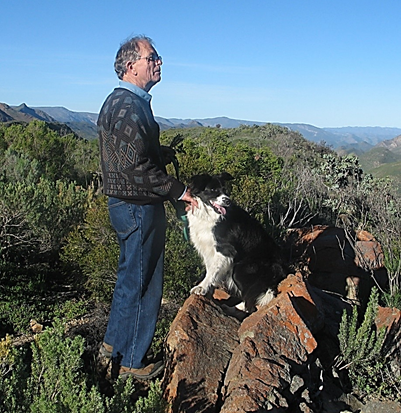
Pieter Mohr Burger
Picture: E. Burger 2019
Mr. Burger relates that he had been exploring the foot of the Langeberg in the Concordia area of the Koo Valley together with his young daughter, Celeste, in search of the varius Pelargoniums that grew there freely. This lead to the discovery of the as yet unknown species. The ensuing scientific examination suggested a hybrid origin.
P. burgerianum is endemic to the Koo Valley and at the time of discovery the species was locally plentiful in its distribution area stretching over a distance of more than five kilometres. Hundreds of plants, including many seedlings, were present in the area which had experienced a veld fire about a year before the material was collected. It is well known that Pelargonium species appear as pioneers after veld fires.
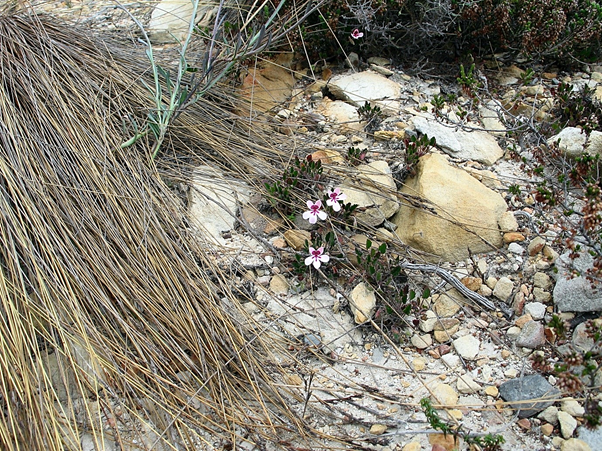
Pelargonium burgerianum
Picture: E. Burger 2019
Article: Home, July 2012 by Jeanne Viall
July 2012 Montagu garden
Cape Town – Heritage and health come together in the indigenous medicinal garden at Montagu’s Joubert House.
And what a delight when I not only discovered this museum garden on a visit to the town, but also met local resident Pieter Burger, who discovered a new Pelargonium near his farm in the Koo Valley in 1992.
The garden is a delight for those who know the plants, and a discovery for those who don’t. Neatly laid out with name boards, and tended by Jerome Douw, it is kept well-trimmed so that it is easy for visitors to see the plants.
Paths are made of peach and apricot pips, and there’s a wetter, marshy area down the centre. Right now some of the aloes are in flower and the orange flower of wilde dagga (Leonotis leonurus) is starting to unfurl from its spiky head. Young fennel with its feathery leaves grows profusely.
There are many kinds of aloes, and the melktou (one of the Euphorbias) named for its milky sap, grows in its unruly fashion.
There’s lots of wilde-als (Artemisia Afra), a popular herbal remedy for many ailments, and one you’ll find in many a garden of those who know herbs.
The medicinal garden has its roots in the 1980’s when the museum trustees decided to gather information from the older generation before the knowledge was lost.
Herbal remedies of the Khoi and San who lived around the Langeberg mountains have been passed down through generations to farmworkers in the area and in 1982 the curator and chairman of the trustees of the museum paid a visit to one Cornelia Swart in Bredasdorp, who had found great relief from the herbs she had learnt about from a Khoi man who worked on her farm. These herbs came from the Montagu mountains.
That was the beginning of the museum’s research into the medicinal plants, and just more than 10 years later, in 1993, on a dusty bare piece of land behind the museum, the garden was started. Paths were laid out and beds established.
Remedies for ailments were written down based on the elders’ knowledge and the museum published a book, Herbal Remedies. The local names of plants were noted as well as the area they were found in.
As many as possible of the indigenous herbs are grown here, but many, like buchu, are habitat specific. Only 10 percent of the area’s herbs can be grown here and the museum’s list of herbal remedies is 115 long.
“When this project was started, it was also a project of job creation in the area,” says curator Annette Cilliers. “Several local people went on training courses to learn about the herbs and were taken on as workers.
“Today we have only one gardener, Jermaine Douw, and one herb cutter (due to lack of funds) who keep us going. Fortunately we have a team on our staff who can help out if necessary, but it can become hectic.”
Many people are involved with the garden, and Pieter Burger is one of them, playing an ongoing role.
He has been largely responsible for identifying the plants, matching their common names with their botanical names and verifying them. He also keeps an eye on the garden.
“I also go with the museum workers to collect plants. I am of this earth and know where the herbs are,” he says.
He shows me some of his piles of old telephone directories at his home, in which he dries the herbs requiring identification.
Using the local names as a guide – and the same plants can have different names depending on the area – he takes the books to the Herbarium in Kirstenbosch, and if they can’t identify the plants, they are sent to other people to do so.
In the museum garden there are many varieties of Pelargoniums: lemon-scented, night-scented, gooseberry-leaved and five kinds of wildemalva.
Other plants that catch my eye are Kruidjie-Roer-My-Nie (Melianthus major), which is a poisonous plant as its name suggests, but is used as a poultice or a soak.
The common Bulbine grows well here, its sap the best remedy for burns, although its listed as good for eczema as well.
The garden is well-established now, with large trees, and it’s a pleasure to go through it slowly with the list of plants and put the folk names to the plants. Uses for plants like Gifbol, Ghoenavy, Kooigoed and Kougoed, Kanniedood and Harpuis are fascinating to read up about.
There are some familiar ones, like Kankerbossie (Sutherlandia frutescens), subject to research for its immune-stimulating properties.
Cilliers has many anecdotes to tell of the people who come to buy the herbs sold at the museum, made up for various remedies according to the old recipes.
The museum collaborates with a research project with the SA National Botanical Institute and UCT.
The University of the Western Cape, which has an indigenous phototherapy centre, buys its herbs from here. These herbs are collected, under permit, from the wider area and dried.
Serendipity has it that Antoinette Pienaar, apprenticed for many years to her teacher Oom Johannes Willemse, is in Montagu to talk about her book, The Griqua’s Apprentice. She talks about the rich heritage of our indigenous herbs.
The Joubert House’s medicinal garden makes this cultural heritage all the more accessible to us.
* Call the museum at 023 614 1950 for more information.
Right spot, right time for unique plant find
Pieter Burger grew up in the Koo Valley and farmed there all his life. His passion is “plant spotting”. Wife Elise says: “When we drive he’ll suddenly slam on the brakes – he’s spotted something at the side of the road that’s interesting.”
The Pelargonium he discovered grows on rough terrain, and is endemic to a very small area of the Koo Valley.
“I can remember that day well,” he says.
“We saw some Pelargoniums and my daughter Celeste, then 10, asked: ‘Papa, what is this then?’ Instinct told me it was something new, something I hadn’t seen before, so I took it to Professor Adri van der Walt (a Pelargonium expert).
“There was great excitement in the botanical world and it was sent to Germany to see if it matched other varieties, and it was unique.”
The Pelargonium was named Pelargonium burgerianum, after Burger, and has a delicate white flower, flushed with pink, with a wine-red centre.
There are almost 40 kinds of Pelargoniums in the Montagu area alone. “I was in the right spot at the right time,” says Burger.
He has tried to grow it in his garden in Montagu, but it won’t take. It likes north-facing slopes with rocky, gravelly soil.
But, he says, he knows of people who have managed to grow it under controlled conditions in Paris. How strange is that?
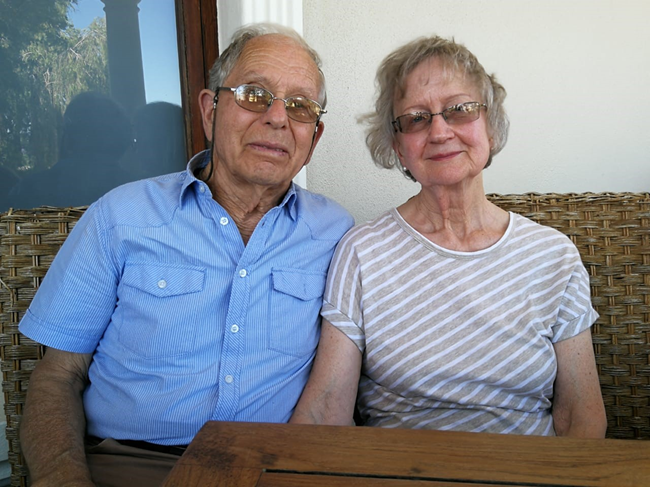
Mr. and Mrs. Burger enjoying their retirement in Montagu
Picture: E. Burger 2019

Contributions: Mrs. Burger for doing the editing of this document.
