
48.Montagu Short Stories 4

Updated: 13/06/2025
Did you Know? Het jy geweet?
Story 1: JOHN MONTAGU
Story 2: MONTAGU SPORTING CLUB
Story 3: THE MONTAGU YACHT CLUB
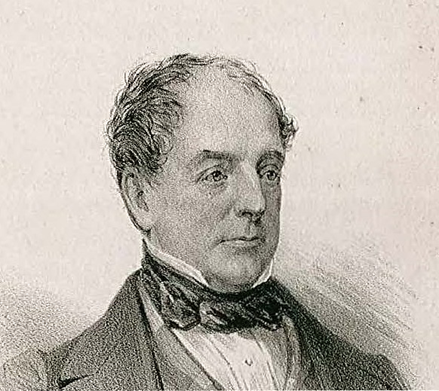
John Montagu
Picture: Geni.com
The following document was found in Montagu Museum no author shown
BENEFACTOR TO SOUTH AFRICA, FOUNDER OF OUR TOWN.
JOHN MONTAGU was born in India on August 21st. 1797, the son of Lt. Col. Edward Montagu who was killed on active service there when John was two years old. He came of a very old family who had always served King and country well. One Drogo de Monteacuto, his earliest known ancestor, came to England at the time of the Norman Conquest, another descendent, Sir Edward Montagu, was Chief Justice of the Court of the King’s Bench in 1539, as well as being one of the 16 Executors of the Will of Henry VIII, and a Regent of the Kingdom and a Governor of the Young Edward VI.
Two or three generations later, in 1620, Sir Henry Montagu, as Lord Treasurer of England, was made Baron Montagu of Kimbolton and Viscount Mandeville, six years after, In the reign of Charles I, he received the Earldom of Manchester.
James, the Third son of this first Earl of Manchester, was John Montagu’s great grandfather, so that James may be said to be a collateral descendent of this illustrious family. In this country he is often quite erroneously given the title of “SIR”. He was in fact plain Mr. Montagu, although he was often spoken of during his service in South Africa as “The Honourable” because of his high place in the civil administration of the Old Cape Colony.
As a youngster he was sent to prep school in Cheam, Surrey, and later to a school in Knightsbridge in London, as well as having a private tutor.
Aged 17, in 1814, he was an ensign in the 52nd. Regiment and after the Battle of Waterloo In which he took part, he was promoted to Lieutenant.
In 1823 Montagu married Jessy, the daughter of Maj. Gen. Edward Vaughan Worsley, and in 1824 he was sent as Private Secretary to the Governor, Sir George Arthur, to Van Diemen’s Land, now called Tasmania. He retired from the army in 1830 and advanced to be Public and Military Secretary as well, in this far-flung corner of the British Empire.
In 1834 he was made Colonial Secretary of Van Diemen’s Land by the British Foreign Secretary, Lord Aberdeen. One of Montagu’s greatest achievements there was the improvement of convict conditions and his work for the more humane treatment of these men.
In 1839, after 15 years’ service, he went back to England, but two years later returned once more but not for long. The then Governor, Sir John Franklin, did not see eye to eye with his experienced Colonial Secretary, and in October of that year (1841), they had a most stupendous “row”. In 1842 Montagu was suspended from office and in February he left for England “lamented” by all and arrived there four months later. Just a year after this, on April 23rd., 1843, he arrived In Cape Town as the new Colonial Secretary, at the Cape of Good Hope, Maj. Gen. Sir George Napier, Governor, (Montagu served 4 other Governors as well: Maitland, Pottinger, Smith and Cathcart).
This Sir John Franklin was a famous explorer in Australia, The Arctic and Northern Canada, He searched for and discovered the North West Passage in 1845 and died on this expedition. His body was not discovered for 14 years.
It is perhaps not unjust to say that it was entirely due to Montagu that the mountain barriers of the Cape were opened for traffic by means of new passes and roads. Before his term of office (1843-53) the hinterland of the eastern and Western Cape were practically cut off from all civilization and markets.
The impenetrable mountain tracks were a sore trial to travelers and farmers’ at that time. The following can be taken as a good example as to what our forefathers had to put up with it is actually a description of what used to be called “Cradock’s Kloof: “It was a most impossible place for horses, much less wagons, to get over, I ever beheld; it is positively as perpendicular in parts as the face of Table Mountain. The distance is only 5½ miles, but what with accidents and detentions it is nothing uncommon for a wagon to be three days on getting over the barrier”.
Before Montagu came to the Cape Colony only two formidable mountain barriers had been opened. These were Fransche Hoek Pass and Sir Lowry’s Pass. Montagu was forever on horseback, it is fantastic that he ever had time for anything else and indeed in 1849 he travelled 2000 miles in this way up and down the Colony searching for new ways of communication. His achievements (and they most certainly were) to which South Africa should forever be indebted, shortly told were: The Montagu Pass, Mitchell’s Pass, Bain’s Kloof Pass (which he had begun with Andrew Geddes Bain but, did not live to see completed), the Zuurberg Pass and the new road at Howisons Poort towards Port Elizabeth.
In those days colossal upheavals caused by road and pass making went into mere thousands of pounds where today they would cost millions, £1,753 (R3,506) was spent on gunpowder alone and 5½ miles were blasted out of solid rock, in the construction of the Montagu Pass. Bain’s Kloof Pass, began in 1849 and finished in 1853, only cost £50,000 (R100,000) odd and used 300 to 400 convict labourers. Incidentally Thomas Bain son of Andrew Geddes Bain, constructed the tunnel at Cogman’s Kloof, the entrance from Ashton to the town of Montagu.
Montagu’s use of convict labour had been practiced with great success in Van Diemen’s Land. From the point of view of communications quite apart from more advantageous markets for the farmers, the postal system from Cape Town to Grahamstown took 135 hours and 1/- (10c) per letter. In 1845, thanks’ to Montagu, It took 30 hours less, and the cost of letters was reduced to 4d. (3c) per half ounce. “Fast” post carts could now do the trip from Cape Town to Port Elizabeth, via Grahamstown at 8 miles an hour and there was now a thrice-weekly mail to Paarl, Worcester and Tulbagh.
Such a benefactor to South Africa in the last century was JOHN MONTAGU. He was enormously popular, being, an unostentatious, energetic, sincere, sympathetic and an extraordinarily able administrator and it was not easy in those days for a civil servant to be admired in all camps, as inter-colonial jealousies were then the order of the day. Not only did Montagu regard convicts as human beings and used them as such, but he had a lot to do with hospitals and health services, and the improvement of the administration of the courts of law in the Colony. And above all, he was remarkably well thought of in Whitehall, as he reduced the Cape’s debts. Before he came the liabilities of the Colony amounted to over £182,000 (R364,000). In two and a half years he had liquidated this sum by means “as fair and easy to the inhabitants of the Colony, as just and simple in their arrangements, requiring no new impost, no burdensome tax, but a vigorous application of the Colony’s available resources”.
In 1841, when Sir George Napier was “Governor and Commander-in-chief of Her Majesty’s Castle, Town and Settlement of the Cape of Good Hope in South Africa”, one Pieter Swanepoel’, farmer, came over the hazardous mountain’ “roads” from Wellington and bought 1448 morgen and 50 sq, roods of “a piece of land situated in the Division of Swellendam, Field Cornetcy of Agter Cogman’s Kloof, being the loan place “Uitvlucht“. This land cost Swanepoel £3 (RS) sterling per annum.
We found a note dated 1852 on the original Swanepoel land deed (Erf No.1) to the effect that free access was now given on his land to the “spanplace through the streets of the village now laid out on this ground“.
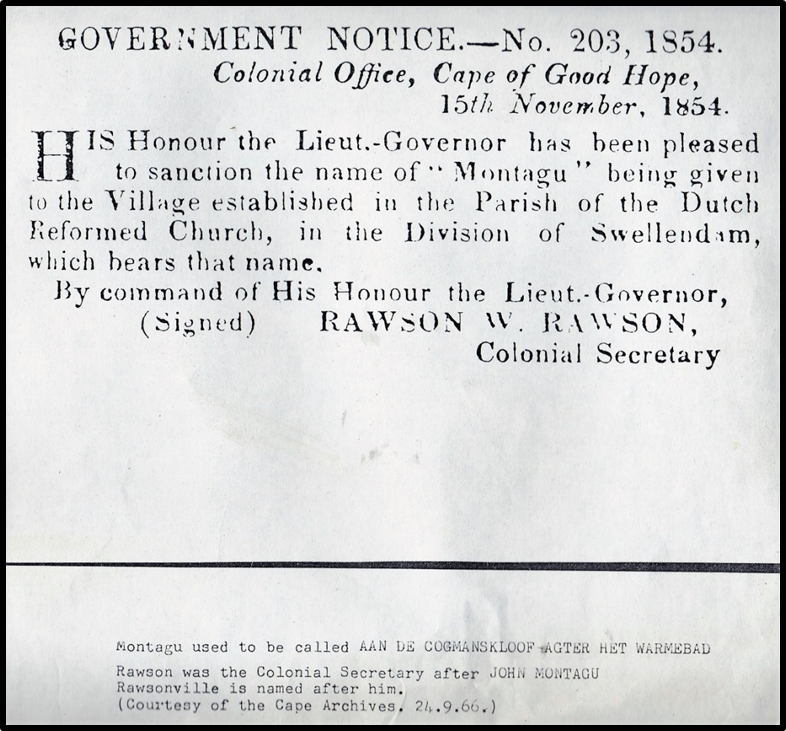
This “village”, once known merely as “Behind Cogman’s Kloof” was now called MONTAGU. It is locally thought today that the Colonial Secretary himself came here in January, 1851, but his biographer does not mention this fact specially. But knowing Montagu’s energy in riding all over the Cape it is highly probable. So that we can assume that he came and “baptized” the town himself with his name. He apparently had a meal on Erf No.35 in a house which is still standing today in Long Street.
Note: It is highly unlikely that he visited the town to baptize it as the town was only officially named after him after his death.
The town itself was founded officially in 1852: in 1854 the Dutch Reformed Church was built; in 1858 it received a postal agency and in 1882 the first Postmaster’s Office; in 1881 the Montagu Village Management Board was established, later (1895) to blossom forth into MONTAGU MUNICIPALITY.
This now flourishing wine and fruit producing town of nearly 6,000 people, approached on one side by Thomas Bain’s “hole in the rock”, and surrounded by the once impenetrable mountains, owes its name and its prosperity through the years, as indeed does the whole of the Cape, to its founder and benefactor, JOHN MONTAGU.
MONTAGU died in London on November 4th.1853, still in office, worn out by his services to the Cape. He was buried at Brampton cemetery on November 8th., the Metropolitan of Cape Town Bishop Robert Gray, officiating at the funeral. He was 56 years old.
The MONTAGU family motto was: “DISPONENDO ME, NON MUTANDO ME – REGULATE ME, BUT DO NOT CHANGE ME”. This might well be the motto of our country.
HORSE RACING IN MONTAGU
Extract from notes by Miss Babsie van Zyl of Le Roux Street, Montagu. She wrote these notes in 1964 to assist Mrs. Bee Jordaan who was at the time the Archivist at the Montagu Library
RACE COURSE
In the old days quite a lot of horse racing used to take place here. This racing took place in Montagu itself at that stage and later on, as the village grew, it used to take place more or less where Mr. McSweeney’s (now Dr. Scholtz’s – in Hospital Street) house is and towards Sofie Brink’s (next door) and further along.
My father also told me that the traditional animosity and competitive spirit between Montagu and Robertson, which has existed for generations, had its origin in horse racing. It appears that a Montagu farmer entered a horse at a race meeting at Robertson. It was an extremely scruffy looking animal, but to the surprise and intense annoyance of the Robertson people, with their beautifully trained and groomed animals, it put up a remarkable performance, leaving the other horses far behind. Evidently the Robertson farmers never forgave this Montagu farmer. The name of the farmer, his farm, his horse and the subsequent history of the horse was told to me, but I have forgotten it all.
Transcribed from a document found in Montagu Museum
On MONDAY, 7th OCTOBER, 1918,
AT 11 O’CLOCK SHARP
President: J. D. MALHERBE, Esq.
Vice President: J. VAN ALPHEN, Esq.,R.M.
Stewards: Messrs. Louis Knipe, Kowie du Toit, Abie Jordaan, W. O’Connor, Kowie Kriel and Josua Bruwer.
Working Committee:
JUDGES: J. van Alphen, Esq., R.M., Dr. Wessels.
STARTER: Mr. J. Ehrenspergen.
CLERKS OF THE COURSE: Messrs. Kowie du Toit, Abie Jordaan.
CLERK OF THE SCALES: Mr. Pon du Toit.
EVENTS
1. Trial Plate.
Open. Value £4. Second 15/- For horses that have never won a race before.
Weight not less than 130 lbs. Entrance 4/-
- Moonlight: Mr. Jan Steyn
- Good Luck: Mr. Kowie du Toit
- Mac: Mr. H. Schonken
- Spring: Mr. G. Bruwer
- Krulie: Mr. James Bruwer
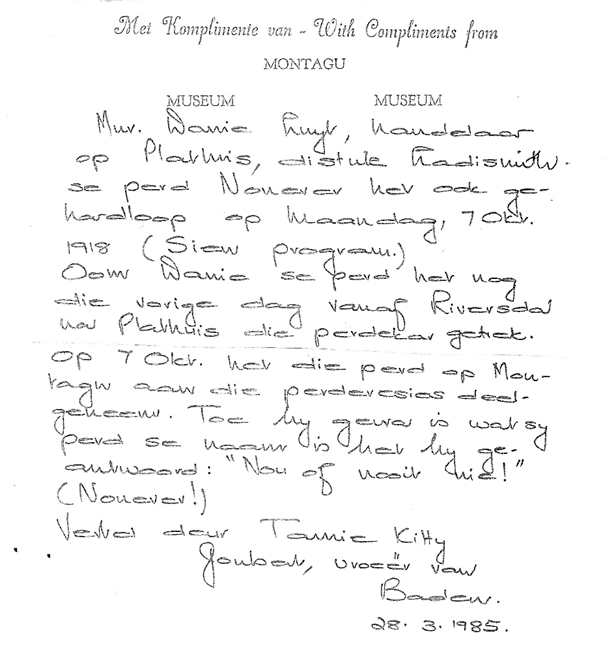
- Noneever: Mr. Luyt
2. District Plate. Closed, Value £5, Second £1. For horses bred in Montagu and Barrydale. Weight not less than 140lbs. Entrance 5/-
- Prodigal: Mr. James Bruwer.
- Marque: Mr. Josua Bruwer.
- Music: Mr. Gillie Burger.
- Victor: Mr Gert Bruwer
3. Three Star Race. Open. Value £10 of which £2 to the Second. Given by Messrs. Harry and Gillie Burger. Three horses to start belonging to different owners. Weight 140lbs. Entrance 5/-
- Non Sequitur: Mr. Gillie Burger
- African Girl: Mr. Josua Bruwer
- Nonever: Mr Luyt
4. Pony Race.Open. Value £3, Second 7/6. Horse 14.1. Weight 130 lbs. Entrance 3/-
- Victor: Mr.Gert Bruwer.
- Ruby: Mr. M.Burger.
- Prodical: Mr James Bruwer.
- Mac: Mr. H. Schonken.
- Galatia: Mr. Gillie Burger
- Snowdrop: Mr. Ebbie de Wet
- Nonever: Mr. Luyt
5. Donkey Race.
- Vaaltijn:Mr. Kowie Kriel.
- Kleinveldt: Mr, Gillie Burger.
- Jacb: Mr. Louis Burger.
- George: Mr. Gert Bruwer.
6. Mile Running.
7. Stewards Handicap. Open. Value £12, Second £2. Weight 135 lbs. Entrance 10/-
- Phoenix : Mr. Joey Malherbe.
- Non Sequitur : Mr. Gillie Burger
- African Girl: Mr. Josua Bruwer.
- Nonever: Mr. Luyt.
8. Red Cross Race. Open. Value of race to be given to the Red Cross Fund. Weight 140 lbs. Entrance 2/6.
- Victor: Mr. Gert Bruwer.
- Good Luck : Mr. Kowie du Toit.
- Music : Mr. Gillie Burger.
- Galatia : Mr. Gillie Burger.
- Ruby : Mr. M. Burger.
- Nonever: Mr. Luyt.
9. Hack Race. Closed. Value £2, Second 5/-. For horses that have not been entered in any other race during the day. Weight 150 lbs. Entrance 2/6.
- Whisky: Mr. J. Steyn.
- Nullus : Mr, Harry Burger.
- Marque : Mr. Josua Bruwer.
10. Ladies’ Purse. Closed. Value £4, Second 15/Weight 140 lbs. Entrance 4/-
- Galatia: Mr. Gillie Burger.
- Music: Mr. Gillie Burger.
- Phoenix: Mr. Joey Malherbe.
- African Girl: Mr. Josua Bruwer.
- Krulie: Mr. James Bruwer.
11. Forced Handicap. Value £2.
CONDITIONS
- No coloured people are allowed to ride.
- All Jockeys must ride in colours.
- Owners of winners of £10 and more from other districts are allowed to enter in No. 8, and in one other open race.
- Owners, when entering in Nos. 1 and 4, must have a certificate from Mr. Louis Knipe, viz. Height and age.
- All entries must be made not later than 1st Oct.
- Three horses must start in each race or the value of the race may be reduced, except in No 8
H. Burger,
Hon. Sec.
THE MONTAGU YACHT CLUB
(Written by Terence Negus for Montagu History F/B page)
In the late 50’s my father, James Negus, Dr. Louis de Villiers and Dr. John Took decided to start a yacht club out at Poortjiekloof dam. The word spread and eventually there were six yachts, all Sprogs having fun on the Poortjieskloof dam! Each yacht had a name beginning with an S. So there was James, with the yacht Spry, Took’s was Sabret, de Villiers with Sabrena, Sakkie Nel with Sultana, Peter Moore Burger with Satan. The sixth yacht was Sarki but for the love of it I cannot remember who the last person was. However we had wonderful times out at P/Kloof dam. They used to have regular Regattas and I remember sleeping over at the wooden club house over weekends!! We used to fish for black bass and all us children used to have a ball!!! Lots more fond memories, but maybe later. Sure there must be more people that would remember these days??!! I was only 5 or 6 years old then.
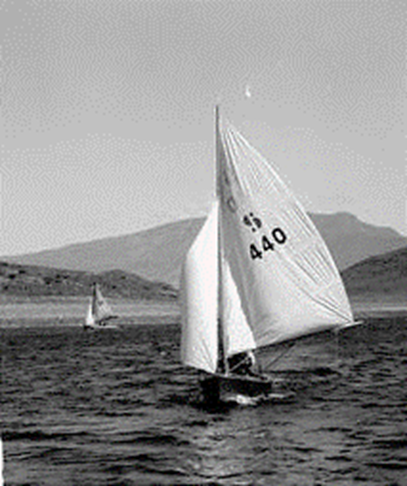
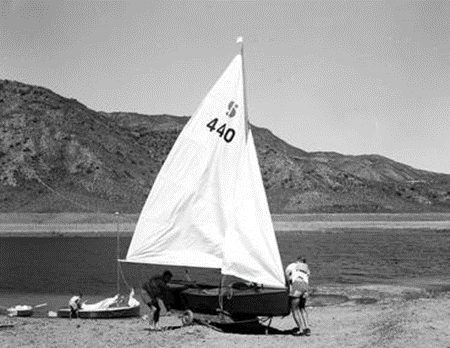
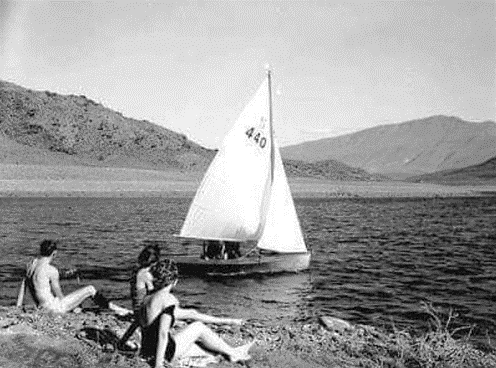
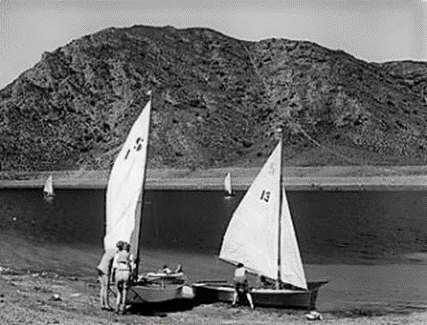
Oh for the return of these days
Pictures: Transnet Heritage Library Photo Collection
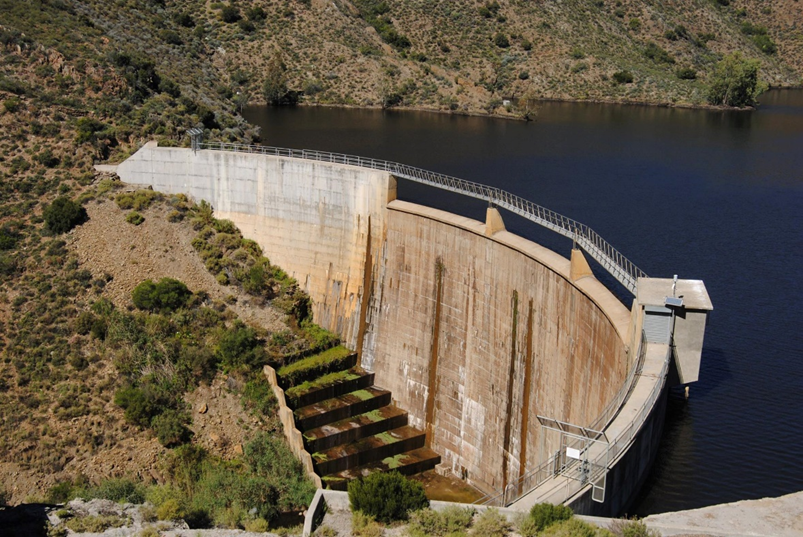
Ronel Fouché (22/11/2014): Die Poortjieskloof dam het van 2003 tot 2008 elke jaar oorgeloop en weer in 2011 en 2012. Die rivier voor ons huis is dan taamlik sterk en ons en die bure kan dan vir ‘n paar dae nie dorp toe gaan nie. Die kinders geniet dit natuurlik want dit beteken geen skool vir ‘n paar dae.
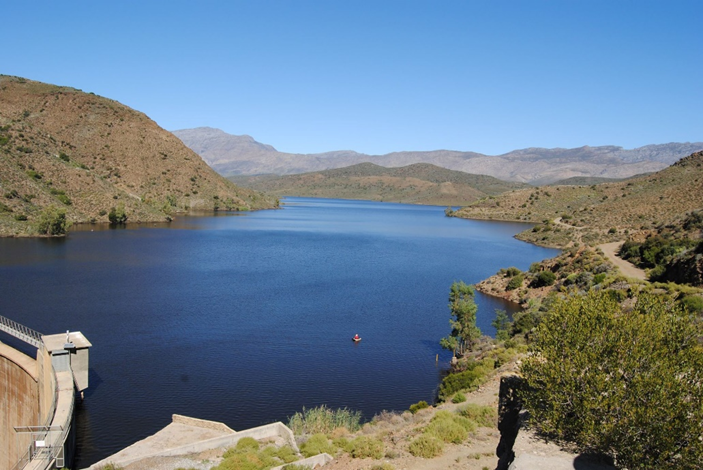
Contributions: Irma Jordaan
