
20.Maestro and Commander (Michael Scott)

Updated: 27/09/2024
MICHAEL SCOTT AND GERRIT WESSELS
Compiled by Irma Jordaan
Source: Die Burger/The Cape Times
Montagu has seen its fair share of interesting people who have landed up here, but none more so than Commander Michael Scott and Gerrit Wessels.
As a couple they lived at no 19 Uitvlucht Street, Badshoogte and they were as diverse in nature as it could get. Michael Scott was shy and retiring and only mixed with a few English speaking locals, whereas Gerrit Wessels, who was born into a poor middle class Afrikaans family from Bloemfontein, was always the centre of attention wherever he went, everyone’s friend and very hospitable.
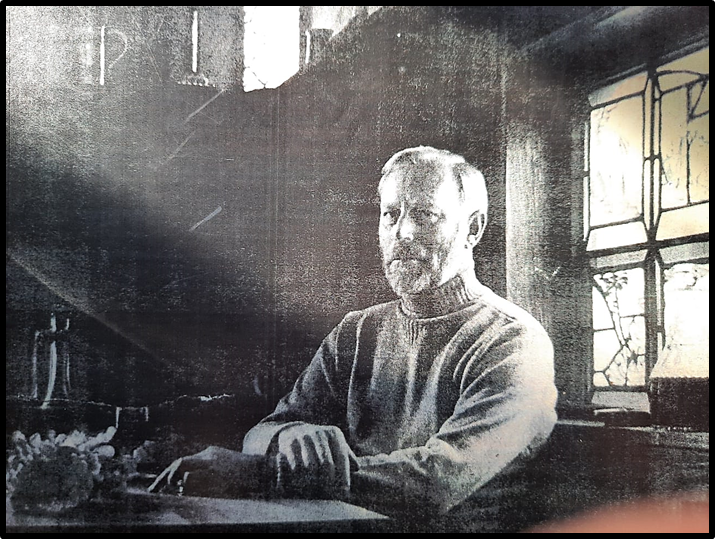
Michael Scott
Picture: Montagu Museum
Michael Scott, was a highly intelligent, well-educated English gentleman, who did not believe in listening to the news or reading the newspapers. He firmly believed that the British Empire as he had known it, had not changed over the years.
He was born into a life of luxury and privilege as his father was the personal physician of the late King George V and his mother the heiress of the Meakin Porcelain fortune. As a result of his father’s position he spent a lot of time in the company of the British Royalty and became close friends with the then Prince of Wales, who went onto become King Edward VIII for a short time and who abdicated his throne to marry Wallis Simpson. Lord Mountbatten or “Dicky” as Michael referred to him, was another childhood friend. Mountbatten became the last Viceroy of India and subsequently Lord Admiral of the Royal Navy.
Michael was educated at Rugby and New College, Oxford and went to study music at Oxford and the Royal College of Music under Sir Hugh Allen and Michael Sergeant, and privately with the late Albert Coates, who took him to Munich in 1929 for the production of the Coates opera Samuel Pepys. He stayed on to study with Knappertsbusch, and became conductor at the Munich Opera House, till he left in 1933, on the advent of Hitler. He continued his musical career in England and performed with the likes of Leopold Stokowski.
As a guest conductor in 1938, he conducted the Municipal Orchestra (now Cape Town Philharmonic Orchestra) in the Cape Town City Hall.
When war broke out in 1939 Michael joined the Royal Navy as an Able Seaman and rose to the rank of Lieutenant-Commander.
After finishing school Michael went to study music and qualified as a conductor. Just before the Second World War he became the conductor at the State Opera House in Munich for a while. With the outbreak of the Second World War, he joined the Royal Navy and after Dunkirk he took up the position of Commander.
Throughout his youth and into adulthood he suffered from severe asthma attacks. It got so serious after the War that a doctor cautioned him to leave England for a warmer climate and suggested that he should move to South Africa. Thus he took the doctor’s advice and settled in Fish Hoek.
It was then during the late forties, early fifties after he had moved to Cape Town, that Michael met Gerrit Wessels. Together with André Huguenot, Elsa Fouché and later Leonard Schach and Berdine Grünewald, Gerrit was one of the well-known and respected actors of his time. Sometimes when Gerrit’s theatre group went on tour, Michael would accompany them. It was one night after a performance that Michael suggested to Gerrit to leave the theatre and accompany him on a yearlong world tour.
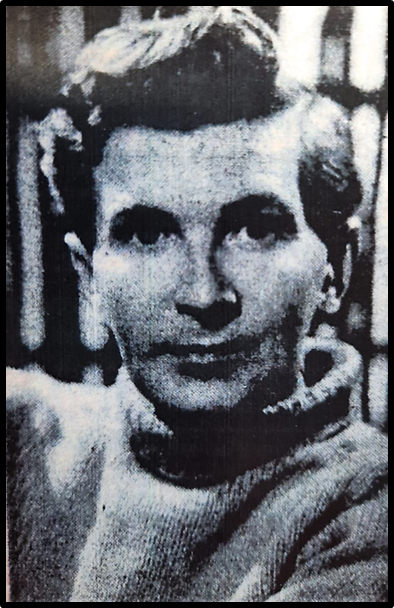
Gerrit Wessels
Picture: Montagu Museum
So they started their life together and went overseas every second year to enjoy the music, food and theatre Europe and England had to offer.
It was during 1951 that they decided to move permanently to Montagu when Michael bought the property situated at 19 Uitvlucht Street, Bath’s Hill.
Michael who was passionate about books and music, built a hammer-beam roofed library at the back of his property, to house his valuable collection of books, music and recordings. The library with its stained glass windows resembled a chapel. It became Michael’s sanctuary and housed his collection of 25,000 books. Some of the books were printed as early as 1537 and 1551 with first editions of Alice in Wonderland and Dickens’ All the Year Round amongst them. His record collection totalled about 5,000 and included full sets of works of Verdi, Wagner (for which Scott had a particular fondness), Tchaikovsky and many more well-known composers.
A large proportion of his time in later years was spent cataloguing his collection.
The photographs on the wall in the library also gave one a sense of how well known and respected Scott was in musical circles. Signed photographs from Jehudi Menuhin dated 1930, Richard Strauss, Stokowki and lesser well known maestros in the musical world, lined the walls. Personalized signed photographs from the British Royal Family could also be seen amongst these pictures. Their house needless to say was a treasure trove of beautiful and priceless items reflecting a life of culture and collection.
Original library building looked like chapel from outside

Picture: Montagu Museum
It was here that the couple entertained their artist friends who came down to visit and spend time with them. The garden was specially designed to stage plays, and it was here that the late Johan Nel performed a never to be forgotten interpretation of King Lear.
Gerrit became part of village life and got involved with being the compere at fashion shows, directing operettas at the High School and a must at every party.
Both he and Michael used to whizz around conservative Montagu in a Mercedes Sport car – always with one or two black poodles at their side.
However, this all came to an end on New Year’s Day in 1976 when Michael passed away in a Cape Town hospital, to be followed three months later by Gerrit.
Gerrit was the sole beneficiary of Michael’s estate. With the passing of Gerrit who died intestate, the entire estate devolved upon Thys Wessels, his brother from Bloemfontein. Thys was clearly totally taken aback when he realized the extent of what he had inherited.
The University of Stellenbosch bought the entire collection of books for an amount of R90,000, whilst the furniture, Persian rugs and other items were sold on public auction at the house on 22 May 1976.

19 Uitvlucht Street Badshoogte in 2020 old library building can be seen top left of property
Picture: Irma Jordaan
Malan Siebritz
The Argus 27 January 1984
Paarl Correspondent
Portrait of Gerrit Wessels by Jean Welz
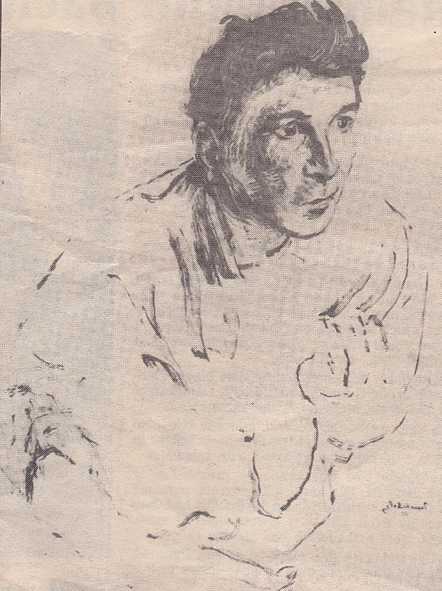
A Painting, Portrait of An Actor, painted by the late Jean Welz in 1962 and currently exhibited at the Hugo Naude Art Centre, Worcester, recalls a loss to South African theatre 36 years ago.
In 1948, actor Gerrit Wessels, then 23, suddenly abandoned a potentially brilliant stage career to become the companion of a 45-year-old retired British fleet commander at Montagu.
The impulsive decision deprived the young actor of any further participation in a profession for which he had shown exceptional promise. When the commander died in 1975, and the actor followed his friend benefactor three months later under sad circumstances.
The painting is one of 84 to commemorate the 40th anniversary of the arrival of Welz at Worcester as head of the Hugo Naude Art Centre. The exhibition continues until January 31.
Once a member of the Gwen Ffrangcon-Davies and Andre Huguenet group and on the threshhold of a brilliant stage career, Gerrit Wessels met Commander Michael Scott at a symphony concert in Cape Town in 1948. The commander had emigrated to South Africa after he was discharged from the Navy as a result of ill-health following the battle of Dunkirk.
A son of a British doctor who was medical adviser to the British Royal household, Scott was extremely wealthy and acquired a large house with extensive gardens at Montagu.
Scott was strongly attracted to the 23-year old Wessels with his sparkling personality and a taste for classical music, the arts, and literature which had formed the background to his life in pre-war England.
The attraction was mutual and Wessels was persuaded by Scott to abandon the theatre. Financial security and a sumptious life style were offered.
This was the beginning of a life for Wessels which revolved around musical and play-reading evenings, visits to art galleries, and attending symphony concerts throughout South Africa and annual visits to the music festivals in Europe and England.
Scott’s affection for his young friend was so profound that during 1962 he commissioned the artist Jean Welz to paint the portrait. Scott did not like the result but Welz, quite satisfied with it, kept it for himself.
During the 27 years of their association Wessels often felt the call of the theatre but remained devoted to Scott. Their cultured lifestyle was some compensation to Wessels who had almost starved in the pursuit of his theatrical ambitions.
At the lowest ebb in his career, Wessels found himself stranded when a touring theatrical company disbanded. He arrived at Paarl penniless and without even the prospect of a bed for the night. He was befriended by a young Paarl businessman and an amateur movie photographer Casparus (Kappie) Botha who provided him with free accommodation, pocket money and clothes during 1946 and 1947.
Wessels’s shattered self-esteem recovered during his two years at Paarl, where Botha encouraged him to keep up his interest in the theatre and classic literature.
Then came the break that he had been waiting for in the form of an offer from a theatrical touring company followed by a short spell with the National Theatre.
Wessels was at his best in the tragic roles. He played the leading role in a film made by benefactor Kappie Botha who had, by then, become a professional cinematographer with a Pretoria based film company. The role was that of a young farm boy whose dreams of a theatrical career were shattered by events beyond his control.
But Wessels played his greatest tragic role in real life. During 1975 Scott, then 72, became ill and died at Groote Schuur hospital in Cape Town at the end of the year. He was cremated and his ashes were buried in the garden of the Montagu home. Wessels, the sole beneficiary under Scott’s will, was shattered by his death.
The vast fortune left to him meant nothing. Although he now had the chance to re-enter the theatre, he lost all interest in his surroundings, neglected his health and simply wasted away to die at the age of 52 in the Montagu Hospital, three months after Scott.
He had bequeathed his body for medical research at the University of Cape Town. There is not even a tombstone to mark his last resting place.
From: Paul Fouche [mailto:pcfouche@gmail.com]
Sent: Sunday, 21 March 2021 20:54
To: ‘allmayfm’ <allmayfm@telkomsa.net>
Subject: Gerrit Wessels
Hallo Rudi
Baie dankie vir die skakel na Anelma Oosthuizen se interessante artikel. Van die mense en die gebeure waarvan sy vertel, onthou ek heelwat. So ‘n interessante aanknopingspunt die mense wat verbystap, soveel heimwee na die geliefde Montagu van weleer!
Ek kon nie help om die gedeelte oor Commander Scott en Gerrit Wessels raak te sien en aandagtig te lees nie. Hoe onthou ek nie vir Gerrit Wessels in daardie blikvanger van ‘n oopdak Mercedes 190 SL nie! Altyd met ‘n swaar sonbril en ‘n serp wat so agter hom in die wind wapper. Met groot eerbied het ek vir Gerrit dopgehou, want vir ‘n plaasseun was die silwerdoek ‘n droomwêreld met wondermense!
‘n Blykbaar vergete stukkie geskiedenis is Gerrit Wessels se hoofrolle in twee Afrikaanse rolprente. Ek sal opstaan (1959) en Kyk na die sterre (1960). Albei rolprente is verwerkings van verhale van Norval Geldenhuys, ‘n predikant en skrywer. Ek sal opstaan spog boonop met dr. Andries P. Treurnicht, oud-redakteur van Die Kerkbode, oud-minister en voormalige stigter en leier van die Konserwatiewe Party in die rol van ‘n dominee. Kyk na die sterre bly nie agter nie en nog twee baie bekende Suid-Afrikaners – die gewilde toneelspeler Paul Malherbe en die joernalis/skrywer/akteur Herman Steytler verryk die rolverdeling.
*CARFO het albei rolprente vervaardig. Waarvoor die afkorting gestaan het, kon ek nie meer vasstel nie. CARFO was ‘n Christelike rolprentmaatskappy wat rolprente met ‘n geestelike strekking vervaardig het. Kappie Botha die stigter, vervaardiger en regisseur van vele Carfo-rolprente, was ‘n professionele kleremaker van Worcester wat later Paarl toe verhuis en hom op fotografie begin toespits het. Hier het die rolprentgogga hom behoorlik gebyt nadat Anton Rupert hom gevra het om ‘n reklamerolprentbydrae oor die Rembrandt-maatskappy te vervaardig vir die nuusfilm African mirror. CARFO-rolprente is op 16 mm kleurfilm uitgereik en deur rondreisende personeel in kerksale vertoon. Sodoende is die rolprente op die kleinste dorpies sonder rolprentteaters gewys nadat dominees die vertonings tydens afkondigings in die kerk bekendgestel en die gemeentelede uitgenooi het. Gewoonlik het die gratis tydskrif, Die Voorligter, wat by die kerk uitgedeel is, vooraf breedvoerig oor die rolprente berig en is vertonings betyds aangekondig. Al wat die bywoning die gemeentelede ooit gekos het, was ‘n vrywillige silwerkollekte.
Twee onvergeetlike aande in die kerksaal toe Ek sal opstaan en Kyk na die sterre vertoon is met in die hoofrol ‘n filmster wat tussen ons op Montagu beweeg het! Met lang oë het ek na die advertensie vir Norval Geldenhuys se twee boeke op die agterblad van Die Voorligter gestaar, maar daar was nie geld vir twee hardebandboeke nie en Montagu het nog nie ‘n Provinsiale biblioteek gehad nie. Dit het ‘n sikspens gekos om ‘n boek uit te neem.
Ai, die heimwee na Montagu en tye van weleer!
Groete, gesondheid en sterkte
Paul
*Bron: Daar doer in die fliek – Leon van Nierop – Protea Boekehuis 2016
