
17a.The Community (Jewish Community) that Disappeared – Part 1

Updated: 25/01/2025
The Community that Disappeared. Part 1 of a 4 Part Series. The audio recording associated with the Abramowitz family was found by Clive Kirkwood who works at the University of Cape Town Special Collections department. The recording takes the form of an interview conducted by Fern Sacks (November 1981) with Mrs. Abramowitz one of the early Montagu Jewish residents…
THE COMMUNITY THAT DISAPPEARED

Part 1
The Montagu Jewish Community
Compiled by Rudi Allmayer
2018
This document makes no claim to historical accuracy but is rather a collection of articles, memories, photos and stories consolidated into one document in the hope of showing the Jewish involvement in Montagu over the years.
The document was intended as a discussion document for the Montagu Historical Society.
The document endeavours to show that the town of Montagu in the Western Cape had at one stage during its history a thriving Jewish community. This community contributed to all walks of life in Montagu.
The highlight of the Project was a talk delivered in the Montagu Museum on 15th May 2018 covering the contents of this document. The talk was part of a Jewish evening which was opened by Rabbi Stuart Serwator who also provided the after event snacks which were all traditional Jewish food.
Note: All red font shown has been taken as written by the original author with grammar and spelling left unchanged.
Contact particulars Rudi Allmayer:
Mobile: 0833544311
Email:stories@montagumuseum.co.za
Contents
- Family Roots
- The Cemetery
- Ministers
- Community Spirit
The Families
- Ansell
- Abramowitz
- Buirski
- Brown
- Fernandes
- Friedman
- Moss
- Goldberg
- Goldblatt
- Idelson
- Koonin
- Millin
- Philips
- Plax
- Raises
- Sandler
- Schachat
- Schlesinger
- Stein
- Vanger
- Contributions
Family Roots
Volume 3 of the Jewish Life in South African Country Communities states that the Cape Naturalization lists of the nineteenth century give names of some of the earliest Jewish settlers in Montagu. The Jewish community, as a collection of Jewish people, began in 1888 and lasted until 1998. Many started as “smouse”in the Little Karoo region. They include Mr. A Buirski from Russia, who worked there as a merchant in 1888. Early feather buyers who had come from Russiaby 1889 were Messrs. N Bussel (not the present Montagu Bussells), N Sanders and M Saunders. Mr. Isaac Buirski was there before 1903 and Barnett Buirski had come and gone by 1903. Mr. Harry Abramowitz from Russia was resident in 1910. Sigismund Gesundheit, a feather buyer from Warsaw Poland, had arrived at the Cape in 1905 and at Montagu before 1910. After he left for Cape Town he became president of the Gardens Synagogue in Cape Town and a member of the United Hebrew School Board.
In addition to the Naturalization lists names of Montagu Jewish residents have been found in the books written by both Tokkie and Yvonne Bussell, and the local Jewish cemetery.
Volume 3 of Jewish Life in The South African Country Communities also states that references can be found tracing early religious services being held in Montagu back to 1894.
In his book Tokkie Bussell mentions that a Mr Rayces who had a home and shop on the corner of Mark (Market) and Joubert Streets was the “Jewish Rabbi” in Montagu. Annie Abramowitz who lived in Montagu for 40 years also names Mr Rayces as the Rabbi in an interview she did in 1981. (See further information under Rayces family).
It has however not been possible to find any additional information on Mr. Rayces qualifications. It is highly probably that he played some leadership role in the local Jewish community but highly unlikely that he was a Rabbi.
The following is an extract of a document found in the Robertson Museum, written in 2008 by the then Manager of the museum R.N. (Becky) Saacks:
By 1914 the number of Jewish families in Montagu must have exceeded at least 10 males, their wives and children, and the Rev N Cohen was hired as leader of the Synagogue, acting as cantor mohel and schoch Names that spring readily to mind in Montagu, are Dr Koonin, one of the Millin brothers, the Browns, one of the Buirski brothers, one of the Abramowitz brothers, Mr and Mrs Ansell and their son, Mr and Mrs Landau and their children. But with the death of several heads of families in the 1918 epidemic, the Synagogue closed down and once again the members rejoined the Robertson Hebrew Congregation which was growing apace.
This brief talk is far from comprehensive. I have frequently been asked if what I have just spoken about has been recorded or written down. In this case yes, but there is a vast amount unwritten. Finding the time to do everything has been something of a problem and one must, after all, leave future historians some research.
Talk given by R.N. (Becky) Saacks to a group of interested local residents on 11 April 2008 at the Jewish Synagogue, 38 Adderley Street, Robertson
R.N (Becky) Saacks
Robertson 11 April 2008
Unfortunately no hard evidence has a yet come to light to support the statement that Montagu did have a Synagogue.
Charles Torrance a local Montagu resident and historian living at Kalkkoennes confirmed that his father told him that Montagu did have a Synagogue which was situated at 8 Church Street.
Unfortunately once again that is as far as the folklore goes at present.
Number 8 Church Street still remains a mystery. The history of the building can be traced back to 1933 when the building was bought by the Masons. A stone plaque is built into the foundation of the building dating the Masons ownership. Rabbi Serwator visited the Deeds Office in Cape Town to try and verify historical ownership of the property but his efforts were inconclusive due to the illegibility of early documents.
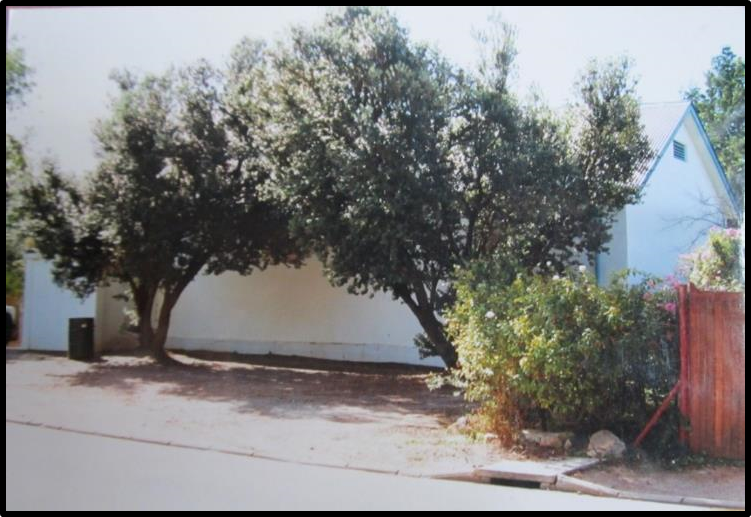
Number 8 Church Street.
Picture: Clive Biden
The following email was received from Cecily Maisel (b Sandler) daughter of local Montagu lawyer David Sandler unfortunately no further verification has been forth coming.
From: maiselcb@bezeqint.net [mailto:maiselcb@bezeqint.net]
Sent: Tuesday, May 22, 2018 3:53 PM
To: Allmayfm <allmayfm@telkomsa.net>
Subject: Re: Test
Hi Rudi. I have been ill (I have R A) then Jack Plax called me. A day later I got your e mail. Meanwhile my computer & printer developed problems and I can’t use them, hence the cell 📞 e mail. Incidentally the masonic lodge in Church Street was a synagogue prior. Do you want me to send on stuff as I come across it? As a point of information, I will be in the Cape in November.
Regards,
Cecily Maisel
maiselcb@bezeqint.net
972 9 8332124
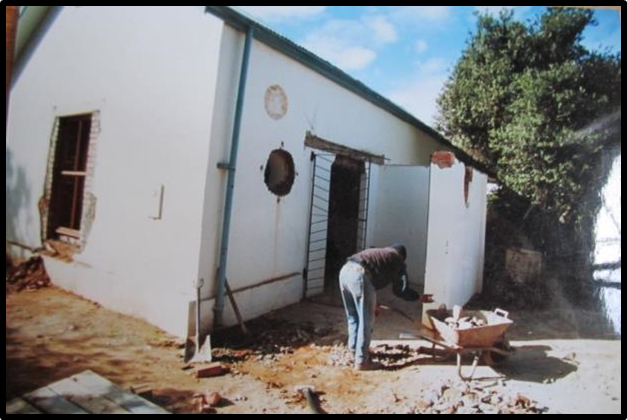
Original and only entrance to 8 Church Street
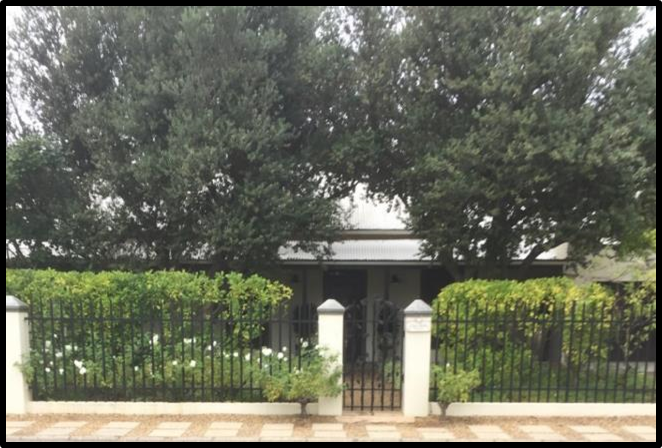
Number 8 Church Street some years after renovations
Pictures: Clive Biden
A party of local residents celebrating Simchat Torah, at Robertson. Simchat Torah is a Jewish holiday that celebrates and marks the conclusion of the annual cycle of public Torah readings, and the beginning of a new cycle. A number of family names can be linked to Montagu but aside from Harry Millin it has not as yet been possible to make any other linkages.
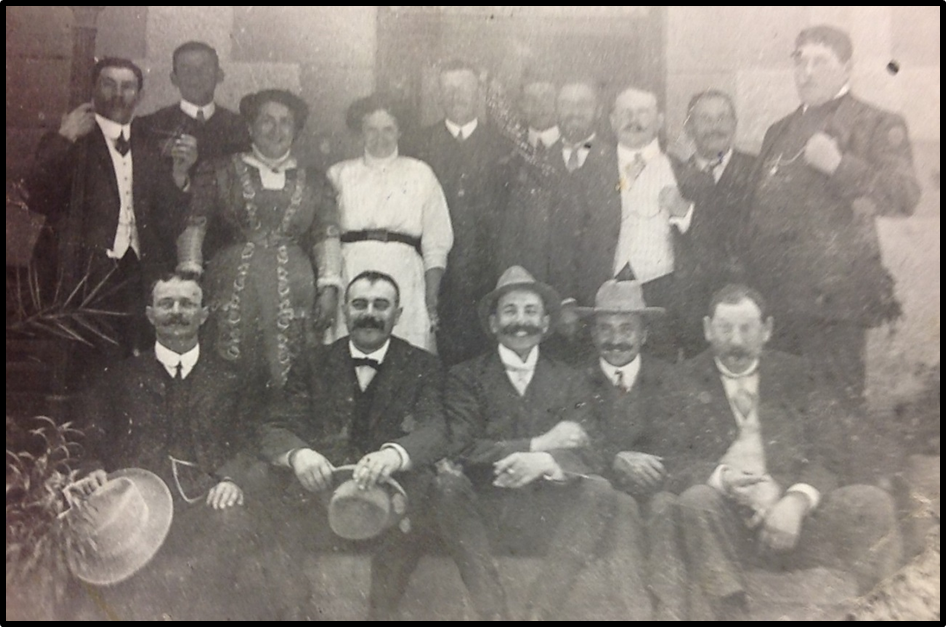
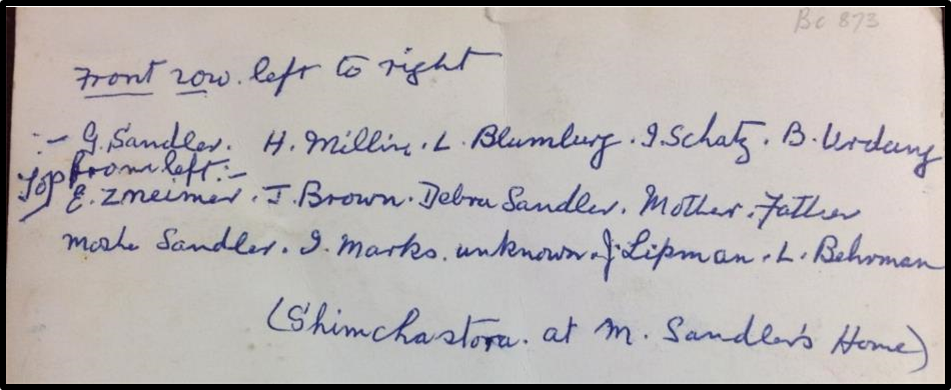
Picture: Special Collections University of Cape Town.
Mrs. Saacks also confirmed in her paper the existence of a Dr. Koonin who is buried in the local Jewish cemetery. Her document also confirms that the Millin, Brown, Buirski, Abramowitz, Ansell and Landau families all lived in Montagu in and around the early 1900’s.
Eunice Movsowitz (b. Goldblatt) who was born in Montagu in 1936 states that their home in Bath Street was used as an informal congregation point to celebrate certain religious events. She had no knowledge of the existence of a Synagogue in Montagu.
For the Jewish holidays the Goldblatt family attended the Synagogue in Robertson, and stayed at the Commercial Hotel which belonged to the daughter of late Reverend Josefowitz, Mr. and Mrs. Epstein.
An interesting snippet of Jewish history that exists in Robertson supplied by Rabbi Serwator (2018). Do you know that at no 54 Victoria Street, is an unusual Jewish feature, special to Robertson?
If you look at the house at no 54 while standing opposite it, you will see that it has not one roof, but two. The second is further back from the street and higher. Why is this?
It is because this building was not built to be a residential house.
It was built in 1896 for the unusual dual purpose of serving as the Robertson Hebrew School, where Jewish children would attend classes in the afternoons, after their Government school timetable had finished for the day, and also as the town’s mikvah, Hebrew for ritualarium.
The Synagogue was neither architecturally designed as, nor furnished to be, a school.
You may wish to Google ”mikvah”, where I recommend you click on the article by Wikipedia, which clearly and comprehensively explains what a mikvah is and its various uses.
However, usually, the Jewish community builds a separate, much smaller mikvah for immersing new utensils as this is more hygienic and thus socially more acceptable.
In 1984 I was a passenger in a car travelling from Oudtshoorn after having participated in the centenary celebrations of the Jewish community there, to Cape Town. En route we passed through Robertson and stopped at 54 Victoria St, where the driver, a Jewish doctor who had previously been the District Surgeon of Oudtshoorn, rang the bell and asked the surprised owners at the time if we might please view the mikvah, which was part of their house. They knew of its existence and kindly agreed and led us to it. It had been covered over and was being used as a bathroom but its unusually high ceiling and unusually thick walls showed that this was no ordinary bathroom.
It is now 34 years later and I have not visited it since but writing to you recently jogged my memory!
The existence of the mikvah is a great compliment to the religious integrity of the founders of the Robertson Hebrew Congregation who clearly tenaciously perpetuated their religious lifestyle in Robertson which they had led far away in Eastern Europe, where they had been born. To do so at that time in Robertson, so far from their home-towns and without whose community support, shows tremendous strength of character, all too often overlooked. It is an even greater compliment to them as not every Jewish community on the platteland built a mikvah.
As it’s historically and culturally unusual, maybe it should feature among Robertson’s tourist spots? Probably, though, the owners would not be happy at the prospect of entertaining unknown and unexpected visitors in their bathroom, even though probably it will be of interest only to Jewish tourists and to those researching the Jewish faith which together probably are few – but one never knows! Maybe a plaque outside?
The Montagu Jewish Cemetery
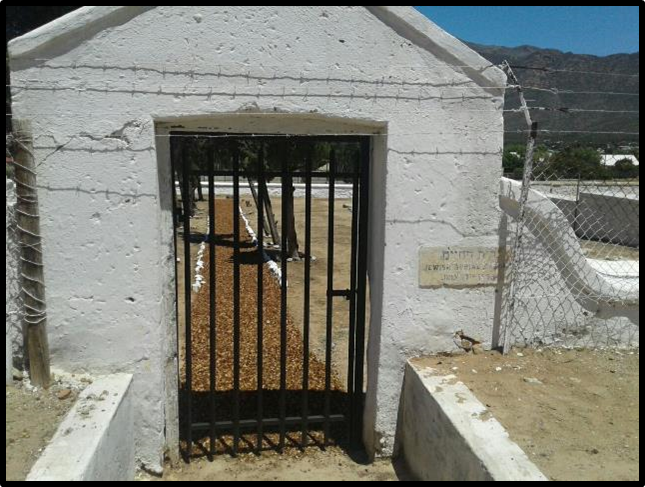
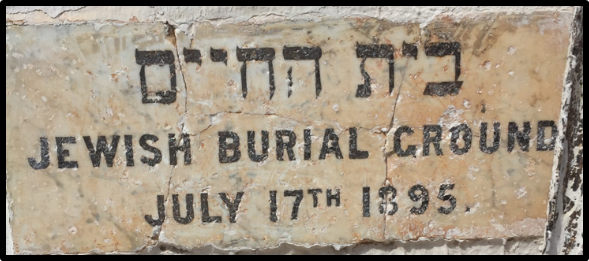
Barnett Buirski established the Jewish cemetery in 1894. The last funeral in this cemetery took place in 1941.The community appears (visible) to have used seventeen graves altogether.
Montagu Jewish Cemetery
14th May 2010
(Recorded by Theo Joubert & Don Woodford)
Block A No 1 Unknown
Block A No 2 Unknown
Block A No 3 Unknown
Block A No 4 Unknown
Block A No 5 Unknown
Block A No 6 Unknown
Block A No 7 Unknown
Block A No 8 Unknown
Block A No 9 Stein, Solomon died 11th June 1909 age 49 years.
Block A No 10 Koonin, Dr J. Born 1852 died 10th September 1912.
Block A No 11 Ansell, Nathan died 30 November 1915 aged 51 years. (Wife Kitty Ansell).
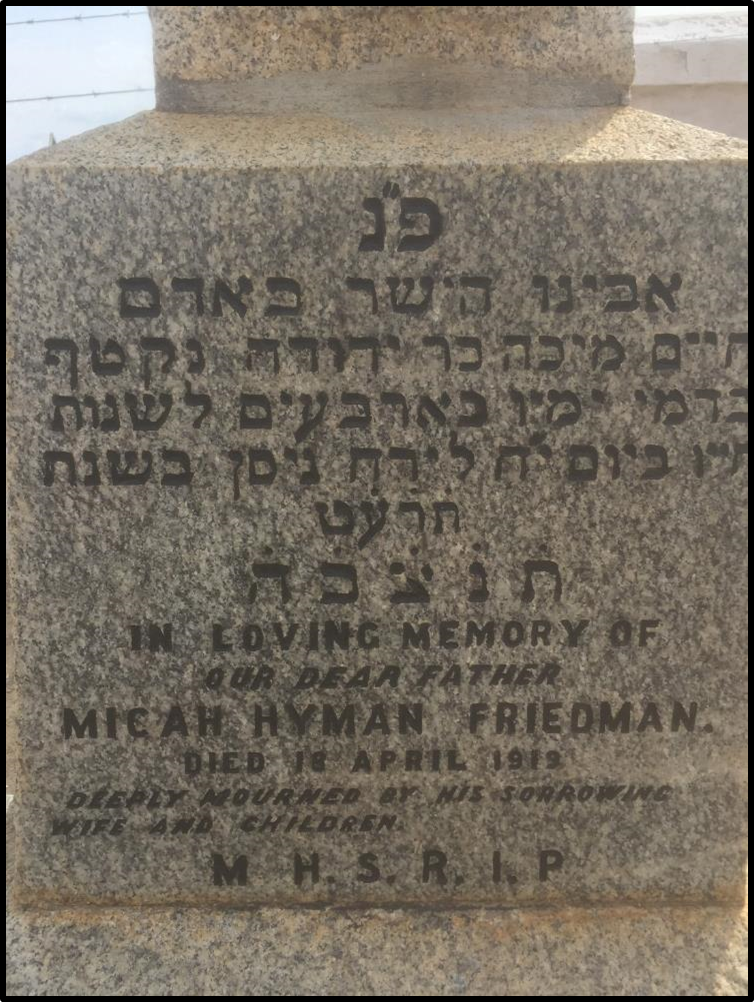
Block A No 12 Friedman, Micah Hyman died 18 April 1919 (Deeply mourned by his sorrowing wife and children) MHSRIP.
Block A No 13 Abramovitz Lewis died Monday 12 July 1926 age 32 years.
Block A No 14 Unknown
Block B No 15 Unknown
Block B No 16 Millin, Aletta Catherine nee Tilley wife of Nathan Millin, mother of Esther and Arnold, died Montagu 6th April 1924 age 56.
Block B No 17 Millin, Nathan born 18th April 1866 died 22 December 1941.
Note: See information under Idelson family for a possible confirmation as to who is buried on Block B No 15.
The Montagu Jewish Cemetery is situated in Buitekant Street. It is enclosed with a stone wall and gate.
There are a few graves with no tombstones or headstones. One of the unmarked graves appears to be that of a child.
A circle of stones on some of the graves was put there relatively recently by the contractor who renovated the graves.
A circle of stones is a symbol of the Boy Scout movement, meaning “Gone Home”.
Putting stones on a Jewish grave is traditionally correct as showing someone remembered the deceased, honouring their memory by visiting their gravesite.
Putting flowers on a grave is not in accordance with Jewish tradition.
According to the date on the oldest tombstone, 1909, this cemetery stood vacant for 14 years from the time it was inaugurated, and has not been used since the last funeral in 1941.

An extract from the autobiography of the late Philip Stein whose father is buried in the cemetery which could explain the unmarked graves.
“There is a small Jewish cemetery in Montague, Nathan’s wife was one of the first persons to be buried there. My father is buried there too. When my mother, my sisters, Minnie and Bessie, and I went to lay a stone on father’s grave we found a number of nameless graves, Jewish soldiers in the British army who had died while in camp in Montague during the Boer war”.
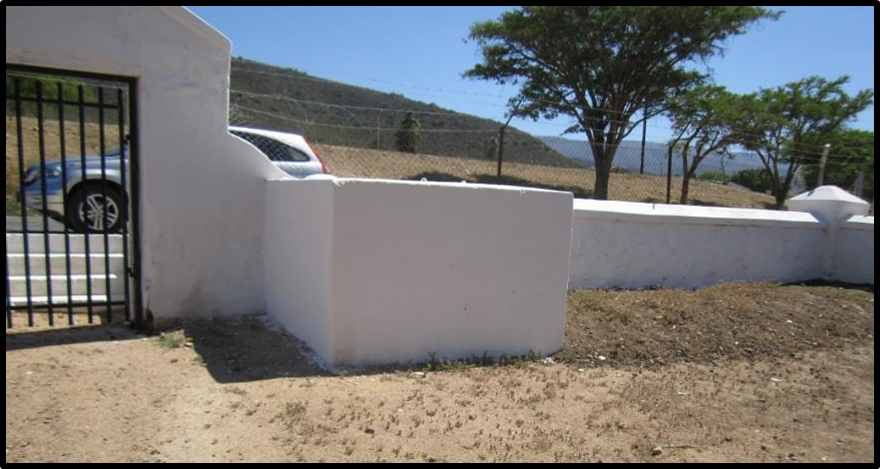
The Montagu Cemetery Genizah (before installation of plaque)
In 1987, Rabbi Zaiden buried old prayer books and other religious articles from the Robertson cemetery in a Genizahgrave near the entrance of the Montagu cemetery. In February 1998, arrangements were made to seal this Genizah(a storage area housing damaged, discarded and sacred relics)permanently.
Over the years it became difficult to maintain the cemetery after the Jewish community had disappeared. In 1981, one ex-resident complained to the SAJBD about its disgraceful appearance and lack of maintenance. This was then attended to.
During 2017 Rabbi Serwator representing the Regional Country Communities’ Rabbi for the South African Jewish Board of Deputies arranged for a local contractor to renovate the cemetery and provide ongoing maintenance.
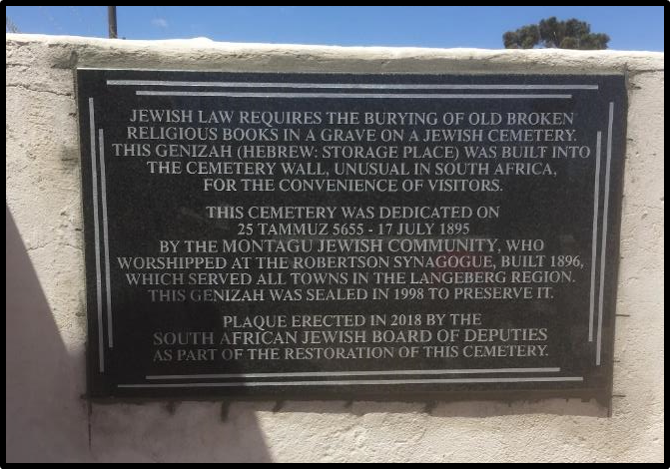
A new piece of history is added to the cemetery in 2019
Ministers
Reverend E. Hirschowitz 1911
Reverend N. Cohen 1914 acting as cantor (an official who sings liturgical music and leads prayer in a synagogue), mohel (person who performs the circumcision) and shochet (person who performs the slaughter of animals according to Jewish Law).
A Mr Rayces also ministered to the Montagu community in or about 1918. It cannot as yet be ascertained what religious qualifications he held.
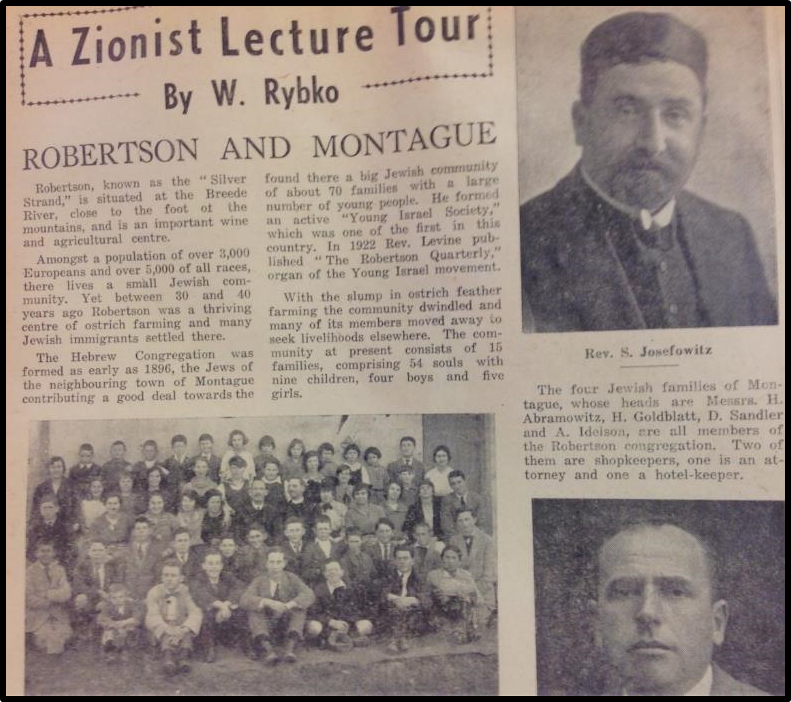
A Zionist Lecture Tour held on 13 June 1947 at Robertson attended by prominent Montagu families
Article: Special Collections University of Cape Town.
An interesting synopsis of a person who served the Montagu Jewish community supplied by Rabbi Serwator (2018) Re- the Jewish exhibition at the Montagu Museum: We must please include info and a photo – and I should photograph for this purpose his tombstone at Pinelands 1 in Cape Town – of a communally devoted man who gave 60 years of his working life to serving Jewish communities. He was the Revd Shmuel Yehuda (= Samuel Judah) Josefowitz, who served the Robertson Hebrew Congregation from 1922 – 1972 and was its last and longest-serving Minister and teacher. He was born in 1889 in Rakeshik in Poland and studied in yeshiva (seminary) in Dvinsk, qualifying as a “shochet” (ritual slaughterer). He studied under the Gaon Rabbi Yitzchak Yaakov (= Isaac Jacob) Rabinowitz from Ponevez. (The Ponevez Yeshiva was, and remains, now in Bnei Brak, Israel, world renowned.)
On arriving in South Africa in 1912 he spent a year serving the East London Jewish community as Hebrew teacher, then was appointed Spiritual Leader to the Zastron Hebrew Congregation in 1914, where served for 9 years. In 1917 he went to Laingsberg until 1922. He was then appointed to the same post in Robertson, where he ministered for 50 years until retiring to Cape Town at 83. He died in Cape Town 2 years later.
His wife, Mrs Rosie Gittle Josefowitz, is buried on the Robertson Jewish cemetery.
Their grandson, whom I know, lives in Cape Town. He is Mr Solly Epstein, a lawyer, tel. 021 – 797.7226 (home).
Not only did the Revd Josefowitz comprehensively care for his congregation, he also reached great heights as a Freemason and went to London to receive the organisation’s highest award.
Perhaps the most remarkable of his achievements was that, while in Zastron, he taught the late born-blind Cantor Abraham Immerman enabling Cantor Immerman to fulfill his dream of becoming a cantor and teacher. Cantor Immerman, whom I remember, died in Cape Town a few years ago aged 96.
He was a legend in his lifetime as his memory was absolutely phenomenal and recently Lisa Chait made a film about him. Maybe if one Googles his name, it’ll come up? The huge amount of amazing work that the Revd Josefowitz did during his long and successful career , from arriving here as a 23-year-old without English and far away from his support in Poland, without telephones, faxes and computers, has, I believe, been overlooked and forgotten, so he deserves a place of honour in the exhibition.
Community Spirit
According to the attendance register of the Women’s South African Party Montagu Branch dated 1926 at least four of the local Jewish ladies were members. The WSAP was part of the South African Party.
Despite many of the Jewish residents starting in the region as a smouse they showed tremendous entrepreneurial spirit and worked themselves into better positions. They could name a tailor, chemist, shopkeeper, hotel owner, civil servant ,general dealer and feather buyer among their number with the children of the original residents going on to become well-known doctors and law professionals.
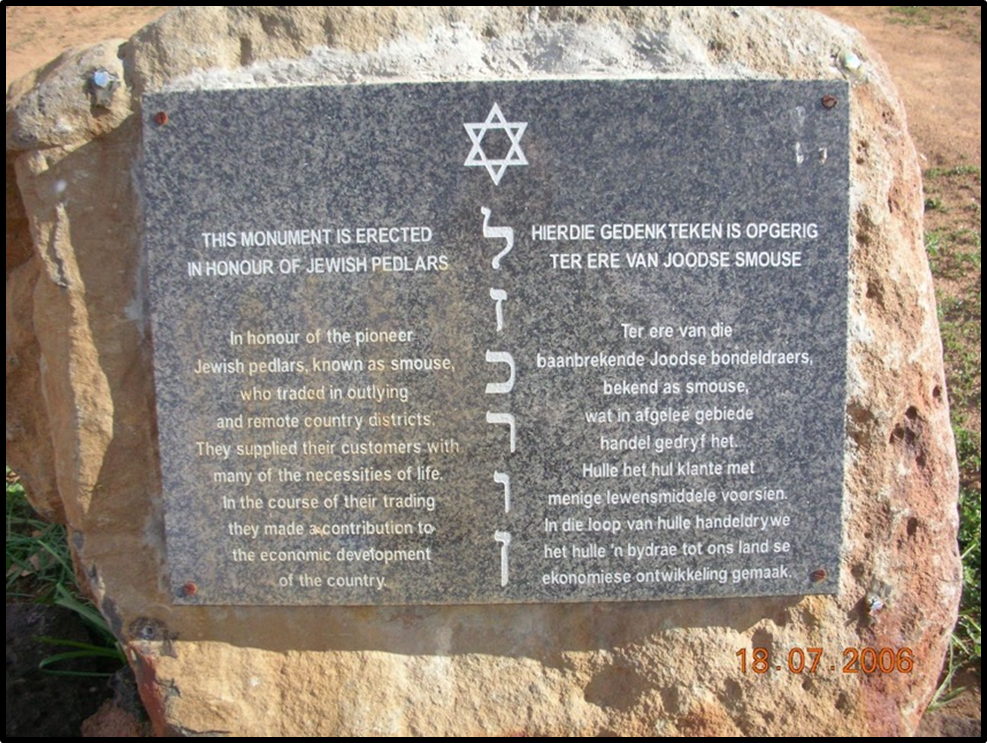
Graaff-Reinet’s unique monument to the Jewish “smouse”, those itinerant pedlars who were a familiar feature of the rural economy a century or more ago.
There were no reported incidents of antisemitism in Montagu. In 1940, Mrs. Steenkamp, wife of Dr H Steenkamp of the Nationalist Party, when speaking at a public meeting, urged the citizens of Montagu to co-operate with the Jews. Previously she had suggested that anti-Semites should burn their bibles if they wished to go against the Jews.
Jewish Organisations
Montagu Zionist Association was formed at a meeting held in 1915 with Mr. M. Raisers (Rayces) as the first president, A. Brown as treasurer and H. Abramowitz as Secretary.
The Jewish community in Montagu contributed to various Zionist causes from 1911 to about 1928. They also contributed to the Cape Relief fund for Jewish War victims.
The records of the Jewish community in Montagu only start with the 1936 census. Despite the collapse of the ostrich boom there were still 70 Jews in Montagu in 1951. A sharp decrease by 1966 left only two Jewish families in residence, the Idelsons and Sandlers. In 1998, Rabbi Silberhaft, Country Communities Rabbi for the SAJBD visited Sylvia Krige (nee Sher) the only Jewish resident in Montagu.
Official records:
| Year | Jewish | White | Total |
| 1936 | 27 | 3992 | 8295 |
| 1951 | 70 | 4223 | 11008 |
| 1980 | 6 | 3460 | 18020 |
| 1991 | 5 | 3870 | 21674 |
Community Records:
| Year | Jewish |
| 1943 | 27 |
| 1953 | 104 (including Robertson) |
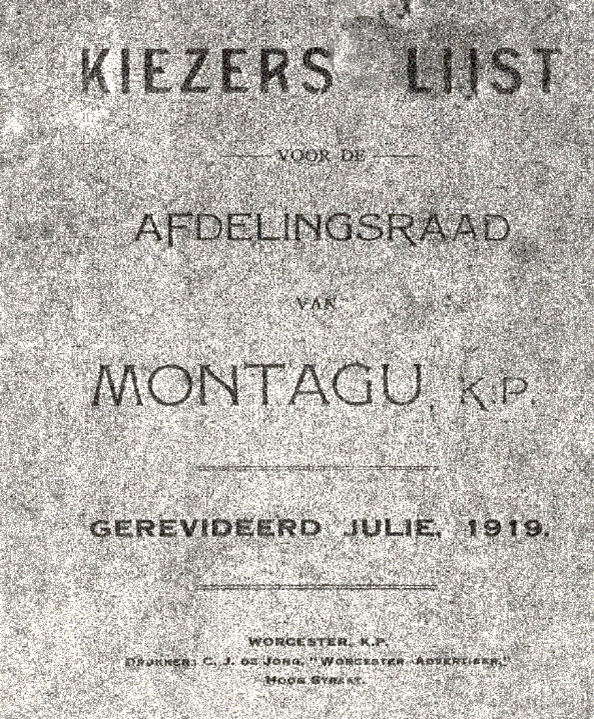
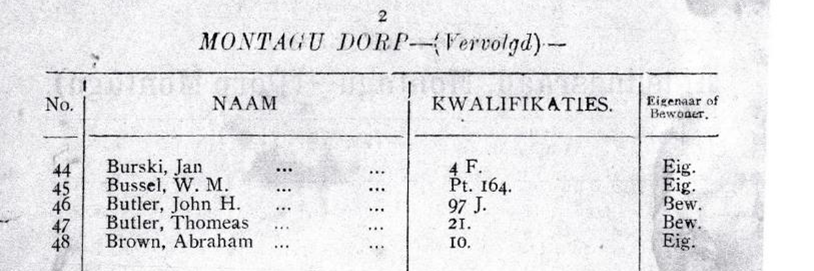
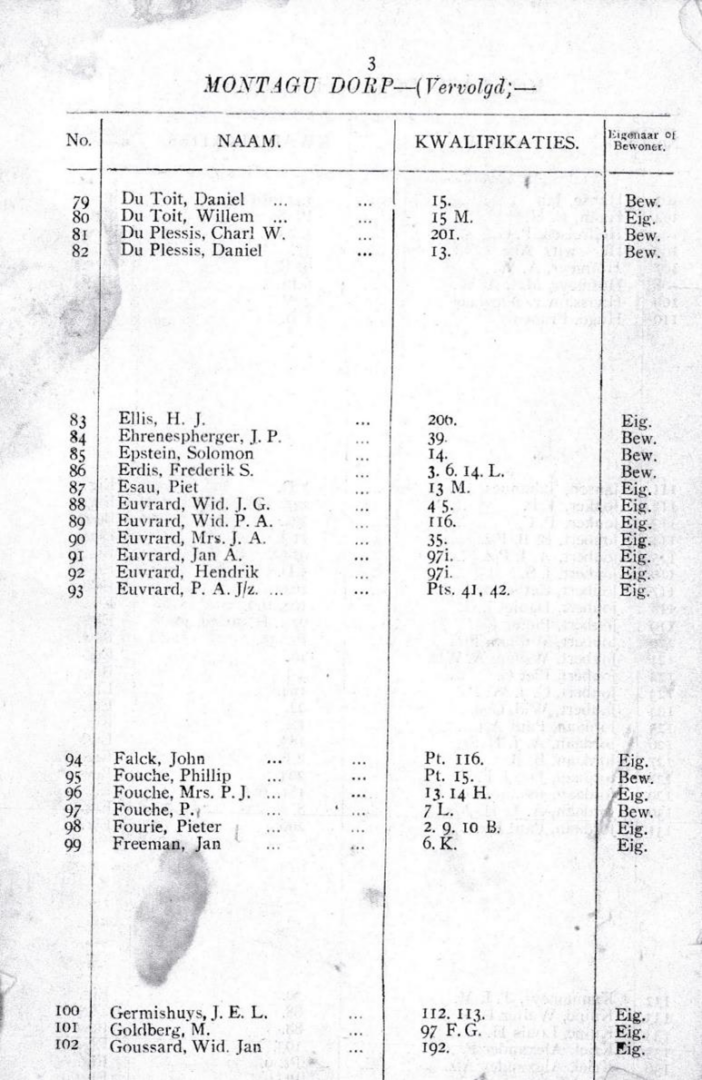
1919 Voters Roll for Montagu showing a number of Jewish families

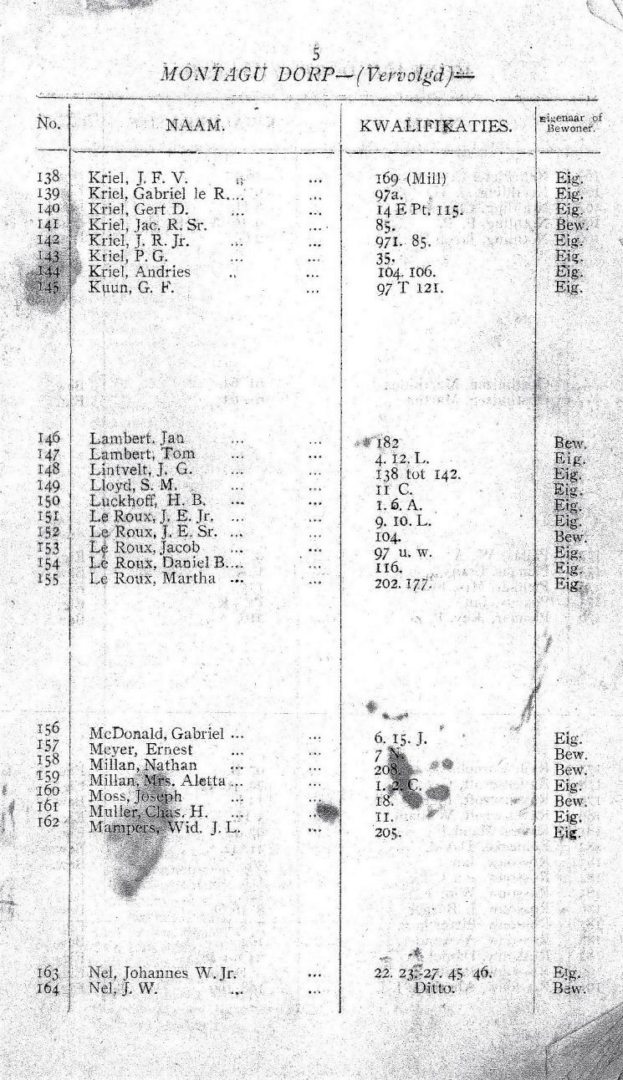

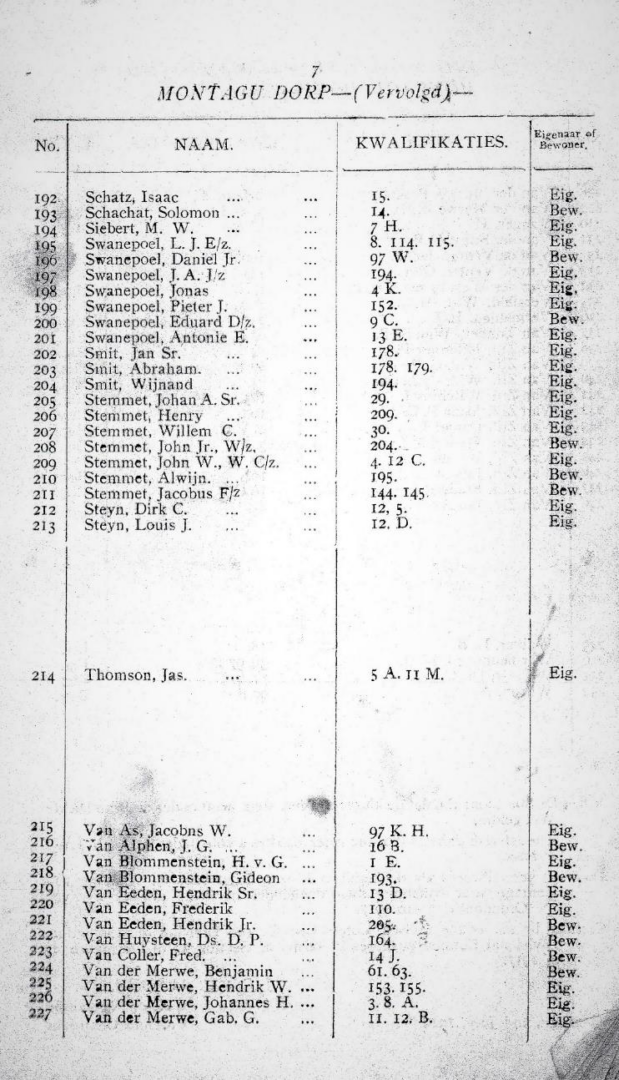
The Families
The following is a list of Jewish families who lived in Montagu from the late 1800’s. This alphabetical list is not necessarily complete. The book Jewish Life in South African Country Communities has some 58 family names linked to the town of Montagu.
Memories/Stories/Anecdotes and Pictures have been collected by the document compiler.
Nathan Ansell
He was born in Tavrig, Russia, applied for Naturalization in August 27 1889, was a resident in the Cape for six years. He was one of the early pioneers who was part of the feather trade. He married an Afrikaans girl Kitty and one of his sons has been identified as Koekie from a photo.
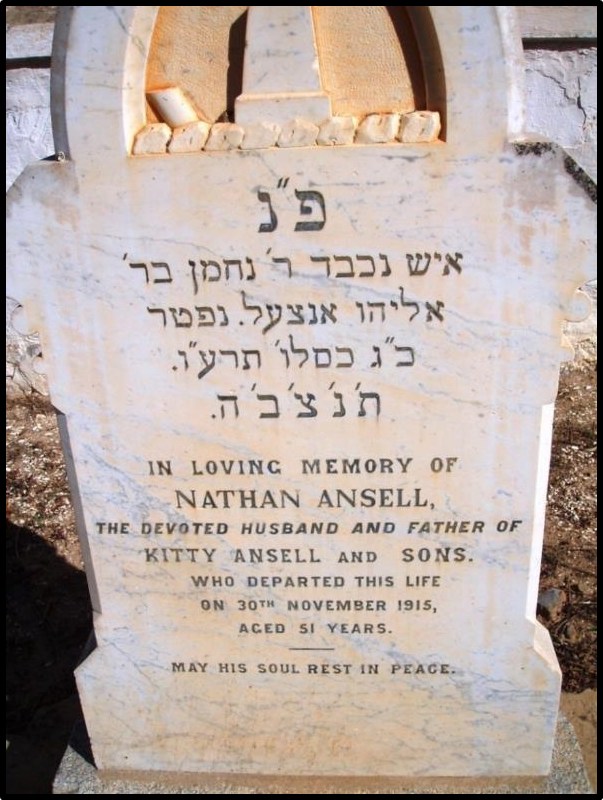
Picture: Don Woodford
An extract from the autobiography of the late Philp Steyn which gives some identity to Nathan Ansell.
“There was a youth named Ansel, a poor relation of an uncle of mine, Barnet Millen. Hearing of the wealth of Sammy Marks Ansel immigrated to South Africa in the 1880’s. He did not become very rich but made a living. So my uncle and his wife, Mary, left for South Africa joining Ansel. So in due course Barnet’s brothers and my father followed. That was in 1890.”
“Ansel, mentioned earlier, had married a Boer girl and so had Nathan Millin.”
In a document discovered in the Montagu Museum it states that Nathan Ansell bought the farm “Het Kruis” from the Jordaan family which is clearly at odds with the poor relation statement above.
He can also be traced as a member of the local library.
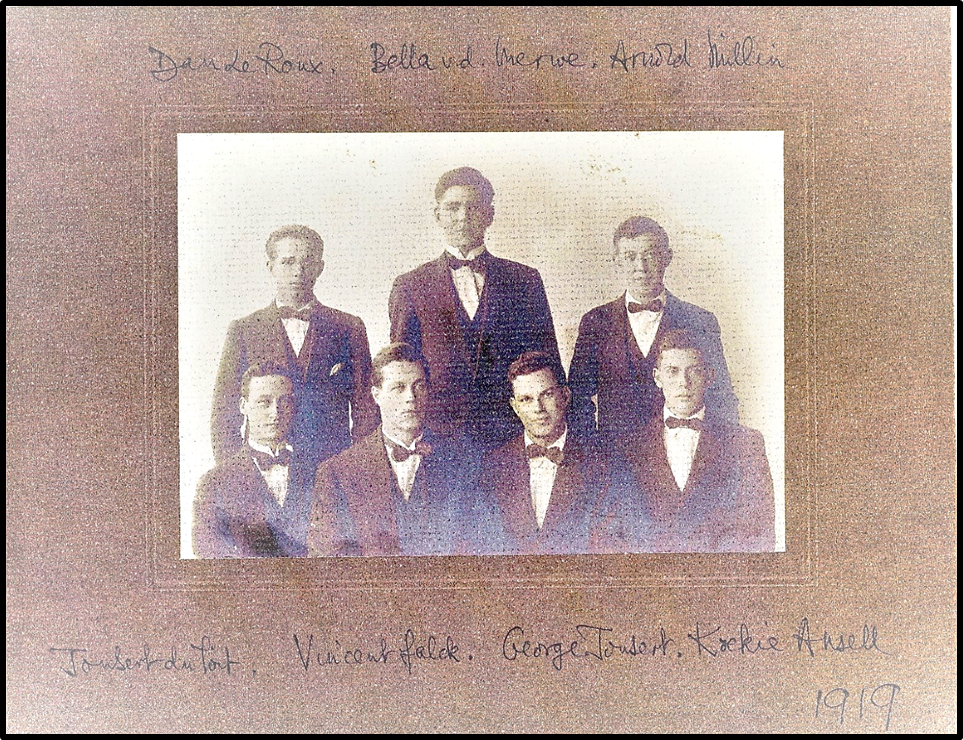
Koekie Ansell son of Nathan and Kitty
Picture found by Irma Jordaan in Montagu Museum
Nathan sells a plot of land
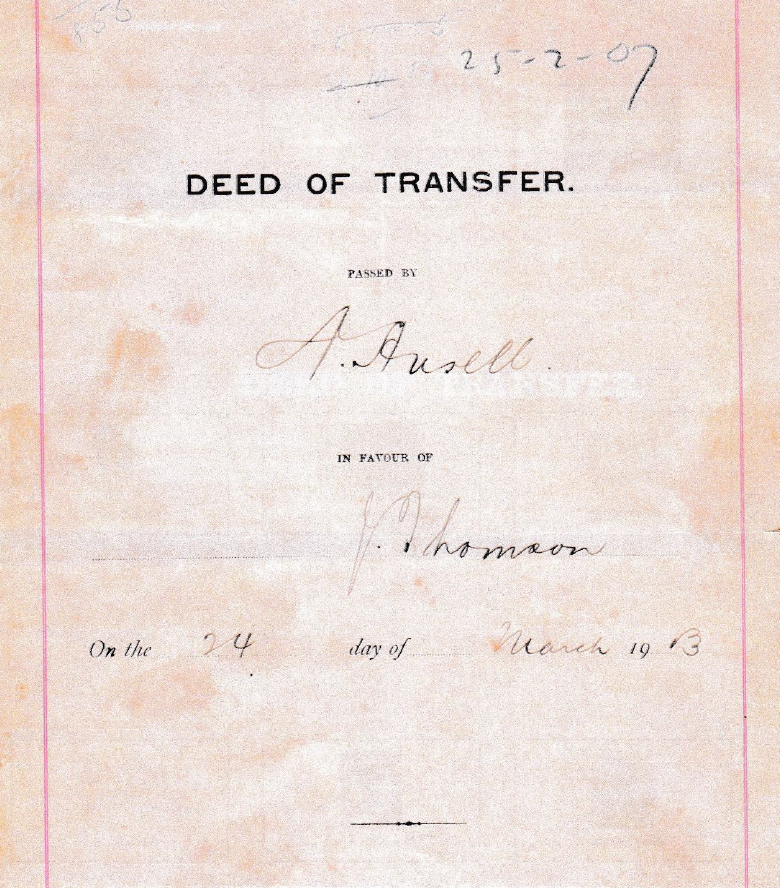
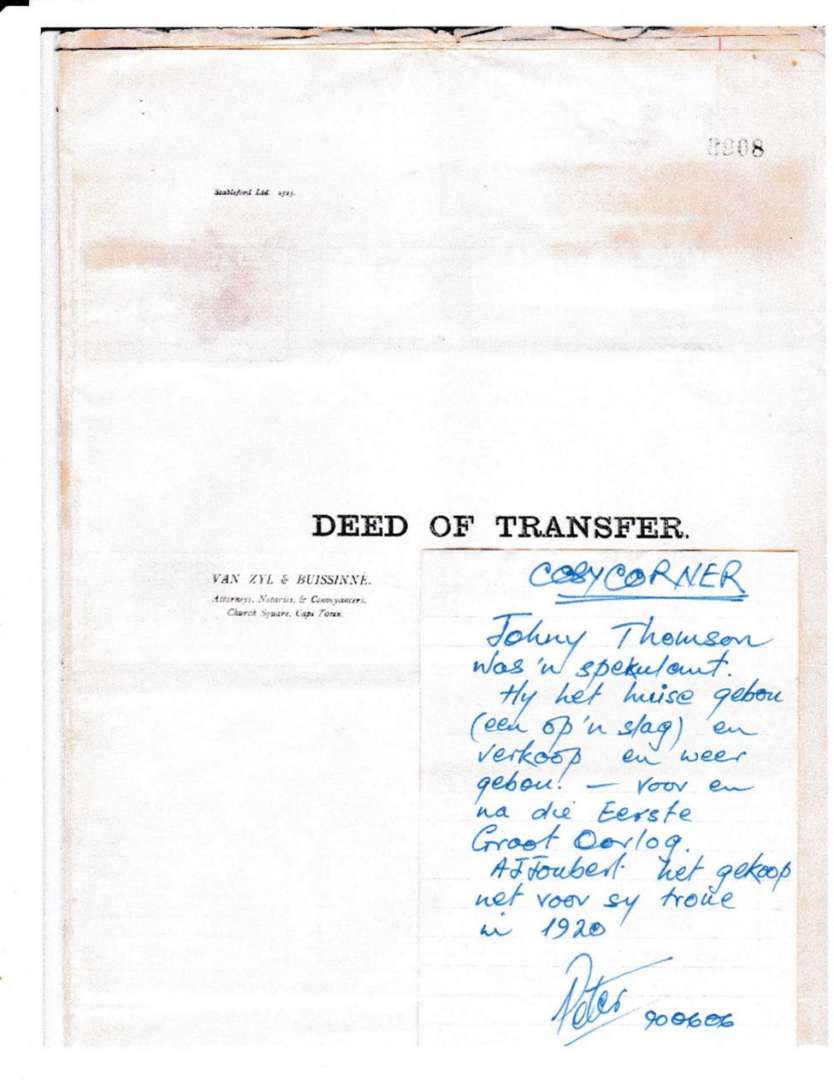
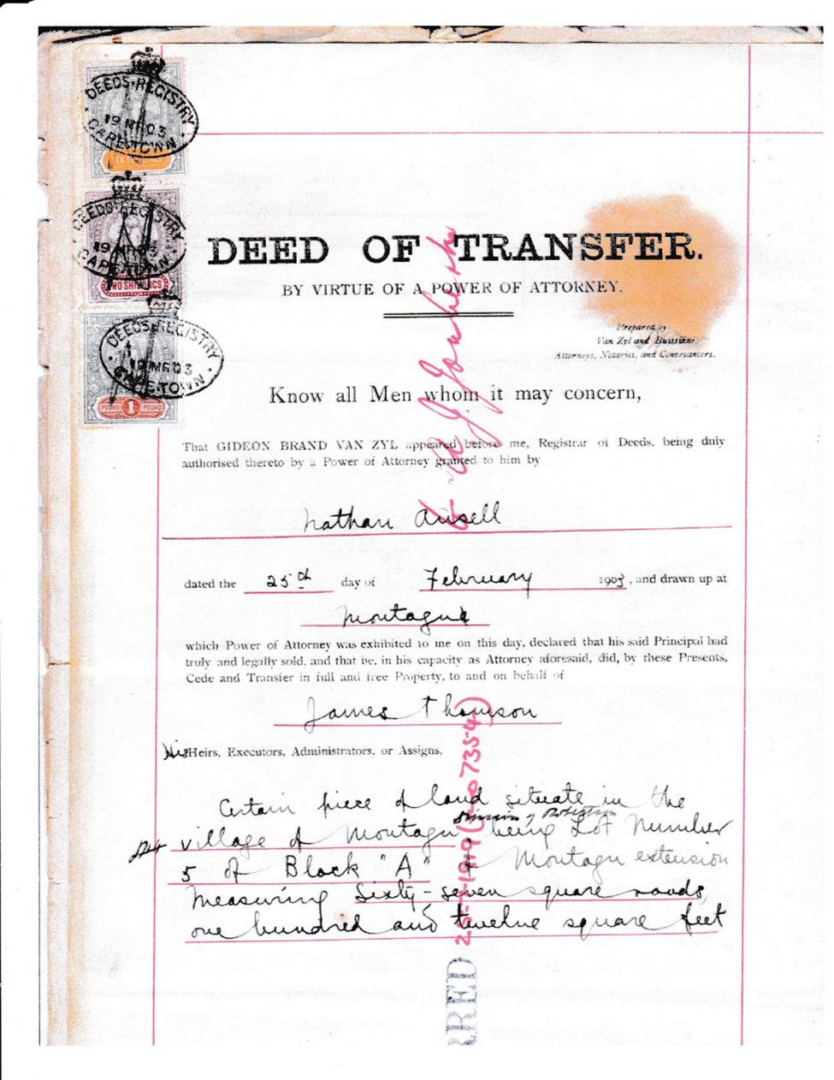

Document found in Montagu Museum by Irma Jordaan
Abramowitz Family

Advert: Montagu High School Year Book 1955
Harry (Harris on Voters Roll) and Annie Abramowitz were resident in 1910. He was a Russian immigrant. The Abramowitz family had a General Dealer store in Bath Street where the current Pep store is today. They lived in the house which now houses Ye Old Tavern restaurant located at 47 Bath Street.

47 Bath Street (2018)
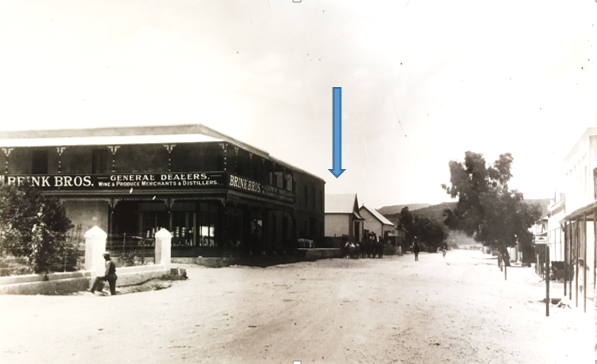
The arrow shows the Abramowitz homestead in the very early years
Picture: Montagu Museum
Based on information obtained from an interview conducted by Fern Sacks in November 1981 with Annie Abramowitz her husband had at least one brother who died while she lived in Montagu. It is possible that Lewis (Louis on Voters Roll) Abramowitz, who died on the 12th July 1926, aged 32 and is buried in the local Jewish cemetery, could be Harry’s brother. The interview document and audio recording was found in the Special Collections Department of UCT.(Audio recording part of this post)
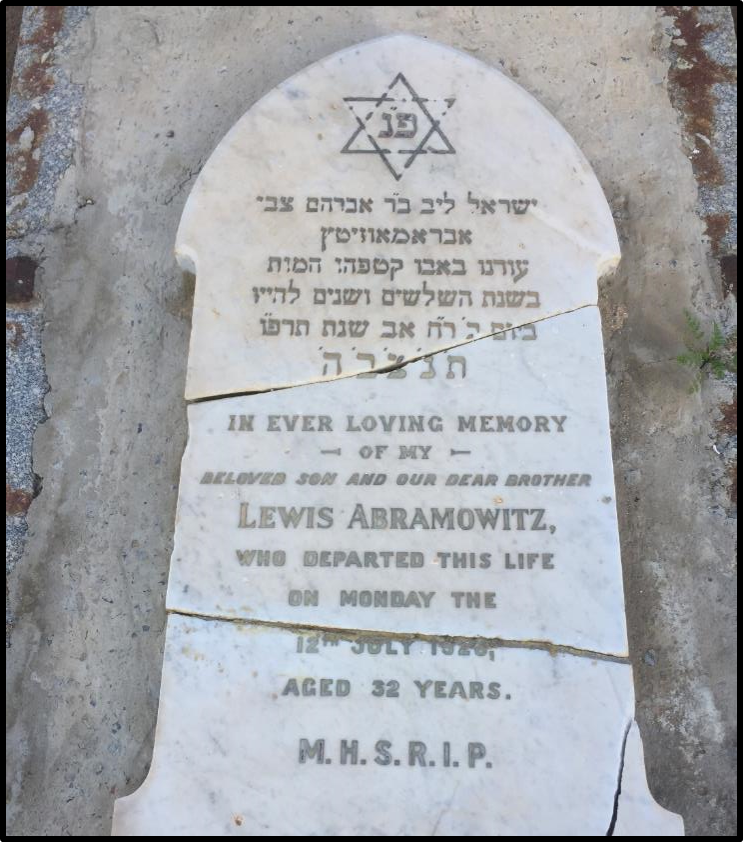
Montagu Jewish cemetery
Harry loved playing cards and would always be trying to find people to join him in a card game. Annie mentions in her interview that the wives would sit in as spectators as there was no other entertainment in Montagu. She specifically mentions Mrs. Goldberg the wife of the owner of the Country Hotel as being her companion at these games.
Mrs. Abramowitz was described by Yvonne Bussell in her book as a dear lady who spoke to everyone who came into the family shop. She gave special attention to the
Karoo families who used her backyard to outspan their animals. Mrs. Abramowitz was also a member of the Women’s South African Party, Montagu Branch according to an attendance register found in the Montagu Museum archives. She is however recorded as absent from the meeting which took place on 04/02/1926.
She is also remembered by Eunice Movsowitz (born Goldblatt) who described her as a vibrant lady full of life and interested in many facets of village life.

Ralph is buried in the Robertson Jewish Cemetery
The Abramowitz children, Mockie, Ralph (lost his life in a drowning accident), Margery and Rona went to school in Montagu. All the children left to settle in Cape Town. Mrs. Abramowitz left Montagu to live with her daughters in Cape Town after the death of her husband.
Some memories from the Montagu History FaceBook page
Hilda Stemmet: Mokkie het die winkel geerf, hy het die eerste Chef Fleetline gekoop in Montagu, almal het gaan kyk,!!! Mokkie nooit getroud,het aan oom Manie Wahl verkoop, en terug Israel toe.
Jaun le Roux Snr.:My ouma Rosie Nel se broer oom Dawie Kriel het ‘n fiets werkwinkel net om die hoek van Abramowitz se winkel gehad. Baie koeldranke gedrink na rugby oefening by ou Vicky se Kom Weer kafeetjie op die hoek van Badstraat.
Maritha Steyn: Mens het so ʼn kleiner blikkie kondensmelk ook gekry in ons kinderjare. Ons het altyd vir ons ʼn blikkie gaan koop by Abramowitz se winkel in Badstraat, vir net 10c as ek reg onthou. Dan maak jy ʼn gaatjie aan albei die kante, sodat dit kan lug kry as jy dit suig. Ons het sommer ʼn hele blikkie op n slag uitgedrink.
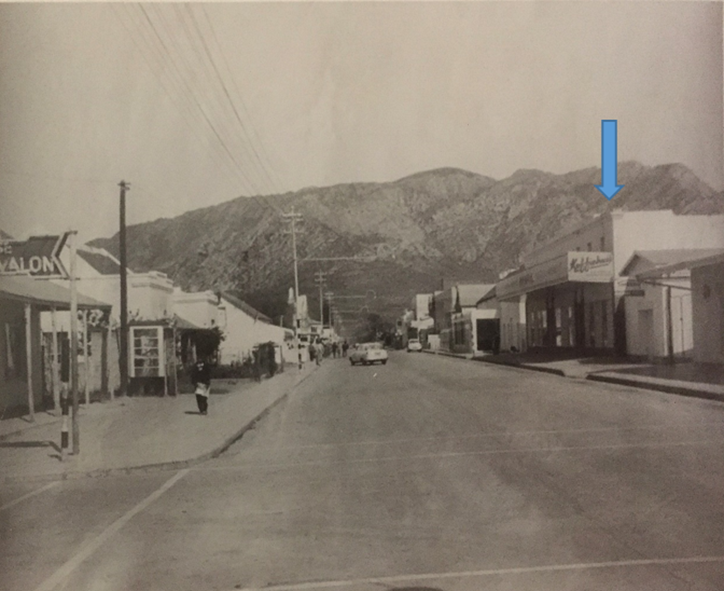
66 Bath Street Montagu. The building which housed the Abramowitz family store is shown by the arrow. The building is still stands today 2025.
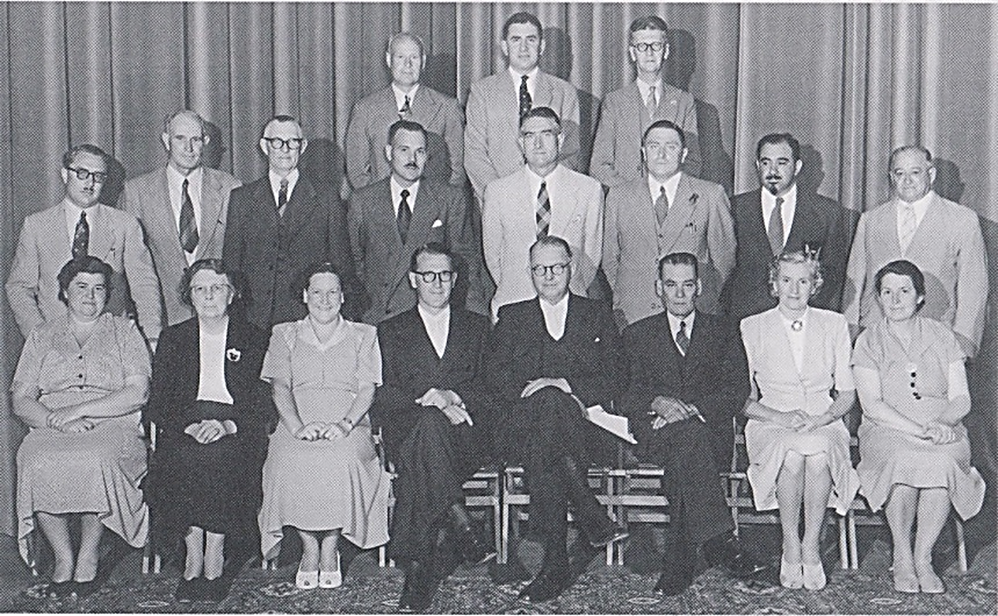
Mockie Abramowitz who is centre back was part of the Dutch Reform churches hundred year festival committee of 1954
Picture: ʼn Geskiedenis van die Nederduits Gereformeerde Gemeente Montagu 1854 2004
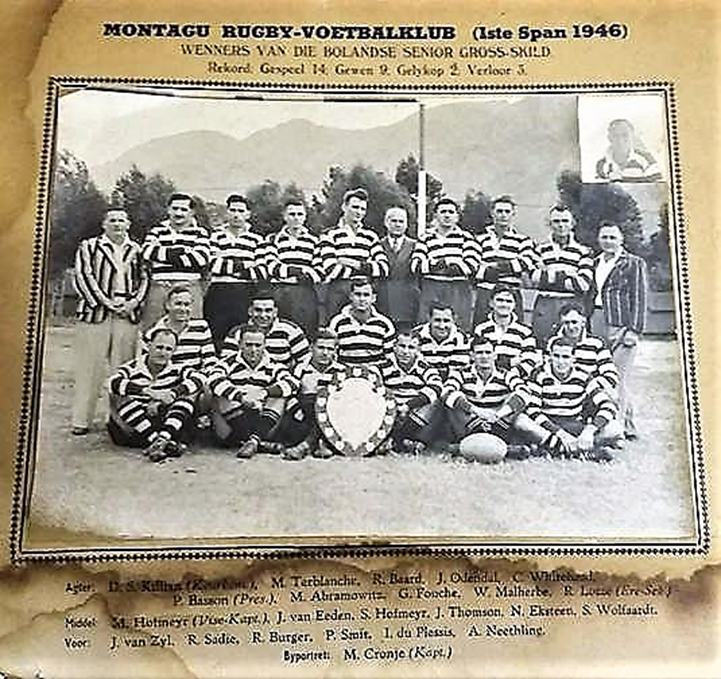
Mockie in the Montagu rugby team
Picture: Montagu Museum

A packet from the Abramowitz store
Found by Irma Jordaan in the Montagu Museum
Mrs. Abramowitz
Interviewed by Fern Sacks November 1981
The audio recording below was found by Clive Kirkwood who works at the University of Cape Town Special Collections department. The recording takes the form of an interview with one of the early Montagu Jewish residents Mrs. Annie Abramowitz. Her husband was a prominent businessman in Montagu. The interview is not only about Montagu but does however carry interesting inputs about her life in Montagu in the early days. It has not been possible to determine why the interview was done.
Click on the link below to listen to the recording
Buirski Family

Advert: Die Burger 2/10/1963
From what can be ascertained the Buirski family are one of the Jewish families who did not continue with the Jewish life style and for whatever reasons chose other life styles. Barnett Buirski (1856-1910) one of the early Jewish pioneers established the Jewish cemetery in 1894 which was dedicated in 1895.Barnett can also be credited with being one of the first councilors after the town of Montagu was declared a Municipality 1895.
Folklore has it that the early generation of Buirski’s lived in Montagu West and according to local resident Debbie Murray(04/2018) the Buirski’s owned two properties number 5 and 7 Krom Streets. His shop was on the corner of Bath and Kohler streets. Barnett had a son Jan (nick named Jan Kantien because he ran the local bar).
The attendance register of the Women’s South African Party Montagu Branch dated 04/02/1926 shows Mrs. Jan Buirski present, Mrs. Freda Buirski absent and Miss Rose Buirski present. It has not as yet been possible to place the aforementioned ladies in the Buirski family tree.
Jan had two sons Johannes (Joe) and James Buirski who are remembered by older residents of Montagu. Johannes built a house at 24 Van Riebeeck Street and ran a successful electrical contracting business.
Mr. and Mrs. Graffie Snyman of Jordaan Woonstelle Montagu still remember Johannes as selling funeral policies as a side line. Mrs. Snyman purchased a policy from Johannes which she still has in her possession (2017). Johannes also electrified the Snyman’s beach house. It appears that James moved to and lived in Ashton.
Brown Family

Advert Montagu High School Year Book 1955
Abraham Brown born in Russia 1873, the son of Abraham and Fruma Brown (nee Fox). According to a handwritten document written by J.F.D. Kriel found in the Montagu Museum Abraham Brown had a store on the corner of Church and Bath Streets. It is assumed that he occupied the building across the road from the current office of Van Zyl & Hofmeyer attorneys. He had three sons and one daughter.
Abraham was a prominent business man in Montagu. Two sons had a large hardware shop in Worcester and another son became a Doctor. Tilly his daughter had a large wedding celebrated in the school hall.
The 1961 Montagu High School year book has input (Baby –sitting) from a student called Isie Freeman in which she refers to babysitting for neighbours a Mr. and Mrs. Brown but no link can be made to the Jewish Brown family members.
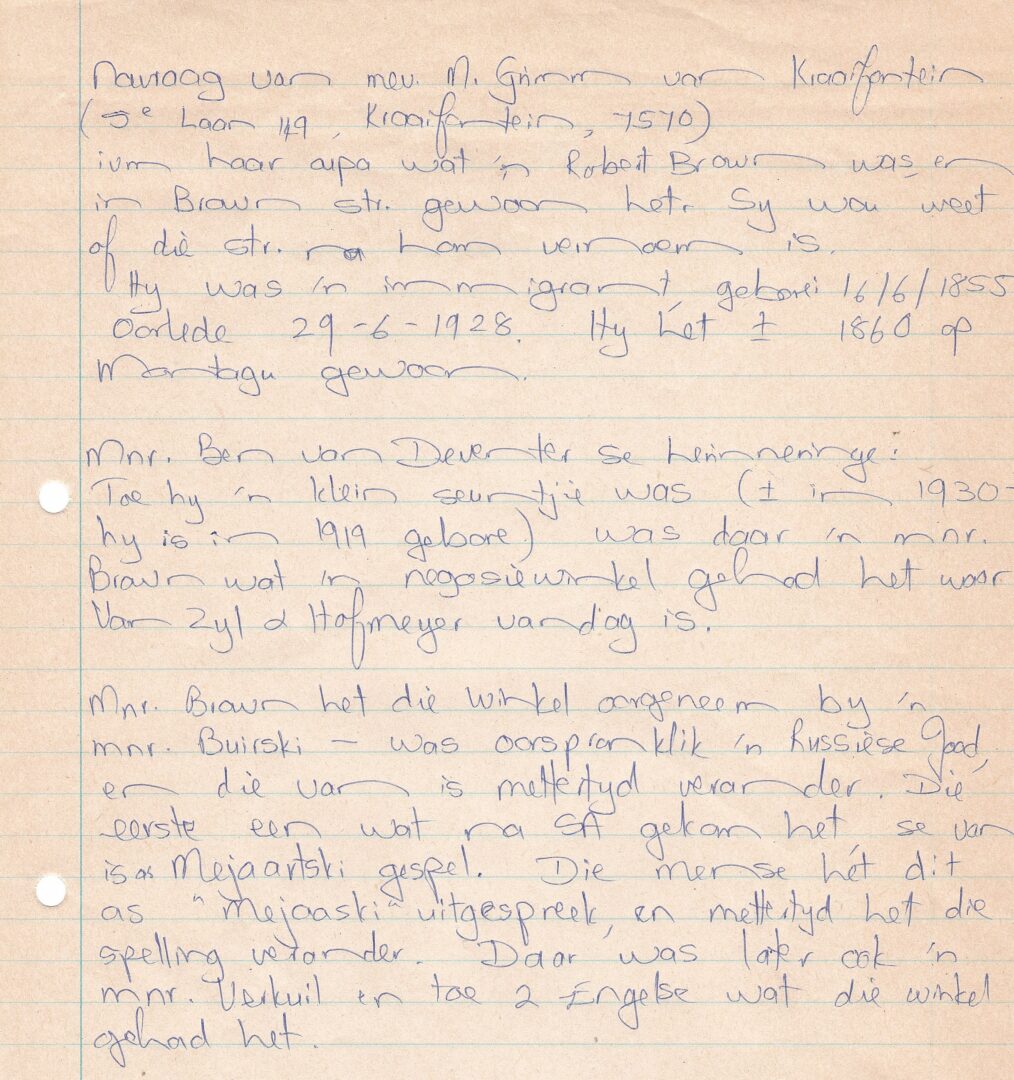
The one page undated document below was found in the Montagu Museum archive. A Mrs. Grimm is trying to find out if Brown Street was named after her oupa Robert Brown. The first name Robert is somewhat confusing but in the early days it was not uncommon for people to change first names and surnames for convenience
Fernandes Family
Picture: Montagu Museum
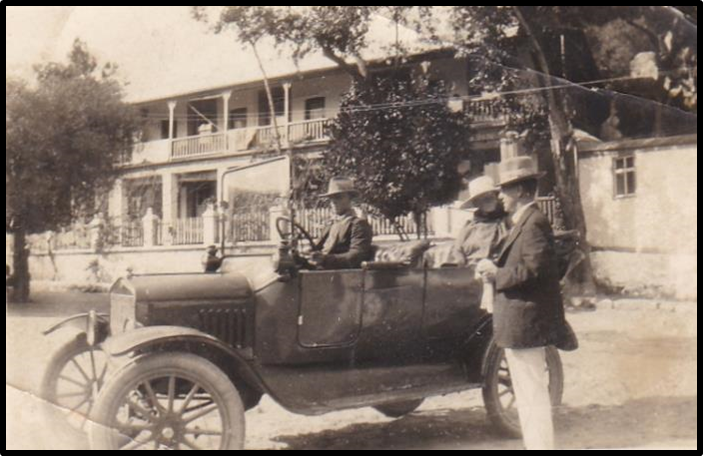
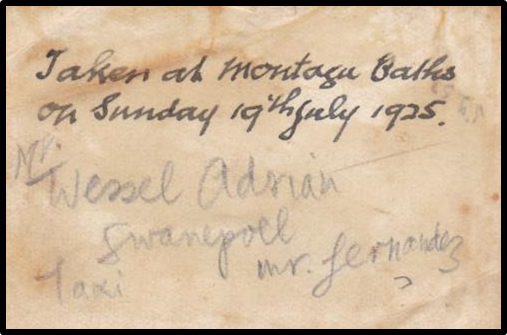
In their books both Yvonne and Tokkie Bussell refer to a Fernandes family as being Jewish.
Past Chemist Jack Plax in a telephonic discussion (2018) also remembers Mr. and Mrs. Fernandes as having one daughter who his wife played with as a child. He confirmed that they owned the Avalon Springs Hotel which they then sold to the Idelson’s.
Mrs. Fernandes is remembered by Yvonne Bussell in her book, as an attractive blond woman. She drove around Montagu in a smart 1948 Chrysler, according to Tokkie Bussell.
In an article written by Yvonne Bussell appearing in the Montagu Mail dated April 2004 she had the following to say:
I grew up on a farm within walking distance of the so called springs. And what a treat to pay a visit to Mr. Fernandes owner of the baths. Very friendly, he welcomed us: “So nice to see you! Go and have a look at all my birds and then go for a swim – No, no money, you are my neighbours!”
The atmosphere and quietness of the place enchanted by birdsong placed you right in the midst of Madeira (where he came from). At the entrance to his domain was a very huge palm tree, the trunk covered with ferns, and beds of flowers round the bottom. The flower beds were encircled by old lemonade bottles with a marble inside, turned upside down, the effect was most enchanting. On the left, a few feet from the palm tree was a most charming timber home called ‘The Cottage’, where the commercial travelers were housed in those days.
Mr. Fernandes lived near the entrance in his timber tree house, with windows on three sides built on top of a very huge tree stump. There he could enjoy an undisturbed life and relax.
Mrs. Fernandes at some stage divorced her husband and bought the Montagu Hotel.
Micah Friedman
Mr. Micah Hyman (or maybe records will state Hyman Micah) Friedman is buried in the local Jewish cemetery, died 2 April 1919, survived by his children.
According to retired Montagu chemist Jack Plax, Micah Friedman was not a resident in Montagu. He came to Montagu for the healing waters and died in Montagu as a result of the flu epidemic and was buried locally.
Montagu Jewish cemetery
Further information on Mr Friedman uncovered in 2018 by Rabbi Serwator reveals the following:
Mr Max Mendel Friedman, son of Mr Micah Friedman who died and was buried in Montagu, died in 2005 aged 88, meaning he was born in 1917.
Mr Micah Friedman came all the way from Wellington to Montagu to take the waters to try to shake off the ‘flu in 1918. At that time he was a new father for, when he died, his son was only 1 year old.
Thus, it is next to a miracle that his son, Mr Max Friedman, o.b.m., was born and survived never knowing his father, and a continuing miracle that his grandson, Mr Paul Michael Friedman, who ‘phoned me this evening, – tel. 071 137 0801, 021 – 439.6258 (number at work: The Corner Bar, cnr Main & Conifer Rds, Sea Point) – is alive to tell the tale.
Goldblatt Family
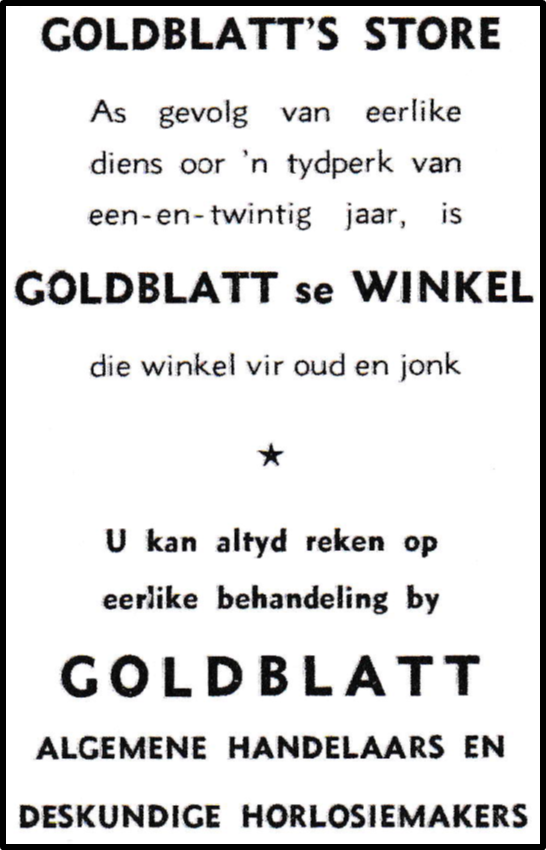
Advert: Montagu High School Year Book 1955
The story of the Goldblatt family in Montagu can best be told by daughter Eunice in the following extract from her autobiography which she has written for her grandchildren. Ouma and Oupa refers to her parents. She left Montagu in 1959 to study in Cape Town qualifying as a radiography.
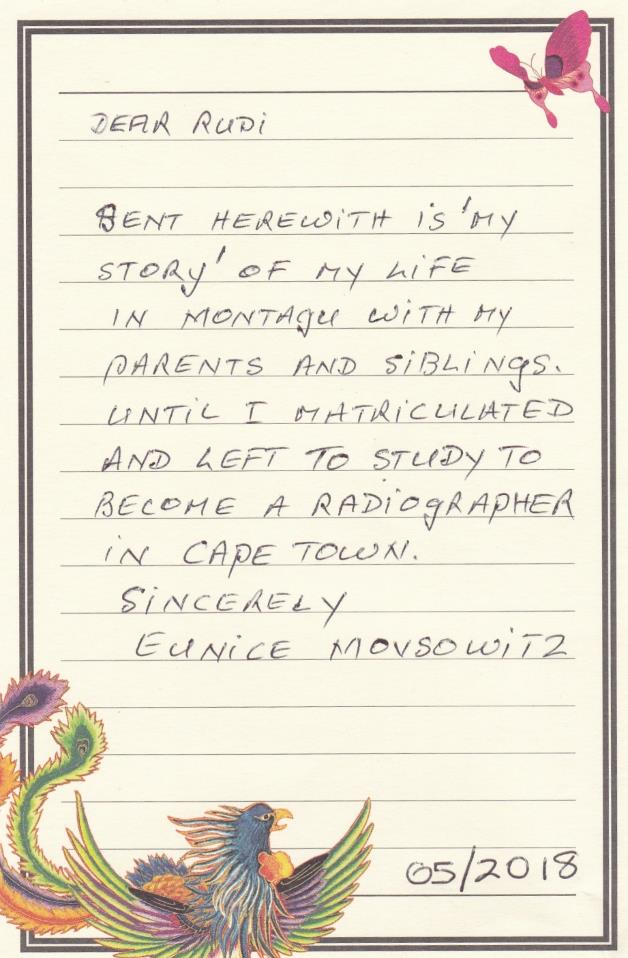
EUNICE MOVSOWITZ – MY LIFE STORY…
My story begins on Xmas eve 1936. Ouma and Oupa had been working in their general dealer store in Montagu, a small country town in the Boland. The shop was filled with men’s and women’s clothing, shoes, bolts of fabric, toys, and even food. After closing up for the Xmas holiday, they went for a walk together. They passed the house of the Dutch Reform Minister and overhanging the wall were the branches of a pear tree with unripe green pear. Ouma picked one and ate it despite Oupa cautioning her that it would upset her stomach. Later that night she complained of cramps and Oupa said it was obviously from the green pear she had eaten. Little did he know that in fact the cramps were early labor contractions. I was born the following day on Xmas 1936. For years thereafter, the story was relayed that I was born from a ‘green pear’.
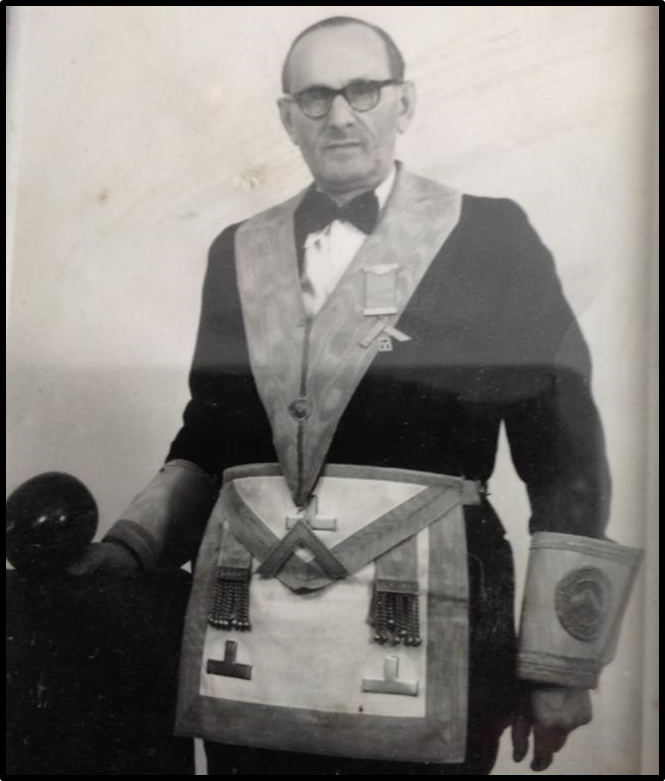
Herman as a member of the local Masons.
Picture: Eunice Movsowitz.
IMMIGRATING TO SOUTH AFRICA
The story of my family actually starts far earlier than 1936…
My father’s family immigrated to South Africa from Rakvere, Estoni4 at the turn of the century. I have little specific knowledge of why they left Estonia but I presume that it
was for the same reason that many Jews left that part of the world at that time. The wave of nationalism and anti-Semitism drove many Jews to leave Eastern Europe, hoping for better and safer lives elsewhere. My uncle Morris Goldblatt arrived in South Africa first. Later, his parents (my grand parents), Yitzchak Leib and Minna Shuntotsky-Goldblatt, and his siblings including my father, Herman (born 8-2A-1894), joined him in South Africa. The name Shuntotsky-Goldblatt was shortened to Goldblatt. The family lived in Calvinia.
My mother’s family immigrated to South Africa from Minsk, Belarus in 1910. Her
grandparents were Rabbi Yosef Yishayahu Cohen (bom in Mirr, Poland 1842, descended from HaShach family and Aharon Ha Cohen) and Fannie Cohen. Her parents were Max and Rose Cohen. My mother, Ouma Bertha was born on 11-5-1905 in Minsk. She was 5 years old when she arrived in South Africa. She had three siblings, David, Morris, and Abe. The family lived in Tulbagh. After graduating from high school, my mother left Tulbagh to work as a bookkeeper at Pinns jewelry store in Cape Town.
I do not know how and where my parents met each other. However, they were married at The Gardens Shul in Cape Town in 1931. They initially lived in Calvinia and owned a bioscope (movie theater)- My older brother, Merrvyn, was born in Calvinia in 1932 My parents and my brother later moved to Montagu and opened a general dealer store and watch repair shop. The property in fact housed the store, a pharmacy, and our home. I was born in Montagu in 1936 and my younger sister, Maureen was born in 1940. I have recently learnt that my parents bought the shop in Montagu from a Mr Schachat whom he met while being treated in hospital for his back problem.
EARLY CHILDHOOD IN MONTAGU
I have vivid memories of my childhood in Montagu. I particularly remember details of
our general dealer shop. My father, Oupa Herman, sat at one window repairing watches and my mother, Ouma Bertha, often sat at another window doing the store accounts.
Under the shelf where Oupa did his watch repairs there were large tins that contained the packets of Baumann’s biscuits and opposite that there were large containers of sugar and coffee beans that would be weighed on a scale on the counter for the customers. There were boxes with loose sweets that were sold for a’penny’. Money was put into a cash register and one would ring up the amount on the knobs. At the other end of the shop, Ouma had her desk where she used to do the books for people who bought goods on credit.
The shop was always busy and sometimes we kids even helped serving customers. When new goods arrived we were always curious to see what was being unpacked. [n one area of the shop there was a showroom for the ladies dresses that Ouma ordered from the samples the travelling salesmen brought to show her. She had excellent taste in clothing and women came from far and wide to the shop to buy their dresses. Other parts of the shop stocked crockery and fancy glassware that was also ordered from samples. There was a deliveryman who would deliver orders to customers on his bicyqle. Non-white customers often bought rolls of dried chewing tobacco. Interestingly, at Passover we ordered in large boxes of matza and other kosher for Passover items. The non-Jewish customers loved the matza and we gave away many boxes each year. Ouma used to make her own chrain (horseradish) and I remember her doing so with tears running down her face as happens when one grates fresh horseradish root. She also made her own taiglach, imberlach, and pletzlach. I used to have some of my school friends over to taste these Jewish delicacies.
In the early years, there was no refrigeration so we had a small cooling room outside the main store where items like cheese and butter from a farm in Bonnievale was kept. It was a concrete room lined with wire netting. Between the concrete and the netting there were pieces of charcoal that helped insulate the room and keep it cold. In later years, once electric refrigeration became available, Maureen and I used that little room as a doll’s house, dressing up our dolls and pretending to serve them tea. We both were given a rubber doll and had a great time playing there. I still have a book that records the day that I received the doll as being its birthday.
My father had three roles in the shop. When goods arrived, he set the prices and tagged the items. He also did the window displays – I clearly remember my father’s Xmas displays of toys and clothing in the shop’s two display windows. His most important role,however, was repairing watches. When he arrived in South Africa” he was already a trained watchmaker, having graduated in 1913 in Estonia (Herman has a pewter Russian tea cup holder that the school principal presented to him to commemorate his graduation).
I remember people coming from far and wide for his expertise. In those days, watches all had a mechanical movement using tiny wheels and springs. He used to sit for hours on end with a small eyeglass and miniature screwdrivers adjusting the springs and oiling the watches. He had Koch’s spine (spinal tuberculosis) and had to wear a very heavy and uncomfortable brace all his life. When he was hospitalized, as was the case on many occasions, my mom, Ouma Bertha” had to look after all of us as well as run the shop on her own. I must admit I don’t remember much of my siblings at a young age. I have almost no recollection of Merwyn until he was a teenager. I mostly remember him listening to classical music played on a gramophone. There are photos of me as a baby with Merwyn and me when I was older with him on Muizenberg beach. However, I don’t remember ever playing with him or him fighting with me.
Surprisingly, I have little memory of when my younger sister, Maureen, was born and
how I reacted to having a baby sister. I do though remember her being allowed to play with a porcelain cup while taking a bath. On one occasion she slipped in the bath and the cup broke cutting her buttock. Ouma grabbed towels to stem the flow of blood and she was rushed to the doctor who stitched up the large cut – apparently she still has the scar to this day. One other vivid memory I have of Maureen is when I would come home on vacation and our little Skippy dog would sleep in my bed rather than hers. Maureen would get so upset and would shout at the dog ‘you traitor” as the dog always slept in her bed except when I was home.
One specific early childhood memory that I have is when I was given a little porcelain tea set for my fourth or fifth birthday. I was so excited receiving it that I ran into the house through the front door, tripped, and dropped the box smashing all the little cups, saucers, tea pot, jug and sugar bowl. I was so upset. I remember other birthdays when I would go to Ouma’s friend, Mrs A. (Abromowitz),who lived not far from us and she would bake cup cakes with pink or white icing and a cherry on top for me. Her late husband’s birthday was also on Xmas day so we always celebrated together.
Another clear childhood memory is of being a flower girl for late Uncle Abe and Aunty Sylvia in Upington. The trip there from Montagu took almost an entire day by car. I apparently kept on asking if there really is a place called Upington. When we finally got there I was so tired that I fell asleep under the Chuppa during the wedding.
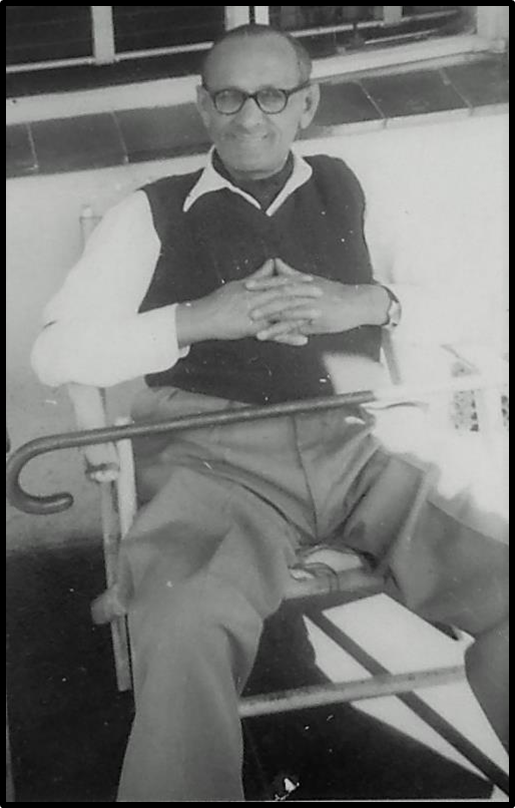
Herman Goldblatt
Picture: Eunice Movsowitz
SCHOOL
When I turned five, I nagged Ouma to let me start school (we never had kindergarden). She approached the principal of the junior school, Mr. Basson, and he agreed that I would be allowed to start Sub A (Grade l). He told Ouma that I would soon tire of coming to school but that did not happen until June when it started getting cold in the mornings and I did not want to get up for school. By that point, six months into the school year, Ouma would have none of it and forced me to continue going to school. In fact, I was actually very happy in school. I always had very good handwriting and by Grade 3 my sewing ability was recognized – we had to make an apron and mine was pinned up on the wall as the hemming stitches were so even. I went to the local junior school and high school. My matric subjects were English, Afrikaans, German, Math, Geography and History – in those days we only did 6 subjects and had to have 3 languages. I played on the school netball and tennis teams against the other schools in the district, Swellendam and Robertson. I was the only Jewish girl in the high school and in my matric year I was chosen to be Head Girl, quite an honor in those days. I graduated high school at 16 years of age.
My closest friends in high school were Suzette Naude, the daughter of the high school principal, and Joan Smit, the daughter of the local barber, who lived just down the road from us on Bath Street. To this day I am still in touch with these two friends. I clearly remember watching Suzette’s mother sewing and also remember swimming in the storage dam at the their house. The water was muddy brown but who cared, it was just lovely being able to swim in the hot weather.
There are a few memories that stand out in my mind from my school days. I remember having to walk to school rain or shine – the high school was up on a hill and seemed so far away. I remember coming home from school and always going in to my parents store to say hello and to tell them about my school day. We had cats in the store to prevent mice eating the flour inthe bags. One of those cats was my favourte and always allowed me to stroke her with her purring away. She never allowed anyone else to touch her.
I was generally very well behaved at school but I got into trouble occasionally. I remember reading the inside cover summary of books rather than the book itself and trying to fool the teacher, because we had to fill in lists of the books we had read. I recall an instance when my piano teacher Mrs Anderson, sent me home from my lesson for not having practiced. I tried to quietly sneak back into the house but Ouma heard the door open and came to investigate and found me under the bed hiding. When she realized I had been sent home for not practicing, you can imagine what trouble I got into. Nevertheless I did do some piano exams and got a few certificates.
I remember trying ballet but never being a great ballet dancer. I also remember playing tennis on the local tennis courts with my friends. Sometimes when we argued we would pelt each other with rotten figs that had fallen from the fig tree next to the courts. I remember once going up on the koppie (hill) behind the High School building and experimenting smoking a cigarette with Suzette and Joan. We coughed and sputtered so much that I never smoked again.

Mrs. Goldblatt, Eunice and Merwyn outside their home in Bath Street
Picture: Eunice Movsowitz
VACATIONS
Ouma’s parents, Max and Rose Cohen, and her brother David, who was never married, lived in a large house in Tulbagh Road, a railway siding some distance away from the town of Tulbagh. I have fond memories of vacationing with them. I used to ride a tricycle on the veranda that wrapped around the house. I used to watch the train pass the house coming in to the station and see the station master hand over a small bag with mail to the train conductor. My grandma, Rose, had a large chicken run at the back of the house and early in the morning she would collect the freshly laid eggs. While the egg was still warrn she would take one in her hand and circle my face saying a ‘brocha’ for me with the freshly laid egg. That is certainly something no child growing up in a city today would ever experience.
I loved visiting my grandparents, Max and Rose Cohen, and my uncle David. They
always made such a fuss of us. My Grandma Rose collected old tennis balls for us to play with. They had a goose down ‘perina’, or duvet, on a large wooden double
bed. We loved jumping on it and curling up in its warmth. There was a large black
coal stove where my grandmother made fresh bread and baked.
My uncle David, Ouma’s brother, made a special fuss of me. Once, when I was
about four years old, we stayed in Ceres at a hotel over Yom Tov. Uncle David sent
me into a semi-dark hotel room and there on the bed was a ‘sleeping doll’ dressed in
a pink organza dress with a white peter pan organza collar that had been painted
with a phosphorescent paint that glowed in the darkened room. The doll’s eyes were closed and when I picked her up they opened. Today, 80 years later, I still have the
doll he gave me and when Sophia and Katya were little they used to love coming to
play with her here in our flat. Uncle David also bought me my first bicycle and
whenever he came to visit us in Montagu he brought presents. He never married so
we were like his own children. Uncle David died in a motor vehicle accident in
1964 while driving a green car. No one in our family has ever owned a green car
since then.
In addition to great memories, I have a couple of physical reminders of my
Grandparents. I have an ornamental shoe in my display cabinet that belonged to my
Grandma Rose and to this day I still wear her gold wedding ring on my right ring
finger together with Ouma Bertha’s wedding ring. I also have a gold chain that she
wore. Grandma Rose died in 1944. Grandpa Max died in 1946. They are both
buried in the Pinelands cemetery.
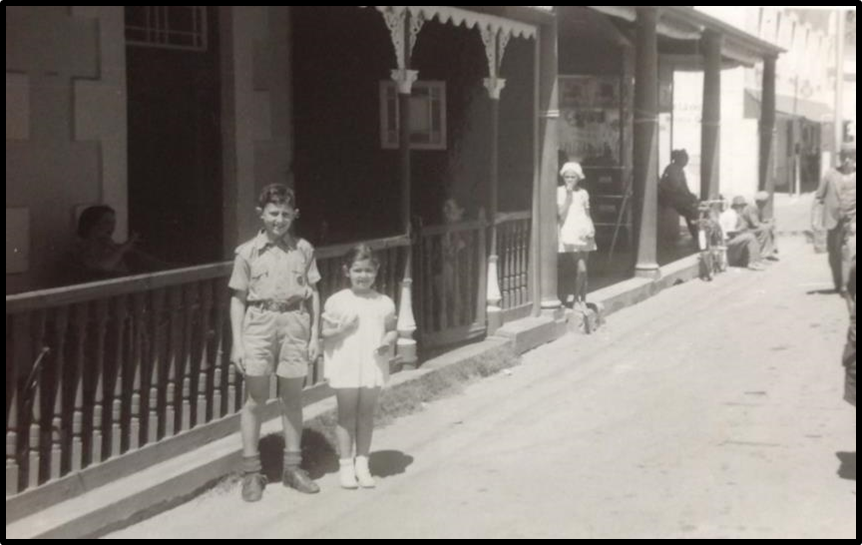
Merwyn and Eunice outside their home in Bath Street. The Goldblatt store is on the right hand side. Merwyn was a member of the local Boy Scout movement.
Picture: Eunice Movsowitz
A number of Jewish families including the Goldblatt’s sent their children to both the old and new local High School. This picture shows the old High School on the left with the current school hostel on the right which is still currently (2018) in use.

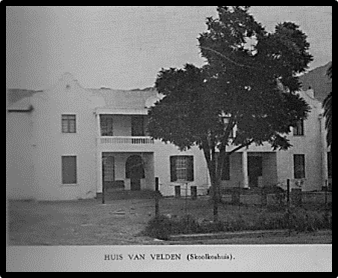
Pictures: Montagu High School year book 1956
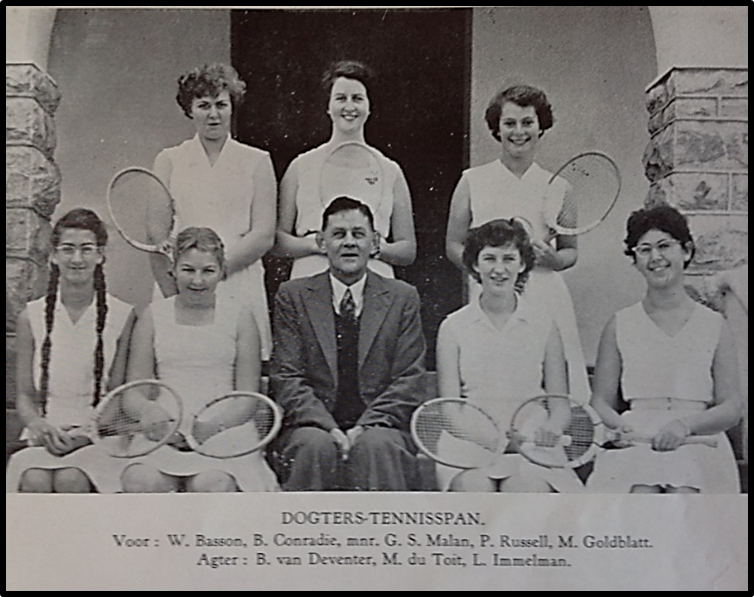
Maureen (right front) Montagu High School tennis team 1955. Maureen also represented Montagu High School in tennis for the 1956 year.
Picture: Montagu High School year book 1955
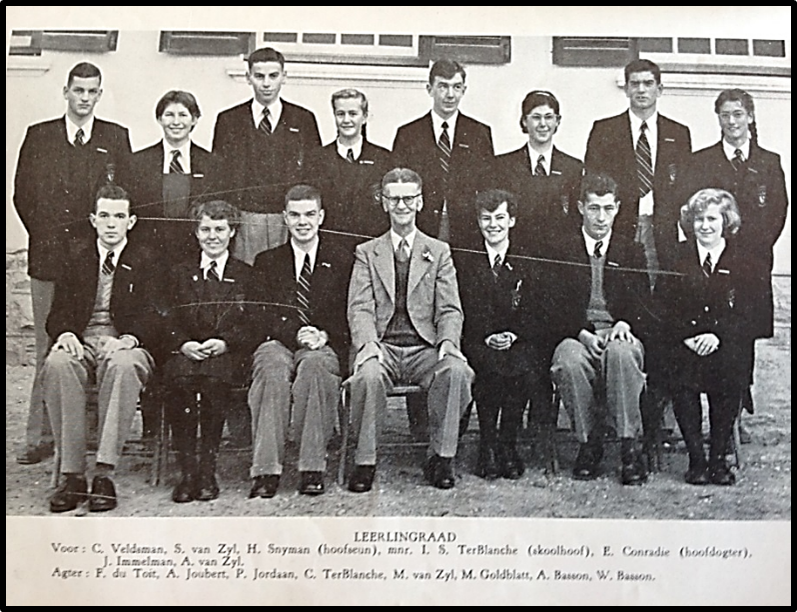
Maureen (back third from right) as part of the Student Council Montagu High 1956
Picture: Montagu High School year book 1956.

Maureen wins competition
Montagu High School year book 1955.
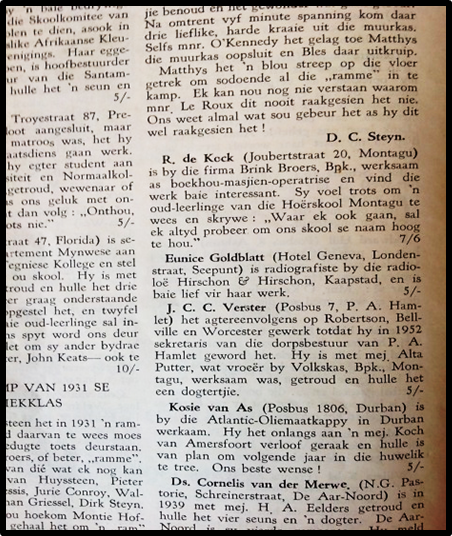
Eunice remembers her High School with a donation
Montagu High School year book 1956

Eunice makes another old girl contribution to Montagu High School in 1959 after she got married.
Montagu High School year book 1959
SHUL
During the school holidays many Jewish families would visit the hot springs in
Montagu. There was no permanent shul in Montagu and as such, the evening shul
services were often held at our house. When somebody needed to say Kaddish for a
Yahrzeit, a mirryan would assemble at our house or sometimes at the Montagu
Hotel across the road where many people stayed.
When it came to the Rosh Hashana and Yom Kippur, the few Jewish families from
Montagu, Swellendam and Bonnievale would go to Robertson where there was a
permanent shul. We all stayed at the Commercial Hotel that was owned by the daughter and son-in-law of Reverend Josefowitz, who was the spiritual leader of those congregations. I remember how Oupa and Ouma would rush to close the shop
in time for us to drive to Robertson, which was only about 30 kilometers away. We
used to love the trip there as it was very exciting for us to stay in a hotel. Another
part of the excitement was getting new clothes for Yom Tov – Ouma would take us
to the local dressmaker to make new outfits for us and Ouma would knit the most
beautiful cardigans and even dresses for Maureen and myself. I remember that one
year she made me a white twin set (a short sleeve sweater underneath a long
sleeved cardigan) and had a white pleated skirt made to match.
We had all of our meals at the hotel in Robertson and each afternoon we would
meet at the home of one of the local congregants for tea. We always broke the fast
at the hotel. They made a fruit tart that I made for many years afterwards to break
the fast. At that time of the year the loquat trees were full of fruit and we used to
love ‘stealing’ the fruit off trees as we walked past a house with the fruit hanging
over the wall.
I have one other recollection of the shul in Robertson. When Merwyn was nearing
bar mitzvah age, he had to go to Robertson for lessons to Reverend Josefowitz. He
would take the train there on Friday and Oupa would pick him up on Sunday. One
Sunday I went with Oupa to pick up Merwyn and along the way we had a car
accident. The car landed on its side and I managed to get out through the broken
front window. Oupa pushed the door open and jumped out but there was a deep
diitch and he landed in a way that injured his back even more (he had Koch’s spine).
Fortunately people saw the accident and came to help us and took us in to
Robertson to the Reverend’s home. I can’t remember how we got back to Montagu
after the accident.
END PART 1
